OWASP AI Red Teaming: The 7 Documents, What Each Covers and How to Test Against Them

Summary
OWASP’s seven AI red teaming documents cover how to scope and run assessments, map findings to risks in LLM and agentic applications and evaluate testing vendors. Teams can fill gaps in OWASP’s guidance by tracking the number of test attempts, measuring guardrail performance separately from model behavior and retesting after system changes.
Key Takeaways
- OWASP’s AI red teaming guidance comes from two projects: the GenAI Security Project (genai.owasp.org) and the OWASP AI Exchange (owaspai.org). Both cover red teaming for AI agents, but their documents rarely cite each other.
- The 2025 Guide tells you what to cover (four areas: model, implementation, system, runtime). The 2026 Manual tells you how to run the engagement (eight phases from planning to remediation). Use both.
- Map findings to the Top 10 for LLM Applications 2026 for anything that generates text or other content, and add the Top 10 for Agentic Applications 2026 the moment the system can call a tool.
- The Vendor Evaluation Criteria (February 2026) names the red flags buyers should screen for, led by stock jailbreak libraries presented as original work. The Landscape (April 2026) is a map of vendors, not a rating.
- None of the documents sets a sample size, asks for guardrail bypass to be measured separately from the model’s response or sets a standing re-test interval. Those come from outside OWASP. This guide draws on research from outside OWASP to address all three.
In This Article
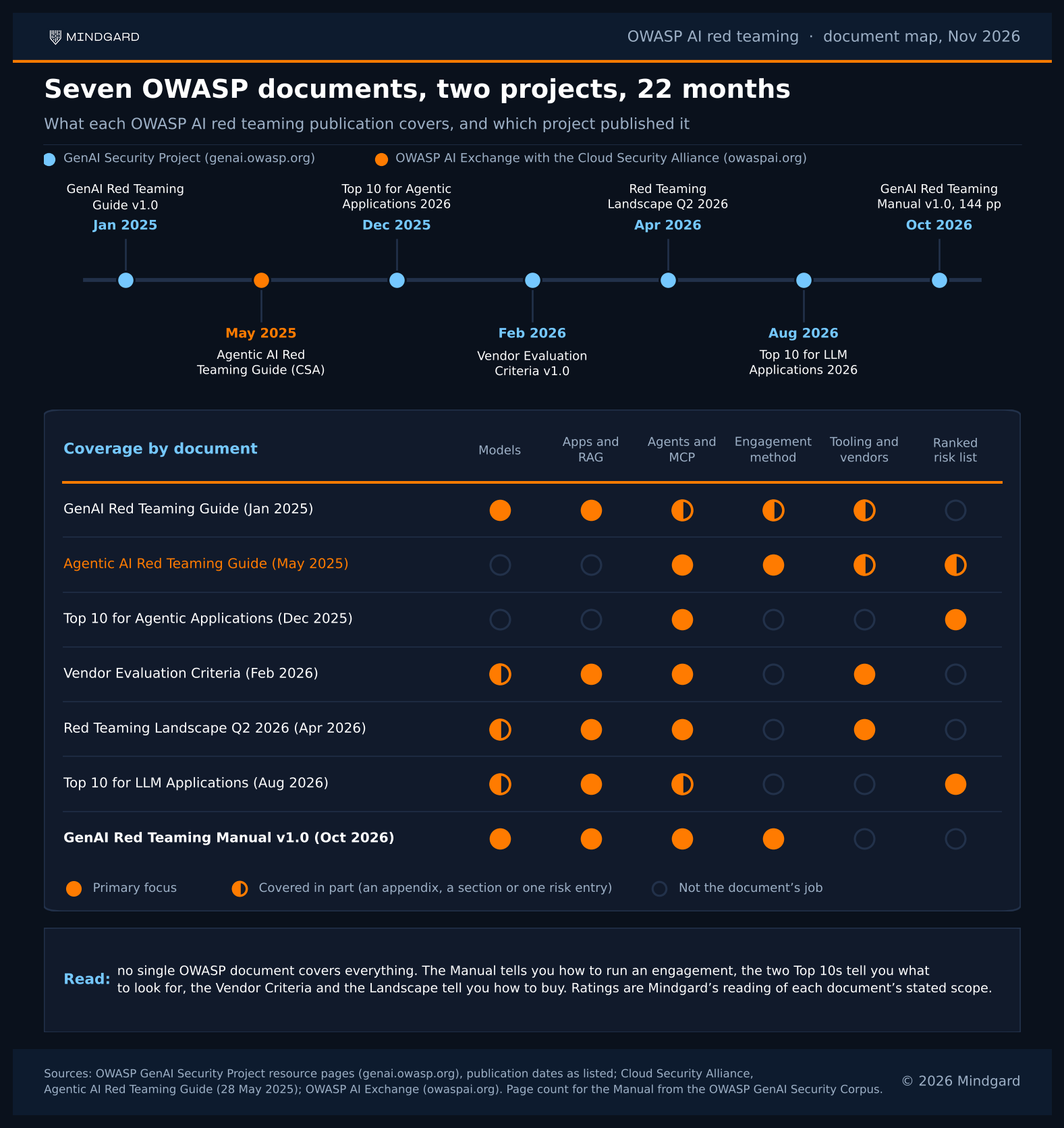
OWASP has published seven documents that bear on AI red teaming since January 2025. The most recent of the seven, the GenAI Red Teaming Manual v1.0 of 20 October 2026, runs to 144 pages on its own. Two of those documents are ranked risk lists, one is a buyer’s guide, one is a vendor map and three are testing guides from two different OWASP projects. A team new to the material may not know where to start or how the seven documents fit together.
OWASP doesn’t define “OWASP AI red teaming” as an official term, but in practice it means adversarial testing of an AI system that follows OWASP’s published methods and reports against OWASP’s risk lists. The methods are the GenAI Red Teaming Guide (January 2025), the GenAI Red Teaming Manual (October 2026) and the Agentic AI Red Teaming Guide that the OWASP AI Exchange wrote with the Cloud Security Alliance (May 2025). The risk lists are the Top 10 for LLM Applications 2026 and the Top 10 for Agentic Applications 2026. The Vendor Evaluation Criteria and the Red Teaming Solutions Landscape cover buying rather than testing.
In this article, we map all seven documents for practitioners who already know what AI red teaming is. We explain what each document is for and where each falls short. Then we map the Manual’s eight phases onto the Guide’s four areas and the two Top 10s, and show how to run an engagement that an auditor can trace back to OWASP.
 MINDGARD
Which OWASP document do you need?
Three answers return the OWASP publication to open first, the section to start in, the second document to keep beside it and the risk list your findings should map to.
What “OWASP AI Red Teaming” Actually Refers To
OWASP AI red teaming is the output of two OWASP flagship projects that approach AI security from different directions. The GenAI Security Project, home of the LLM Top 10, runs an AI Red Teaming Initiative led by Sonu Kumar and Jason Ross that has published the Guide, the Manual, the Vendor Evaluation Criteria and the Red Teaming Solutions Landscape. The OWASP AI Exchange, founded by Rob van der Veer, maintains a control framework for all AI (including predictive models) and co-wrote the Agentic AI Red Teaming Guide with the Cloud Security Alliance.
The OWASP AI Exchange has contributed 70 pages to ISO/IEC 27090, now published, and 70 pages to prEN 18282, the draft EU AI Act security standard, through official liaisons with ISO and CEN/CENELEC. Because the Exchange’s threat matrix informed both standards, findings filed against it use terms an auditor working from either will recognize. The GenAI Security Project’s documents carry more detail on LLM and agent testing but are not tied to a formal standard in the same way.
The GenAI Red Teaming Guide (January 2025): What to Cover
The OWASP GenAI Red Teaming Guide is the strategy document, and its lasting contribution is the four areas it says every engagement must address: model evaluation, implementation testing, system evaluation and runtime behavior analysis. Model evaluation probes the model itself for weaknesses such as bias and robustness failures.
Implementation testing checks whether the guardrails and system prompts that control the model hold up in production. System evaluation covers the supply chain, deployment pipeline and data security. Runtime analysis studies what happens when outputs reach people and connected systems, including over-reliance and social engineering.
The Guide was announced on January 22, 2025 and is licensed CC BY-SA 4.0. It groups risks into security, privacy and robustness; toxicity and harmful content; and bias, content integrity and misinformation, then adds a short section on multi-agent risks: multi-step attack chains across services, manipulation of agent decision-making and exploitation of tool integration points. It recommends threat modeling with MITRE ATLAS™ and structures the program around the NIST AI RMF and the NIST AI 600-1 generative AI profile.
Its quick start lists eight steps: define objectives and scope, assemble the team, threat model, address the full application stack, use tools and frameworks, document findings, debrief and improve continuously. Appendix B lists more than 30 tools, from PyRIT, garak and Promptfoo to CyberSecEval and HarmBench. Appendix D sets out 12 agentic red teaming tasks, including agent authorization and control hijacking, goal and instruction manipulation, memory and context manipulation and multi-agent exploitation.
The Guide has two limitations. It predates the Agentic Top 10 by eleven months and the Model Context Protocol’s spread by more, so its agent material is a strategy appendix rather than a procedure. It names the phases of a blueprint but leaves the deliverables of each phase to the reader. The Manual fills in those deliverables.
The GenAI Red Teaming Manual v1.0 (October 2026): How to Run It
The OWASP GenAI Red Teaming Manual is the operational method, published on October 20, 2026 after a public comment period that opened in mid-2026. Its eight phases are planning and scoping, reconnaissance, attack surface mapping, attack execution, persistence and privilege escalation, post-exploitation (impact assessment and severity scoring), evaluation and reporting, and remediation. (This article uses shortened names for these phases.) It covers models, applications, multimodal interfaces and AI agents and asks for ethical testing, reproducible findings, measurable outcomes and integration with defensive operations.
The phases follow a conventional red team arc, which is the point. A security team that already runs network red teams can slot the Manual into its existing engagement templates.
Planning covers stakeholders, governance and regulatory context and environment access. Reconnaissance covers fingerprinting the model and its supply chain from public artifacts. Persistence asks whether an attacker’s influence survives the session, which is where memory poisoning and instruction planting live. Remediation closes the loop with retesting.
Appendix B carries worked examples, and two OWASP documents released in September 2026, the Agent Control Standard and the GenAI Security Industry Framework Crosswalk, handle agent controls and framework mapping.
The Manual does not replace the Guide. The Guide’s four areas are the scope statement, while the Manual’s eight phases are the work plan. The table below is our mapping of one onto the other, with the Top 10 entries each phase exercises most and the evidence a tester should leave behind. OWASP does not publish this mapping, so treat it as a practitioner’s reading rather than an official one.
The Vendor Evaluation Criteria (February 2026): How to Buy
The OWASP Vendor Evaluation Criteria for AI Red Teaming Providers and Tooling v1.0 is a buyer’s screen, published on February 4, 2026 to separate adversarial testing from what it calls jailbreak-only offerings. It splits systems into two tiers: simple GenAI systems (chatbots, copilots, RAG applications) and advanced systems (tool-calling agents, MCP architectures, multi-agent workflows), and it sets different expectations for each.
For simple systems, it asks for multi-turn adversarial conversations, persona-based manipulation, RAG-specific attacks such as retrieval override and repeated-attempt stress tests across sessions, with jailbreak success rate, guardrail bypass rate, hallucination frequency and leakage severity as the metrics. For advanced systems, it makes stateful testing a baseline requirement and adds tool misfire frequency, unsafe tool-call rate, MCP capability misuse coverage and multi-agent contamination rate. It also asks for operational fit (CI/CD integration, sandboxing for destructive tool calls, logs that allow deterministic replay) and for data governance (retention, isolation of sensitive prompts, whether third-party model providers see customer data).
The green flags are reproducible multi-turn evaluations, custom testing that produces novel findings, reporting that maps technical failures to business impact and human verification of high-severity findings. The red flags are stock jailbreak libraries presented as original work, vague claims of one-click or complete coverage and testing that stops at model output without touching tool calls or workflow actions.
A disclosure: Mindgard is a vendor and appears in OWASP’s LLM and Generative AI Security Solutions Landscape, so read our view of the criteria with that in mind. Our view is that the red flags are correct and that the metrics section is the part buyers skip and should not. A vendor that can’t show the number of attempts behind a reported success rate hasn’t measured anything.
The Red Teaming Solutions Landscape (April 2026): Who Does What
The AI Security Solutions Landscape for AI and Agentic Red Teaming Q2 2026 is a map, published on April 9, 2026 as the first OWASP landscape dedicated to red teaming alongside the existing LLM and agentic landscapes. It presents red teaming as a lifecycle-wide activity that uses adversarial testing, defensive validation and continuous feedback, and it is backed by a Red Teaming Taxonomy that classifies red, blue, purple and shared capabilities across lifecycle stages.
Use it for a shortlist and for vocabulary, but don’t use it as an evaluation. Entries are vendor-submitted, and the document doesn’t rate quality or coverage. The Vendor Evaluation Criteria exists for that step. A reasonable procurement sequence is Landscape for the long list, Criteria for the screen, then a scoped pilot that reports rates with sample sizes.
The Agentic AI Red Teaming Guide and the AI Exchange: The Other OWASP
The Agentic AI Red Teaming Guide is a Cloud Security Alliance publication written with the OWASP AI Exchange, released on May 28, 2025 with input from more than 50 contributors across 62 pages. It’s the most procedural of the three methods. Each of its 12 threat categories (agent authorization and control hijacking, checker-out-of-the-loop, critical system interaction, goal and instruction manipulation, hallucination exploitation, impact chain and blast radius, knowledge base poisoning, memory and context manipulation, multi-agent exploitation, resource exhaustion, supply chain and untraceability) carries test requirements, numbered sub-tests and actionable steps.
Those 12 categories are the same 12 that appear in Appendix D of the GenAI Security Project’s Guide, which tells you the two projects share contributors despite the fact that they don’t cross-reference explicitly. The CSA guide excludes threat modeling, which it hands to CSA’s MAESTRO framework, and focuses on test procedures.
The AI Exchange’s own testing section is the OWASP material that gives predictive models the most attention. It lists evasion, model exfiltration and model poisoning alongside the generative threats, names the CSA guide as the primary agentic methodology and gives tool lists for each: Adversarial Robustness Toolbox, Armory, Foolbox and TextAttack for predictive AI; PyRIT, garak, Prompt Fuzzer and Promptfoo for generative AI. If your organization runs predictive models, such as fraud detection or computer vision, the Exchange is the OWASP document to start with. For the current field of AI red teaming tools, the Exchange and Guide lists are a starting inventory rather than a ranking.
How the Two Top 10s Fit Into a Red Team
The OWASP Top 10 for LLM Applications 2026 and the Top 10 for Agentic Applications 2026 are the risk vocabularies an OWASP-aligned red team reports in. A system that only generates content needs the LLM list, while a system that can act needs both. The LLM Top 10 2026 was published on August 4, 2026 and moved eight of its ten entries, the largest reordering since the list began in 2023. Prompt injection stays first and sensitive information disclosure second. Excessive agency rose from sixth to third, unbounded consumption rose from tenth to sixth, improper output handling fell from fifth to tenth and system prompt leakage was renamed hidden context exposure.
The Agentic Top 10 was published on December 9, 2025 with input from more than 100 contributors. Its entries are agent goal hijack (ASI01), tool misuse and exploitation (ASI02), identity and privilege abuse (ASI03), agentic supply chain vulnerabilities (ASI04), unexpected code execution (ASI05), memory and context poisoning (ASI06), insecure inter-agent communication (ASI07), cascading failures (ASI08), human-agent trust exploitation (ASI09) and rogue agents (ASI10). Each entry cross-references the LLM list, so ASI01 is read as the agentic consequence of LLM01.
In practice, the two lists give a red team its exit criteria. For a chatbot, the engagement is complete when LLM01 through LLM10 have each been tested enough times to report a rate. For an agent, add ASI01 through ASI10 and test the action, not the text. The question isn’t whether the agent says something harmful but whether it does something harmful through a tool. The guide to AI agent security maps each ASI entry to the red team test that exercises it, and the field notes on prompt injection testing cover the five injection paths that feed LLM01 and ASI01.
What the OWASP Documents Leave Out
Read together, the OWASP documents cover scope, process, vocabulary and procurement. They leave three questions open: how many attempts a result needs, whether to measure guardrails separately from the model, and how often to test again. Research and guidance from 2025 and 2026 help answer them.
Sample size. None of the documents says how many times to run a technique before reporting a result. NIST’s CAISI found in its own agent hijacking evaluations that testing an attack multiple times gives more realistic results than a single attempt. A technique that succeeds 3% of the time returns “blocked” 97 times in 100, so a single probe proves nothing. The Vendor Criteria’s demand for reproducibility only has teeth if the report states the attempts behind every rate.
Guardrails as a separate target. The Guide puts guardrails under implementation testing, and the Vendor Criteria lists guardrail bypass rate as a metric, but neither asks for the bypass rate to be measured separately from the model’s response. Research by William Hackett and colleagues (several of the authors are affiliated with Mindgard), presented at ACL LLMSEC 2025, bypassed six commercial and open-source prompt injection detectors at average rates between 20% and 92% using character injection. A finding that says “the guardrail blocked it” and a finding that says “the guardrail passed it and the model refused” are different findings with different fixes.
Testing cadence. The Manual’s remediation phase ends with retesting, and the Manual lists the occasions that call for a red team, including regression checks after updates. It does not set a standard interval between engagements. In 2026, NIST’s Apostol Vassilev published a proof that no finite set of guardrails holds against every adversarial prompt, and NIST recommends a continuous monitor-and-update model with standing red teams.
The practical trigger is change: a model upgrade, a system prompt edit, a new tool or a new retrieval source each reopen closed findings. Mindgard’s guide to continuous AI pentesting explains how to wire that into a release pipeline, and our article on AI red teaming statistics show how far most programs sit from it.
Running an OWASP-Aligned Engagement
An OWASP-aligned AI red team engagement is most efficient when the documents are used for the jobs they were written for. Four steps cover it:
- Scope with the Guide. Inventory one high-risk system across the four areas (model, implementation, system, runtime) and write down every input path, tool and identity. Decide which Top 10 lists apply: the LLM list for a generator, both lists for an agent.
- Plan with the Manual, Phase 1. Write the rules of engagement, the success definition (an impact such as an unauthorized tool call or a leaked record) and the severity tiers on one page, signed by the product owner.
- Run Phases 2 to 6, agent-aware. Fingerprint, map, exploit, persist and assess impact. For agents, use the CSA guide’s 12 categories as the test checklist. Repeat every technique enough times to report a rate, and record guardrail bypass and model success separately.
- Report and remediate with Phases 7 and 8. File each finding against the Top 10 entry and the MITRE ATLAS technique it represents, turn it into a regression test and schedule the re-test for the next release. Buyers of this work should hold the vendor to the Vendor Criteria’s green flags at this step.
The four steps above produce the evidence that the NIST AI Risk Management Framework uses in its Measure and Manage functions, where an organization assesses AI risks and then acts on them. For why an engagement built around specific attack objectives finds problems that a checklist scan misses, see our comparison of red teaming vs pentesting.
The Mindgard Platform follows the same arc as the Manual. It starts with attacker-style reconnaissance to map the AI attack surface across models, agents, applications and infrastructure, then runs continuous, automated AI red teaming to find how attackers could exploit it, with findings mapped to MITRE ATLAS and both OWASP Top 10s. For engagements that need human testers, Mindgard’s AI red teaming services are expert-led and platform-backed, delivering reproducible findings, a remediation roadmap and regression tests that keep running after the engagement ends. Book a demo to see an OWASP-mapped report for one of your systems.
Frequently Asked Questions
What is OWASP AI red teaming?
OWASP AI red teaming is adversarial testing of an AI system that follows OWASP’s published methods and reports against OWASP’s risk lists. The methods are the GenAI Red Teaming Guide (January 2025), the GenAI Red Teaming Manual v1.0 (October 2026) and the Agentic AI Red Teaming Guide written by the Cloud Security Alliance with the OWASP AI Exchange (May 2025). The risk lists are the Top 10 for LLM Applications 2026 and the Top 10 for Agentic Applications 2026.
What is the difference between the OWASP GenAI Red Teaming Guide and the Manual?
The Guide (2025) is the strategy document: it defines four areas to cover (model, implementation, system, runtime), a risk taxonomy and a blueprint. The Manual (2026) is the operational method: eight phases from planning to remediation with deliverables for each, across 144 pages. Use the Guide to decide scope and the Manual to run the engagement.
Does OWASP certify or rank AI red teaming vendors?
No. The Vendor Evaluation Criteria v1.0 gives buyers vendor-neutral green flags, red flags and metrics, and the Red Teaming Solutions Landscape maps which vendors and tools exist across the lifecycle. Neither document scores or endorses a vendor. OWASP’s own description of the criteria is a guide for organizations assessing vendors, not a certification.
Which OWASP Top 10 should an AI red team use?
Use the Top 10 for LLM Applications 2026 for any system that generates text or other content, and add the Top 10 for Agentic Applications 2026 for any system that can call tools, write to other systems or hand work to another agent. The agentic list extends rather than replaces the LLM list, and each ASI entry cross-references the LLM entries it builds on.
How does OWASP AI red teaming relate to MITRE ATLAS and the NIST AI RMF?
OWASP supplies the testing method and the risk categories. MITRE ATLAS supplies the adversary tactic and technique taxonomy for reporting individual findings. The NIST AI RMF supplies the governance loop (Govern, Map, Measure, Manage) that the engagement feeds. The OWASP Guide recommends ATLAS for threat modeling and structures its program around the NIST AI RMF and AI 600-1, so the three work together in practice.
Is OWASP AI red teaming required by regulation?
Not by name. Article 55 of the EU AI Act requires providers of general-purpose AI models with systemic risk to perform and document adversarial testing, in force since August 2, 2025, without prescribing a method. The OWASP AI Exchange has contributed to ISO/IEC 27090 and to prEN 18282, the draft standard for the EU AI Act, so following OWASP’s methods produces evidence in terms those standards share. prEN 18282 is not yet final.