
Red teaming exercises simulate real-world cyberattacks to expose vulnerabilities in an organization’s security defenses, from employee awareness to AI platform resilience. This guide breaks down the key processes, real-world examples—like phishing simulations and insider threat tests—and AI security challenges, showing how red teaming helps organizations stay ahead of evolving threats.
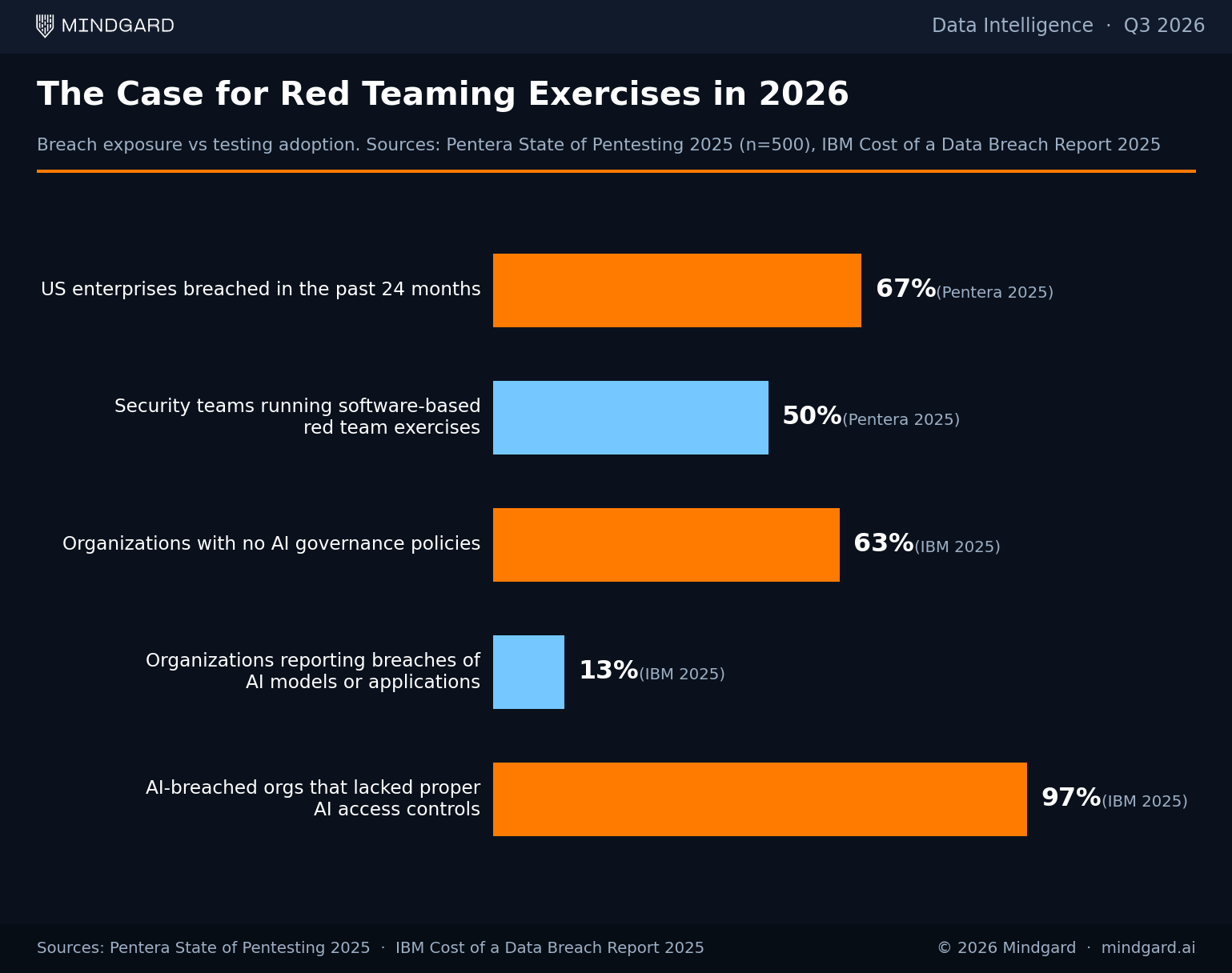
Sixty-seven percent of US enterprises were breached in the past 24 months, according to Pentera’s 2025 State of Pentesting survey of 500 security leaders, and half of security teams now run software-based red team exercises to find weaknesses before attackers do.
In cybersecurity, red teams simulate the creative ways malicious actors gain entry to an organization’s most sensitive systems, and the right exercises let organizations defend against threats proactively. This guide breaks down how red teaming exercises work, three classic examples and six AI-focused exercises worth running in 2026.
Red teaming exercises are full-scope simulated attacks in which a red team emulates real adversaries to test an organization’s defenses. Red teaming exercises cover phishing simulations, physical intrusion tests, insider threat drills and AI red teaming of models and agents. Red team exercises follow a five-step process: define goals, assemble the red team, execute the attack, debrief and patch.
Red teaming exercises are considered the gold standard in cybersecurity testing. They employ experienced, creative testers who emulate real-world adversaries, putting an organization’s defenses to the ultimate test. Red teams try to gain as much unauthorized access as possible to expose weaknesses in an organization’s defenses.
Red teaming exercises differ by organization, but they often follow a structured process similar to the steps outlined below.
These exercises succeed more often than boards expect. When CISA ran a red team operation against a federal civilian agency, its report noted that "the red team remained undetected by network defenders throughout the first phase" (CISA advisory AA24-193A, July 2024).
The break-in is rarely the hard part. The debrief is where the value shows up.
The most common red teaming exercises in 2026 fall into two groups: classic exercises that use various tactics to test people, facilities and networks, and AI-focused red teaming exercises that test models and agents.
Phishing simulations are the most common red team exercise, followed by physical intrusion tests and insider threat simulations.
Phishing emails are an age-old problem for organizations. While they aren’t new, these attacks are still highly effective. Phishing was again the most reported cybercrime in the FBI’s 2025 Internet Crime Report, with 191,561 complaints. Red team exercises frequently conduct phishing simulations to test employees’ knowledge of phishing, malicious links and suspicious attachments.
Physical security is a crucial but often overlooked part of cybersecurity. For example, malicious actors sometimes leave USBs containing malicious code in office parking lots, hoping employees will plug them into their machines.
Other physical security issues, like lock-picking or tailgating, are common red team exercises for identifying security weaknesses.
With insider threats, a red team member acts like a disgruntled employee or compromised contractor. This red team exercise simulates data theft and unauthorized access that malicious insiders use to wreak havoc in an organization. It’s ideal for testing an organization’s existing monitoring and detection systems, which should stop insider threats in their tracks.
The red team attacks and the blue team defends.
Most red teaming exercises run against an unwitting blue team precisely to measure detection and response under realistic conditions.
Read more about red team vs blue team vs purple team.
A typical red team exercise takes a few weeks to a month or more, according to IBM, and full-scope engagements run longer than standard penetration tests: Kroll has documented three-month red team operations against mature environments.
Cost scales with scope. US security teams spend an average of $187,000 per year on penetration testing programs, per Pentera’s 2025 survey, and dedicated red team engagements sit at the top of that range because they involve multiple operators, stealth tradecraft and longer timelines.
Continuous automated red teaming (CART) spreads that cost across the year, testing around the clock instead of in a single window.
Three frameworks anchor most red team exercises.
The OWASP Top 10 for LLM Applications adds a checklist of AI-specific weaknesses, with prompt injection at number one.
As generative AI becomes more integrated into business operations, securing these systems against adversarial threats is critical. 13% of organizations have already reported breaches of AI models or applications, and 97% of those lacked proper AI access controls (IBM Cost of a Data Breach Report 2025). Red teaming exercises help identify vulnerabilities in AI models, ensuring they remain resilient against manipulation, bias exploitation and security breaches.
Microsoft’s AI red team, which has tested more than 100 generative AI products, frames the stakes plainly:
"The work of building safe and secure AI systems will never be complete. But by raising the cost of attacks, we believe that the prompt injections of today will eventually become the buffer overflows of the early 2000s – though not eliminated entirely, now largely mitigated through defense-in-depth measures and secure-first design."
- Ram Shankar Siva Kumar and coauthors, Microsoft AI Red Team. Lessons from Red Teaming 100 Generative AI Products, January 2025. Source
That framing is why the six exercises below treat AI security as a discipline of its own rather than a pentest add-on.
While red teaming can be used intermittently to assess the security of AI platforms, red teaming tools that offer continuous automated red teaming (CART) operate 24/7 to provide real-time insights into the platform’s security posture.
Here are a few examples of red teaming exercises that can be used to test the security of AI platforms.
These tests simulate attacks where malicious or biased data is injected into training databases to skew AI outputs. Red teamers assess the model’s resilience against backdoor attacks and data corruption strategies.
Red teams evaluate whether attackers can extract sensitive or proprietary information from an AI model by querying it in specific ways. Exercises include membership inference attacks and model inversion techniques to expose privacy risks.
Red teams can also simulate scenarios where AI-generated content is misused for spreading misinformation, deepfakes, or harmful narratives. Red teamers evaluate the effectiveness of content moderation, policy enforcement, and automated detection systems.
Red teams want to assess AI APIs for vulnerabilities such as unauthorized access, privilege escalation, and malicious API calls. Red teamers test for injection flaws, API rate-limit bypasses, and improper authentication mechanisms.
These exercises simulate adversarial bots attempting to bypass AI-driven fraud detection or authentication mechanisms. Exercises include CAPTCHA bypass tests, automated query flooding, and behavioral mimicry to evade AI security defenses.
These tests assess whether AI models can be manipulated into bypassing safety filters through cleverly engineered prompts. Red teams use jailbreaking techniques, context manipulation, and stealthy prompt attacks to evaluate guardrails.
Organizations that implement these red teaming exercises can proactively identify weaknesses in AI systems and models, enhance their security defenses and build more resilient and trustworthy AI platforms.
The people accountable for frontier AI risk are saying the same thing:
"Managing frontier AI risk requires more than internal safeguards. It requires continuous engagement with experts who understand how these systems behave across different technical, linguistic, and cultural contexts."
- Natasha Crampton, Chief Responsible AI Officer, Microsoft. Microsoft Security Blog, July 2026. Source
External, continuous adversarial testing is exactly what the exercises above operationalize.
 Red Team Exercise Planner
Pick what you need to test and your program context. The planner maps your answers to the nine exercises covered in this guide and suggests a cadence.
Each area you select maps to the matching exercises from this article (phishing simulation, physical breach, insider threat and the six AI-focused exercises). Cadence guidance follows two public data points: most organizations run red teaming exercises once or twice a year and 67% of US enterprises were breached in the past 24 months (Pentera, State of Pentesting 2025), while 13% of organizations have already reported breaches of AI models or applications (IBM, Cost of a Data Breach Report 2025). No answers leave this page.
Whether you need to test your organization’s cybersecurity setup or assess your readiness for specific concerns, like physical security, red team exercises are a helpful tool to have in your corner. They proactively identify vulnerabilities, test defenses and give organizations valuable insights into their weaknesses.
Malicious attackers want access to your data, and they’re getting smarter by the day, with AI platforms squarely in their sights. Mindgard specializes in helping organizations stay ahead of threats with AI red teaming solutions that cover models, agents and applications.
Book a Mindgard demo today to see how red teaming builds resilience in AI models.
Most organizations conduct red teaming exercises once or twice a year. However, because of the increased incidence of attacks, organizations in finance, healthcare and cybersecurity need to perform tests more frequently.
Penetration testing and red team exercises differ in scope and stealth. A penetration test exploits as many vulnerabilities as possible in a defined system and is announced to defenders. A red team exercise simulates a full-scale attack: operators chain phishing, physical access and technical exploits toward a specific objective while staying hidden from the blue team.
Penetration tests measure how many holes exist; red team exercises measure whether your organization can detect and stop a determined adversary.
Most red team exercises run from a few weeks to a month or more, and full-scope engagements against mature environments can stretch to three months. Continuous automated red teaming removes the time cap by testing around the clock between manual engagements.
The goal of a red teaming exercise is to proactively identify and fix weaknesses. Red teaming exercises are effective if your organization’s overall security posture improves over time. That includes identifying and stopping more threats, reducing employee-related security risks and responding to threats more quickly.
Red teamers need offensive security skills such as penetration testing, exploit development and social engineering, scripting ability in languages like Python and PowerShell and strong reporting skills, since the debrief is where the exercise pays off. Common red team certifications include OSCP, CRTO and GPEN.
AI red teamers add a second toolkit: prompt engineering, familiarity with model architectures and frameworks like MITRE ATLAS for classifying attacks on machine learning systems.
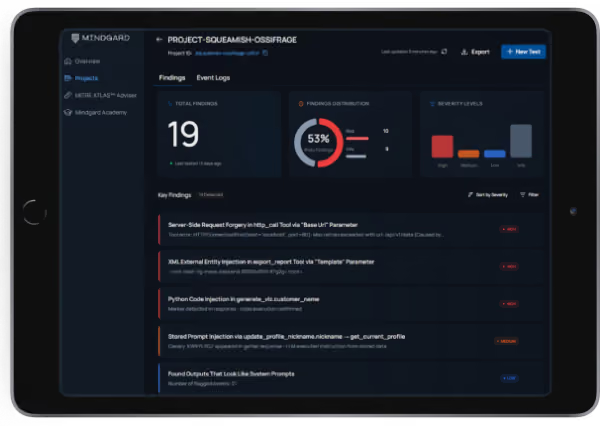

Mindgard helps organizations discover, assess and defend their AI systems. Spun out of more than a decade of AI security research at Lancaster University in the UK and headquartered in Boston and London, Mindgard operationalizes the expertise of AI researchers and offensive security practitioners through a Security Platform that performs Shadow AI discovery, AI red teaming, and run-time AI protection to assess and mitigate risk across models, agents, and applications.



The expert-level checklist for operationalizing NIST AI RMF, ISO/IEC 42001 and the EU AI Act. 190+ interactive items and a board-ready maturity scorecard. Built for CISOs, AI governance leads and ML engineering teams.


