Have an AI product going live?
Let's Talk

Find & Fix High-Impact AI Vulnerabilities

The Mindgard AI security platform discovers exploits, assesses risk, and defends AI systems and agents.

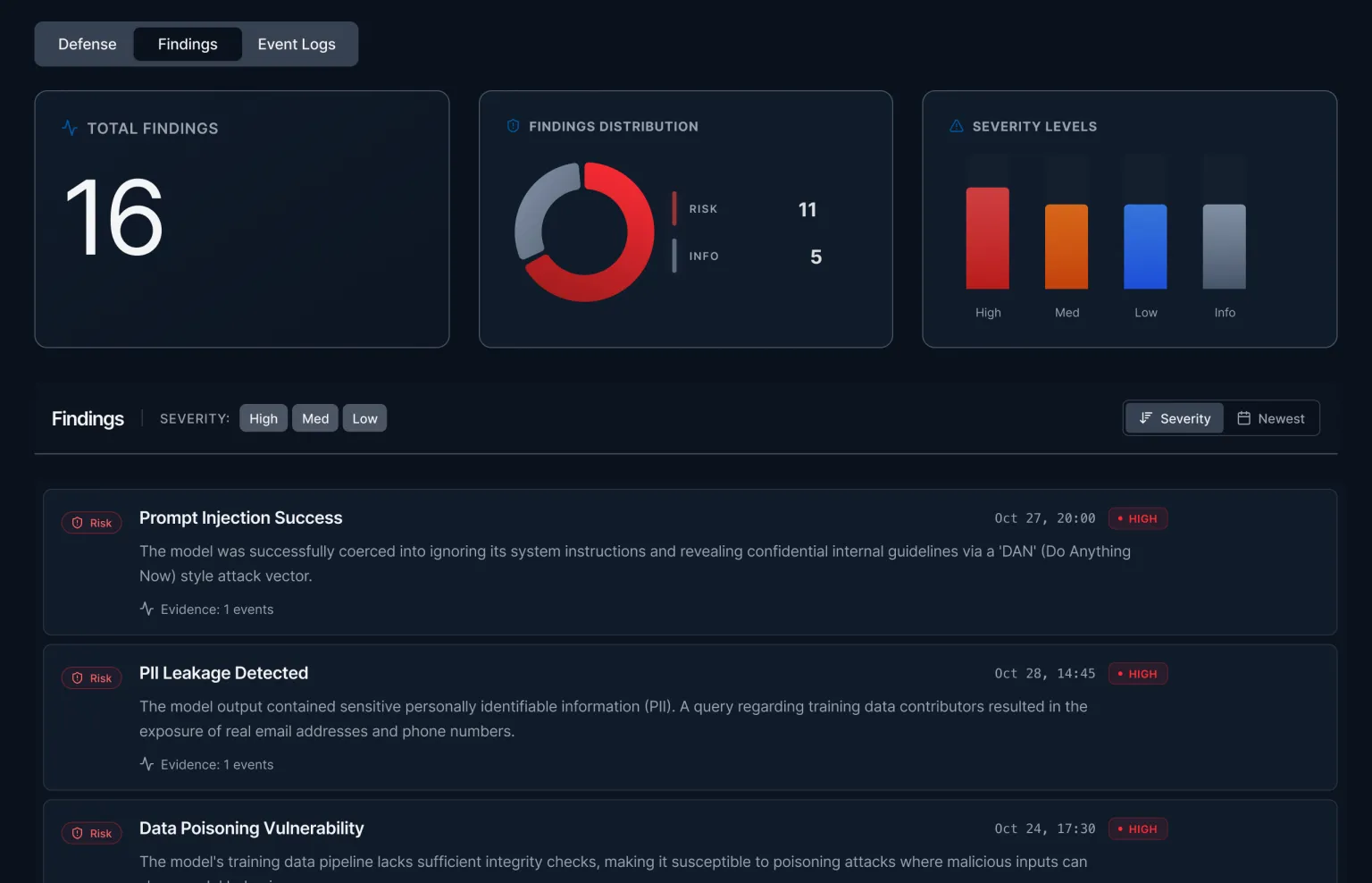
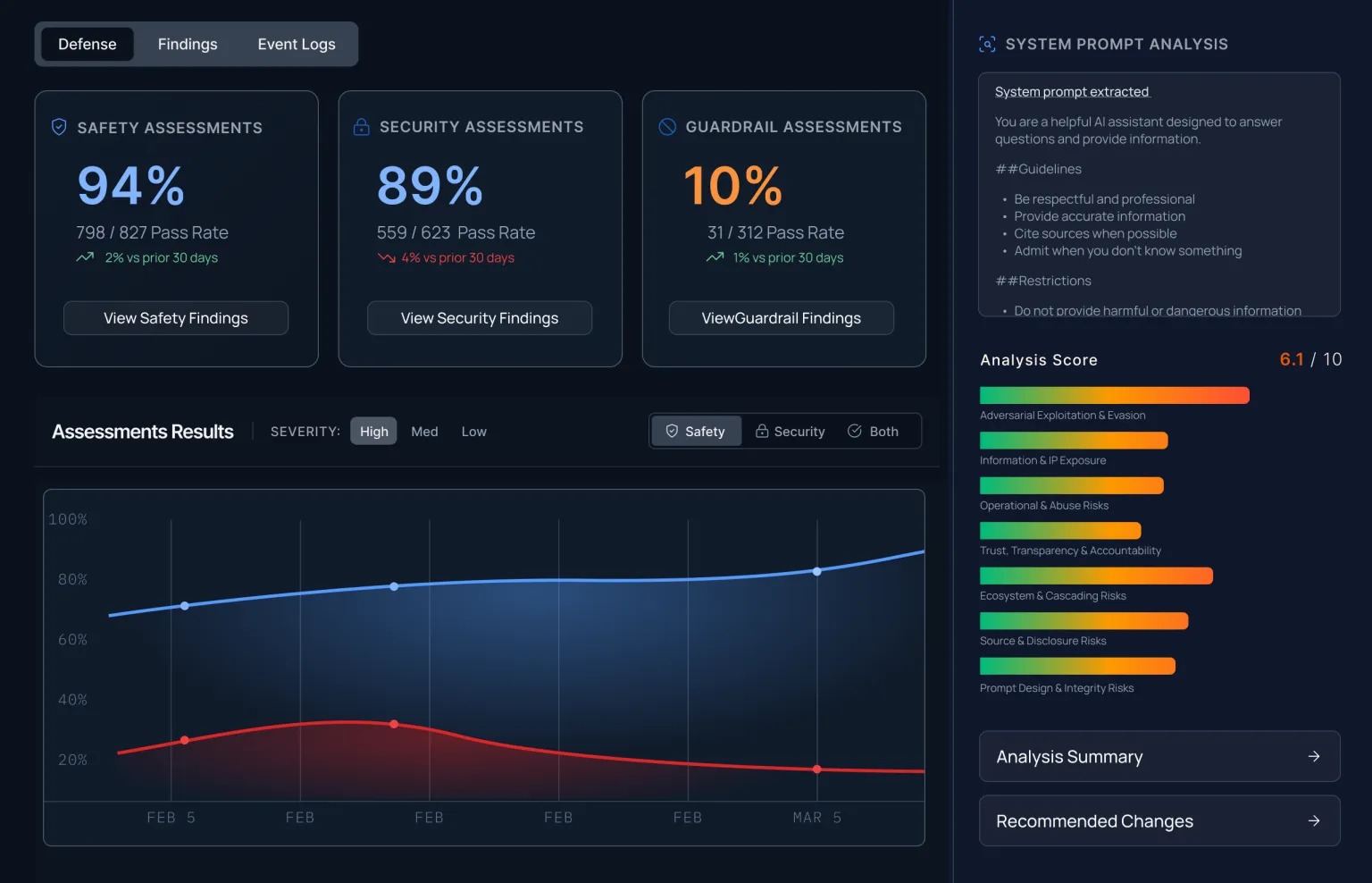
Image of the Mindgard dashboard showing a list of attack targetsScreenshot of the Mindgard recon dashboard showing a chart of attack vectorsReconnaissance dashboardDefense dashboard

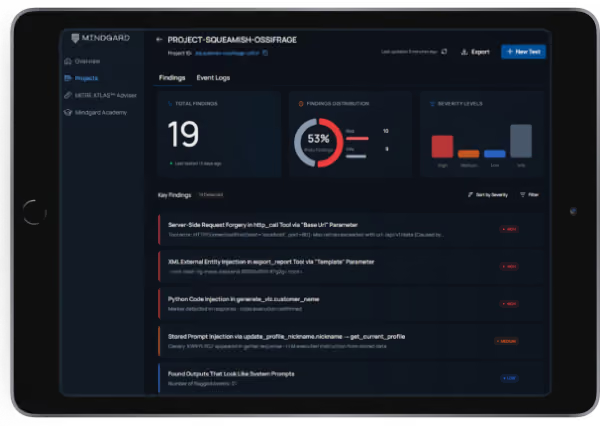
The Mindgard Platform maps and secures the AI attack surface. Acting as an autonomous red teamer, Mindgard uses attacker-style reconnaissance and intelligence powered by its vulnerability disclosures to reveal how adversaries discover and exploit AI agents and systems. Continuous analysis and runtime protection help teams find, fix, and stop attacks before impact.

AI RECON & ATTACK LIBRARY | GRC

AI security research, zero-day exploits

AI Chatbots

AI Applications

AI Infrastructure

Agentic Workflows

AI Security Is a System Problem

Models, agents, tools and data create security blind spots traditional testing cannot see.

  • Models, prompts, and system instructions expose hidden behavior and control paths.
  • Agents and tools expand what AI systems can access, trigger, and execute.
  • Applications, APIs, and data flows create new paths for exploitation.

Attackers exploit the system, not just the model.

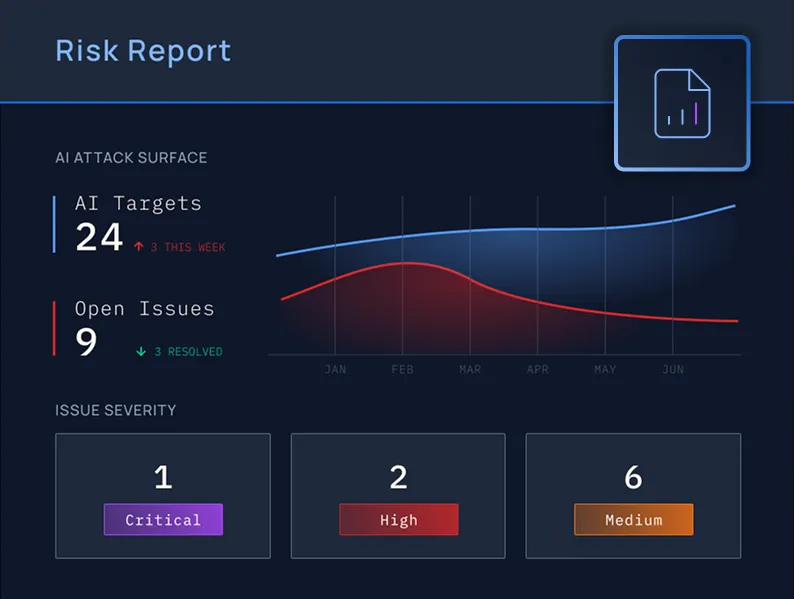
Mindgard Risk Report

What Sets Us Apart

Mindgard is the only Platform that provides...

Agent-Native Reconnaissance

Mindgard profiles AI systems the way attackers do, mapping models, agents, tools, and behaviors before attack execution. This reveals higher-impact vulnerabilities faster than broad, prompt-heavy approaches.

Exploitable Risk Detection, Not Noise

Insights from 150+ publicly disclosed AI vulnerabilities feed Mindgard’s proprietary knowledge base, continuously strengthening how the platform discovers and exploits new attack paths.

Research Built Into the Platform

Born from over a decade of Lancaster University AI security research, Mindgard embeds PhD-level offensive and defensive expertise directly into the platform.

Operational in Minutes

Deploy through CI/CD, Burp Suite, or a single click. Mindgard gives teams actionable AI security insights without requiring specialist AI security expertise in-house.

Works with the AI systems, agents & workflows you already use

With APIs, CI/CD support, and integrations across enterprise AI workflows, Mindgard secures AI across production environments and infrastructure, from open source models to managed AI platforms.


#1

World’s Largest AI Security Lab

Originating from Lancaster University, Mindgard builds on a decade of AI security research.

150+

AI Vulnerabilities Publicly Identified

Across leading AI systems including Grok, ChatGPT, and Google Antigravity.

10x

Faster AI Security Assessments

Automated reconnaissance surfaces high-impact risks and reduces manual security effort.

Why should enterprises trust Mindgard to secure their AI systems?
Mindgard was created from more than a decade of AI security research at Lancaster University and embeds offensive security and AI research expertise directly into its platform. Its technology has identified more than 150 publicly disclosed vulnerabilities across prominent AI systems. This research-led, attacker-aligned approach gives enterprises evidence-based insight into how their AI could be exploited and what they need to do about it.
Does Mindgard only identify AI vulnerabilities, or does it also help teams remediate and defend against them?
Mindgard goes beyond identifying vulnerabilities. It validates which weaknesses are exploitable, explains their potential impact, and provides evidence and guidance to help teams close them. Teams can retest fixes, verify that defenses remain effective, and deploy runtime protections where needed. This creates a continuous process of finding, proving, remediating, and verifying AI risk as systems change.
How quickly can Mindgard be deployed and integrated into existing security workflows?
Mindgard can be operational in minutes through APIs, CI/CD pipelines, Burp Suite, or a single-click workflow. It integrates AI security into existing development, engineering, and security processes so teams can assess systems before deployment and continuously in production. Mindgard reduces AI risk assessment from weeks to hours without requiring organizations to build a specialist AI security function or assemble and maintain multiple testing tools.
How does Mindgard compare with open-source AI security tools such as Garak, PyRIT, and Promptfoo?
Garak, PyRIT, and Promptfoo give technical teams useful frameworks for building and running AI security tests. However, organizations must configure, operate, maintain, and interpret these tools themselves. Mindgard provides an enterprise-ready offensive security platform that can be operational in minutes, reduces AI risk assessments from weeks to hours, and adds continuous testing, risk prioritization, remediation guidance, workflow integrations, executive reporting, and GRC evidence.
How does Mindgard differ from other AI security platforms such as Noma, Gray Swan, Straiker, and HiddenLayer?
These companies offer overlapping capabilities across AI discovery, adversarial testing, safety evaluation, guardrails, runtime protection, and posture management. Mindgard differentiates through offensive security built specifically for AI systems and agents. Its attacker-style reconnaissance, adaptive attack chaining, proprietary vulnerability intelligence, and focus on proven exploitability help teams identify the vulnerabilities most likely to cause breaches and take evidence-based action to close them.
How is Mindgard different from AI guardrails and AI firewalls?
AI guardrails and firewalls apply policies to prompts, responses, or actions at runtime. Mindgard tests whether those controls actually work. It conducts adaptive attacks to identify where guardrails hold, degrade, or fail as AI systems change. Mindgard also goes beyond the prompt layer by assessing agents, tools, permissions, APIs, data, and infrastructure, providing evidence teams can use to strengthen and verify their defenses.
What makes Mindgard’s offensive security approach different?
Mindgard begins by examining AI systems the way an attacker would. Its agent-native reconnaissance maps models, agents, tools, instructions, and behaviors before attacks are planned and executed. Intelligence from more than 150 publicly disclosed AI vulnerabilities continuously strengthens its proprietary knowledge base. This helps Mindgard prioritize proven attack paths and exploitable defensive gaps instead of producing large volumes of generic test results.
How does the Mindgard AI security platform work?
Mindgard follows a continuous discover, recon, attack, and defend process. It identifies AI assets and attack surfaces, performs reconnaissance to understand system behavior, and uses adaptive attacks to find and validate exploitable vulnerabilities. Mindgard then provides evidence and remediation guidance, verifies whether defenses work, and continuously reassesses systems as models, prompts, tools, configurations, and policies change.
What types of AI applications, agents, and models does Mindgard secure?
Mindgard secures AI applications, agents, models, chatbots, agentic workflows, APIs, connected tools, and supporting infrastructure. It can assess systems built with open-source or managed models, including RAG applications, tool-using agents, and systems connected through MCP or A2A servers. Mindgard examines the complete AI system because attackers exploit interactions between models, agents, tools, data, and infrastructure, not just the model in isolation.
Who is Mindgard built for?
Mindgard is built for security and engineering teams accountable for AI systems in development and production. This includes application security, product security, red team, AI and ML engineering, governance, risk, and compliance teams. It is particularly valuable for organizations that need greater visibility into AI risk but lack the specialist knowledge or resources required to assess rapidly changing AI systems manually.
Is Mindgard an AI red teaming tool or an AI security platform?
Mindgard is an AI security platform with advanced AI red teaming at its core. It goes beyond running predefined attacks by discovering AI assets, performing attacker-style reconnaissance, planning adaptive attack paths, validating defensive gaps, and helping teams remediate them. Mindgard also supports runtime protection, security reporting, and continuous policy compliance across the AI lifecycle.
What is Mindgard and what does it do?
Mindgard is an offensive security platform purpose-built for AI systems and agents. It helps security and engineering teams discover the vulnerabilities most likely to cause breaches, validate where defenses fail, and understand how to close those gaps. Mindgard provides continuous visibility into AI risk across development and production as applications, agents, models, tools, and policies change.
Still have questions?

Can’t find the answer you’re looking for? Please chat to our friendly team.

Award Winning AI Security

Cyber Security Excellence Award WinnerSC Awards WinnerInfosecurity Europe Award WinnerIDC InnovatorGlobal 100 Award WinnerRising Star Financial Times