Contact Us

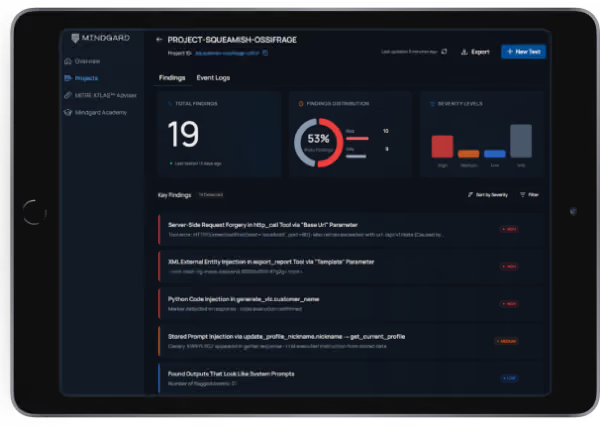
Mindgard's researchers attack your AI systems the way a motivated adversary would: prompt injection, agent hijacking, tool abuse, data extraction and guardrail bypass, chained into the attack paths that matter to your business. You get reproducible findings, a remediation roadmap and a platform that keeps testing after we leave.
A Mindgard AI security lead replies within one business day.
Every Mindgard red team engagement ends with five things your security team can act on the same week:
Mindgard red teams the whole AI system, not just the model. Scope typically covers:
The techniques below are the core of every engagement. Each maps to a public taxonomy so your findings speak the same language as your auditors and your engineering backlog.
Five phases. Typical elapsed time from kickoff to final readout is four to six weeks for a single AI application.
Red teaming is now a named obligation, not a nice-to-have. Article 55 of the EU AI Act requires providers of general-purpose AI models with systemic risk to perform and document adversarial testing. ISO/IEC 42001 asks for AI risk assessment and treatment with evidence. The NIST AI RMF Measure function expects AI systems to be evaluated for security and resilience against adversarial input.
A Mindgard red team engagement produces the evidence each of these asks for: the threat model, the test record, the findings mapped to a public taxonomy and the retest confirming remediation. If your governance team needs a specific artifact, tell us during scoping and we build the report to fit. Talk to us about compliance-ready red teaming.

Can’t find the answer you’re looking for? Please chat to our friendly team.
Book a demo to watch the Mindgard platform attack a live AI system, or scope a red team engagement with our researchers. Either way you leave with a clearer picture of your AI risk than you had this morning.
A Mindgard AI security lead replies within one business day to confirm scope and set a 30-minute call.

Mindgard helps organizations discover, assess and defend their AI systems. Spun out of more than a decade of AI security research at Lancaster University in the UK and headquartered in Boston and London, Mindgard operationalizes the expertise of AI researchers and offensive security practitioners through a Security Platform that performs Shadow AI discovery, AI red teaming, and run-time AI protection to assess and mitigate risk across models, agents, and applications.