See why AI and security teams choose Mindgard ahead of Promptfoo (acquired by OpenAI) for visibility into their AI attack surface, measurement of AI risk and active defense of AI Systems.
See why AI and security teams choose Mindgard for attack‑driven testing, visibility across models and agents, and enterprise‑grade controls.

Map the AI attack surface to gain visibility into AI inventory and activity; reveal what attackers can find out about an organization’s AI.

Continuously red‑team models, agents, and apps across the AI lifecycle to measure risk. Assess how attackers can exploit your AI and validate fixes.

Actively defend AI. Enforce controls and policies to mitigate AI attacks at run-time. Stop attackers from breaching AI.
Below is a side-by-side comparison of Mindgard and Promptfoo across key capabilities that matter to enterprise security and AI teams. Each category highlights how the two platforms approach visibility, testing, and control differently.
Feature


Winner
AI Risk Visibility
Surfaces high impact AI risks including architecture, integration and intellectual-property vulnerabilities. Works across agents, applications and models, providing full-stack visibility and giving teams earlier, deeper risk discovery than runtime-only inspection.
Analyzes the prompts, models and apps you configure. Does not automatically discover your broader attack surface.

Shadow AI Discovery
Surfaces AI asset inventory and hidden AI usage. Detects ungoverned model deployments and unapproved data flows that runtime tools miss.
Promptfoo tests what developers explicitly target. Does not discover shadow AI outside its configured scope.
AI Risk Assessment
Continuous and automated AI red teamingDelivers continuous and automated AI red teaming across agents, models and AI applications. Identifies real exploitation paths to demonstrate exactly how attackers can compromise AI systems.
Delivers security assessments and automated red teaming for LLM applications, agents, and RAG systems. Targets configured assets using known vulnerability tests, scheduled scans, and CI/CD integrations versus organization-wide risk assessment.
Behavioural Science Testing Capabilities
Models attacker behavior across human, linguistic, and system biases to surface vulnerabilities that static testing and persona-based probes cannot surface. Research-driven attack generation continuously evolves to reflect emerging AI threats.
Heavily dependent on pre-existing attack plugins, adversarial prompts, and data sets. No mention of behavioral science research or cognitive attacker modeling.
AI Security R&D Talent
86% of staff on R&D team, 38% hold PhDs. Founded by Professor at Lancaster University. Research pipeline from the UK’s top AI security lab.
8% on R&D team; per People statistics on LinkedIn Sales Navigator.
Simplicity and Usability
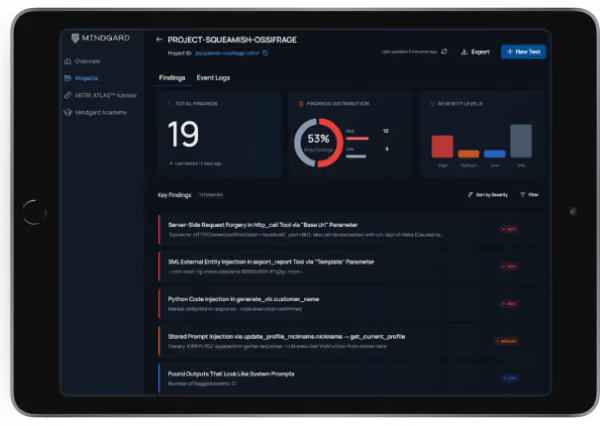
Built for both security teams and AI developers with intuitive dashboards, explainable findings, guided remediation workflows, one-click retesting and prioritized risk scoring to accelerate fixes and reduce alert fatigue.
Offering developer-first experience with CLI, YAML configuration, and open-source workflows. Enterprise adds features like dashboards, guided remediation, and collaboration tools but assumes a level of comfort configuring evaluations and test suites.
AI Guardrails
Validates and continuously tests guardrail effectiveness through adversarial attacks. Focuses on measuring, stress-testing and improving guardrails rather than acting as a runtime guardrail itself.
Delivers configurable guardrails to detect/block unsafe model outputs, prompt injection, and policy violations within your application development workflows. These guardrails are designed to provide application-level protections rather than comprehensive runtime governance.
Attack-Driven Testing
Continuously red-teams models, agents, and applications through attack-driven testing that covers jailbreaks, data exfiltration, and prompt injection. Supports multi-turn adversarial chains with reproducible results to validate fixes.
Automatically red teams your LLM applications with powerful plugins for all major attack categories including prompt injection, jailbreaks, tool misuse, data leakage, and more AI vulnerabilities. Integrates into your CI/CD process with repeatable evaluations.
Runtime Detection & Policy
Provides inline detection and enforcement for prompt injection, sensitive data exposure, jailbreak attempts, and tool abuse. Configurable actions include blocking, alerting, enrichment and integration with existing security controls.
Primarily focused on pre-deployment testing and continuous evaluation. Offers scheduled monitoring and alerts but is not positioned as an inline runtime detection and enforcement platform.
Enterprise Controls
Delivers enterprise-grade governance with granular permissions, pDelivers enterprise-grade governance with RBAC, SAML/SSO, SCIM provisioning, granular permissions, audit trails and centralized policy management. Enables organizations to standardize AI security testing and demonstrate compliance across teams and environments.
Enterprise edition includes RBAC, teams, SAML/OIDC SSO, audit logs and role-based collaboration. Designed to support enterprise governance of AI security testing workflows.
Integrations
Integrates seamlessly across developer and security workflows, including CI/CD pipelines, GitHub, IDE hooks, SIEM, ticketing systems and APIs. The first AI red teaming solution with a native Burp Suite integration, enabling red teams to extend attack-driven testing into familiar tooling.
Integrates seamlessly into developer workflows, including CI/CD pipelines, GitHub Actions, APIs and has connectors to multiple LLM providers. Good engineering tool integrations, but not as many dedicated security integrations as Mindgard.
Deployment Options
Most flexible: SaaS, Private cloud, Customer‑managed. On-prem available for certain use cases.
Available as open-source CLI, fully-managed SaaS (Enterprise) and self-hosted (Enterprise) options for organizations that need network isolation with on-prem deployments.
Reporting & Scorecards
Provides comprehensive reporting that connects testing outcomes to business risk. Teams can assess how attackers could exploit their AI, validate defenses, and evidence compliance through detailed scorecards, trend analytics, and executive summaries.
Delivers dashboards, test reports, remediation recommendations, and vulnerability tracking/trend analysis. Reporting is largely focused on test results vs. business risk or executive-focused scorecards.
Support & Partnership
Every customer receives a dedicated success team backed by world-class AI security researchers. Mindgard provides hands-on guidance informed by active attack research, helping enterprises apply the latest insights to their own AI environments and continuously strengthen defenses.
Customers on the enterprise plan are given priority support and have named account managers as well as implementation support. Users on the Community plan mainly have access to open-source documentation and community resources.
Pricing Model
Contact sales for tailored pricing.
Community edition is free and open source. Enterprise and enterprise on-prem plans are custom-priced based on organizational requirements.
Powered by the world's most effective attack library for AI, Mindgard enables red teams, security and developers to swiftly identify and remediate AI security vulnerabilities.
Don’t just take our word for it, see how offensive security teams rate the experience across platforms.

CEO at AI software company
Red teamer at F500 bank
AI Testing Guide


Purpose-built features that surface AI security threats that really matter.

Extend offensive testing into familiar workflows. Mindgard’s native Burp Suite integration lets red teams chain AI-specific attacks, validate exploits, and report findings directly within their existing toolset.
Learn More >
Turn findings into fixes with guided remediation workflows. Automatically reproduce vulnerabilities, validate patches, and document risk reduction for auditors and leadership
Learn More >
Test beyond text with coverage for vision, audio, and multi-modal models to uncover cross-channel vulnerabilities that attackers can exploit.
Learn More >
Plug into CI/CD pipelines, IDEs, SIEM, and ticketing systems to bring AI risk visibility and testing automation into every stage of development and security operations.
Learn More >
The world’s most effective library of jailbreaks, data exfiltration methods, and prompt injection chains—curated from ongoing research and field testing to mirror the latest real-world threats.
Learn More >
Align findings to emerging frameworks like OWASP Top 10 and MITRE ATLAS, translating technical vulnerabilities into compliance-ready evidence.
Learn More >View and learn more about Mindgard's features, data handling capabilities, or integration options.

Mindgard secures AI models, agents, and applications against exploitable threats. Spun out of more than a decade of pioneering AI security research at Lancaster University, Mindgard combines offensive security expertise, AI red teaming, attacker intelligence, and automated protection to help organizations discover, assess, and mitigate risk across AI models, agents, and applications.