
Continuous AI pentesting is automated, always-on penetration testing of AI systems: it attacks your models, LLM applications and agents for prompt injection, jailbreaks, data poisoning and model extraction, then re-runs the attacks every time the system changes.
Continuous AI pentesting is automated, always-on penetration testing of AI systems: it attacks your models, LLM applications and agents for prompt injection, jailbreaks, data poisoning and model extraction, then re-runs the attacks every time the system changes. Continuous AI pentesting replaces the annual AI pentest with a continuous one, and the numbers explain why.
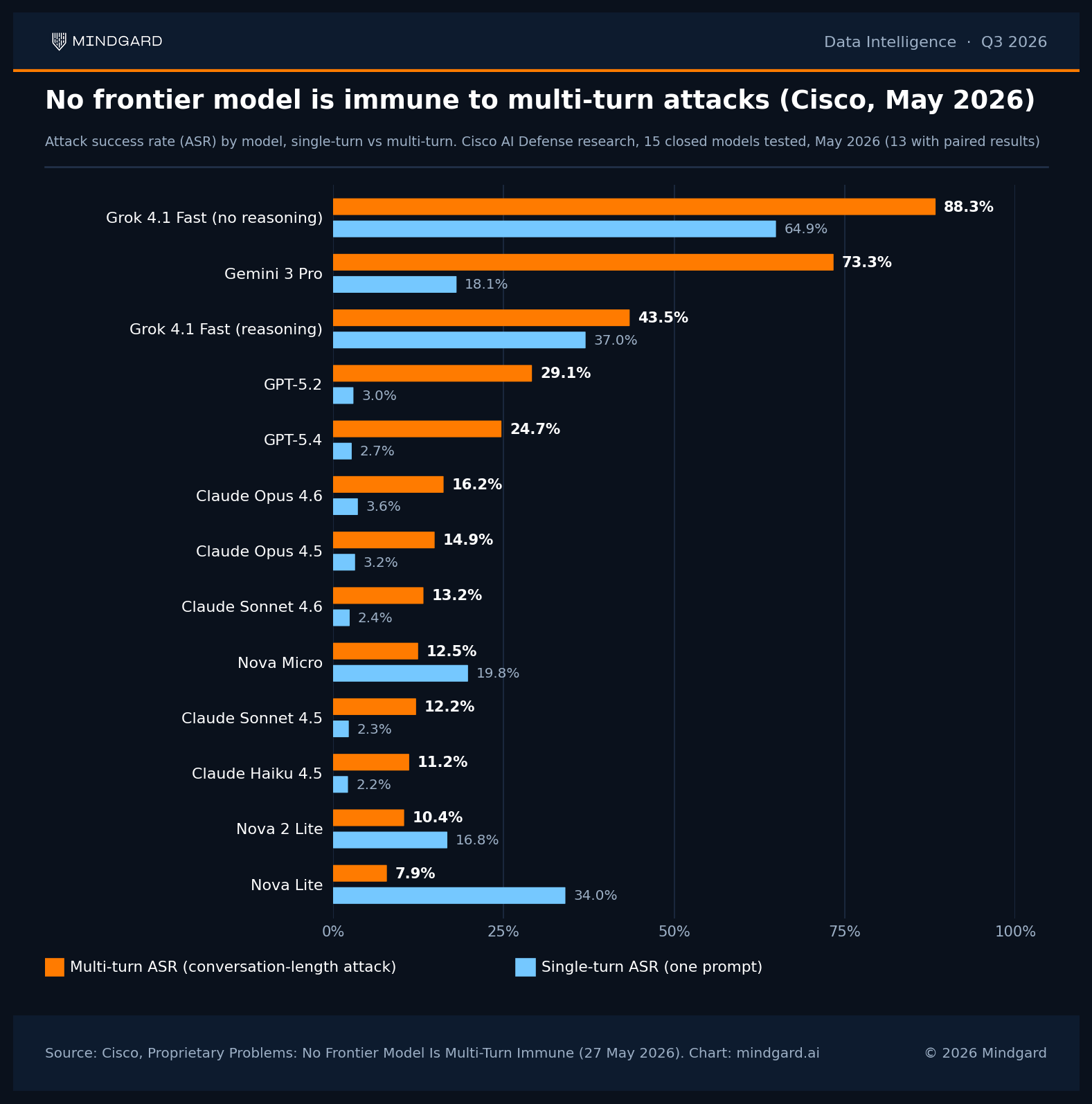
49.4% of security teams still test their AI systems only when a stakeholder asks, according to a June 2026 Pentest-Tools.com survey of 158 practitioners. When Cisco tested 15 frontier models in May 2026, every one failed some multi-turn attacks; Gemini 3 Pro’s attack success rate rose from 18.10% on single prompts to 73.35% across a conversation. The model that passed a pentest in March is not the model in production in September.
Penetration testing is a must for AI, and an annual engagement was the right starting point when most companies had one chatbot. It is the wrong cadence now that providers ship new model versions on their own schedule, prompts change weekly and agents pick up new tools. Traditional penetration testing leaves everything that changed between tests untested.
This guide explains what continuous AI pentesting is, how it differs from continuous pentesting with AI, how it works step by step, what it catches, how often to retest, what it costs and how to set it up in a CI/CD pipeline.
AI-driven pentesting and pentesting of AI systems are different practices, and the phrase continuous AI pentesting is used for both.
This article covers the second. The two overlap in one way that matters: AI agents are what make continuous testing of AI systems affordable, because a human red teamer cannot re-run thousands of attack variants every time a model or prompt changes.
Continuous penetration testing is a security testing model that replaces the annual or quarterly pentest with always-on assessment: automated attacks run against production-like environments on a schedule or on every change, findings feed straight into ticketing and fixes are retested automatically.
A conventional pentest is a point-in-time snapshot, valid for the day it was run. Continuous penetration testing, often sold as penetration testing as a service (PTaaS), shortens the window between a change and its first test from months to hours.
Synack’s July 2026 pricing guide puts a single web application engagement at $10,000 to $30,000 and an annual continuous PTaaS program at $20,000 to $100,000 or more, with the higher fee covering retests and a larger share of the attack surface. For AI systems the same model applies, with one difference: the change that triggers a test can be a model upgrade, a system prompt edit or a new tool connection rather than a code commit.
AI penetration testing is adversarial security testing of AI systems (machine learning models, LLM applications, RAG pipelines and agents) to find vulnerabilities an attacker could exploit. It keeps the goal of conventional pentesting, prove exploitability rather than list theoretical weaknesses, but the techniques are different.
AI pentesters use prompt injection, jailbreaks, multi-turn manipulation, adversarial examples, data poisoning, model extraction and tool abuse, mapped to the OWASP Top 10 for LLM Applications and MITRE ATLAS. NIST’s Adversarial Machine Learning taxonomy (NIST AI 100-2 E2025, March 2025) groups these attacks into evasion, poisoning, privacy and misuse. AI penetration testing can be a one-off engagement or, as described in this article, a continuous program that re-runs after every model, prompt or tool change.
Unlike traditional penetration testing, which happens quarterly or annually and reports on one snapshot, continuous AI pentesting works as a six-stage pipeline that re-runs every time the AI system changes. It covers large language models (LLMs), classic machine learning models and the applications and agents built on them, each of which has unique attack vectors that differ from conventional software.
Human red teamers stay in the loop for novel attack chains and business-logic abuse that automation cannot invent. Bias and harmful-output checks run in the same pipeline as a separate test class, so the program reports on safety failures as well as security ones.
An annual AI pentest and continuous AI pentesting differ in cadence, coverage and cost model.
The annual test produces a PDF; the continuous program produces a live record of pass and fail results per model version, which is the evidence auditors ask for under the EU AI Act and ISO/IEC 42001. Synack’s July 2026 pricing guide prices a single engagement at $10,000 to $30,000 and a continuous annual program at $20,000 to $100,000 or more.
AI applications are vulnerable to constant attacks, ranging from data leaks to model manipulation. While it’s impossible to design a 100% attack-proof model, continuous AI pentesting allows organizations to close exploitable paths before an attacker finds them. Here are the key benefits of implementing continuous pentesting for AI models and LLMs.
Unlike traditional applications, AI models are dynamic and constantly evolving. Continuous AI pentesting detects prompt injection attacks such as jailbreaking, model inversion risks and adversarial manipulations as they appear, before an attacker exploits them. It has to test conversations, not single prompts: in Cisco’s May 2026 tests, GPT-5.4 blocked 97.26% of single-turn attacks but only 75.32% of multi-turn ones, and Grok 4.1 Fast reached an 88.30% multi-turn attack success rate.
Adversarial inputs are small, carefully crafted modifications that cause incorrect or unexpected outputs by tricking the AI model. Continuous AI pentesting tests AI models against adversarial inputs that could mislead them, including encoded and multilingual variants of known jailbreaks.
This approach also improves model resilience by spotting weaknesses in the learning process.
AI models rely on high-quality training data, but attackers can inject malicious data during training, fine-tuning or retrieval to create biased outputs or degrade performance.
Continuous AI pentesting allows organizations to identify these data poisoning attempts before they affect production models, and it tests the training and retrieval pipelines for tampering so the integrity of your model holds between releases.
A pentest result belongs to one model version. Providers retire and replace versions on their own schedule, and each new version has its own attack profile: in the same Cisco study, GPT-5.2 and GPT-5.4 posted different multi-turn success rates (29.15% and 24.68%) despite sharing a product line. Continuous AI pentesting re-runs the full attack library on every version bump and flags any finding that was closed and is now open again, so a regression shows up in the pipeline rather than in an incident report.
Continuous penetration testing of AI systems catches prompt injection, jailbreaks, data poisoning and model extraction vulnerabilities, along with the rest of the OWASP Top 10 for LLM Applications (2025 edition): sensitive information disclosure, supply chain weaknesses, improper output handling, excessive agency, system prompt leakage, vector and embedding weaknesses, misinformation and unbounded consumption.
Each finding maps to an OWASP identifier and a MITRE ATLAS technique so the fix and the retest are unambiguous.
To set up continuous AI pentesting in a CI/CD pipeline, treat adversarial tests like unit tests: they run on every change and block the release when they fail.

Describe one AI system. The planner returns the triggers that should start a test, the scheduled cadence, an estimate of test runs per month and how long a new vulnerability stays untested under your current cadence versus a continuous one.
Risk tier is the sum of four scores: system type (assistant 1, customer-facing 2, RAG 2, agent 3, regulated 4), data sensitivity (1 to 4), untrusted inputs (0 or 2) and whether the change rate exceeds 8 per month (0 or 1). A total of 9 or more is Critical, 6 to 8 is High, 4 to 5 is Medium, below 4 is Low. Scheduled runs are daily for Critical, daily for High agents and otherwise weekly, weekly for Medium and fortnightly for Low. Test runs per month is the number of changes plus the scheduled runs (30, 4 or 2). Average exposure under a periodic cadence is half the interval in days (an annual test leaves a change untested for 183 days on average, a quarterly test 45 days); "only when someone asks" is shown as unbounded. Under change-triggered testing the exposure is the pipeline run time, shown as under one day. These are planning estimates derived from your inputs, not measurements.
Sources for the external figures quoted in the results: Pentest-Tools.com, The state of AI pentesting survey (June 2026, n=158); Cisco, Proprietary Problems: No Frontier Model Is Multi-Turn Immune (27 May 2026); Synack, How Much Does a Pentest Cost? (updated 1 July 2026); Workstreet, What Is AIUC-1? (quarterly technical testing requirement); EU AI Act, Article 15. Run counts and exposure days are derived from your inputs.
How often should AI models be retested for security vulnerabilities? Retest AI models on every change and on a fixed schedule, not on an annual calendar.
Change-triggered pentests should fire on a model version upgrade, a system prompt edit, a new retrieval source, a new tool or MCP connection and a guardrail change, because each one can reopen a closed finding. Scheduled tests should run at least weekly for customer-facing assistants and daily for agents that hold credentials or execute actions, because attack techniques change even when your system does not.
A quarterly deep review with human red teamers covers novel attack chains that automation misses; the AIUC-1 standard for AI agents requires quarterly technical testing to keep certification. The pressure is already there: the Pentest-Tools.com survey of June 2026 found 37.3% of practitioners say stakeholders now demand more frequent testing than a year ago.
For where the cadence is heading next, see our review of AI red teaming trends.
The main AI red teaming platforms and tools for continuous testing are Mindgard, Garak, PyRIT and Promptfoo, and they should not be confused with AI-driven pentesting tools that attack conventional software. Continuous AI red teaming platforms attack your models, LLM applications and agents on a schedule and on change:
AI-driven continuous pentesting platforms use AI agents to attack web apps, APIs and cloud: XBOW, Horizon3 NodeZero, Escape and Aikido. Most enterprises with production LLM applications need the first group; teams that already run PTaaS on their web estate may add the second.
Our guide to the best AI pentesting tools compares 12 options in detail.
The cost of continuous AI red teaming versus a manual penetration test comes down to price per year against price per finding. Synack’s pricing guide, updated July 2026, puts a single manual penetration testing engagement at $10,000 to $30,000, a multi-week red team engagement at $30,000 to $150,000 or more and an annual continuous PTaaS program at $20,000 to $100,000 or more, with the continuous fee covering retests and a larger share of the attack surface.
The same shape applies to AI red teaming. A manual AI pentest covers one model version, one system prompt and the integrations that existed that week; a continuous program covers every version shipped during the year. The cost that matters is the exposure window: a jailbreak or prompt injection path that opens after a model upgrade in month two stays open for ten months under an annual cadence and for hours under a change-triggered one.
Our round-up of AI red teaming statistics collects the adoption and breach-cost benchmarks behind that trade-off.
Continuous pentesting of AI models produces the evidence that the EU AI Act, ISO/IEC 42001, the NIST AI Risk Management Framework and AIUC-1 ask for, because each one expects testing to be repeated, not one-off.
Continuous AI pentesting also supports GDPR by detecting personal data leakage through model outputs.
NIST’s lead author on adversarial machine learning, Apostol Vassilev, put the case for repeated testing bluntly when the agency published its attack taxonomy:
"Despite the significant progress AI and machine learning have made, these technologies are vulnerable to attacks that can cause spectacular failures with dire consequences. There are theoretical problems with securing AI algorithms that simply haven’t been solved yet. If anyone says differently, they are selling snake oil.”
- Apostol Vassilev, Computer Scientist, NIST. NIST news release, January 2024. Source
NIST reissued that taxonomy in March 2025 as AI 100-2 E2025 with the same conclusion, which is why the mitigation is a testing cadence rather than a product.
More businesses rely on AI and LLMs to do faster, better work. As the technology changes, so do the threats targeting it: Check Point Research reported in July 2026 that between 87% and 93% of organizations saw at least one high-risk AI interaction every month between October 2025 and May 2026. Continuous AI pentesting is a change-triggered, always-on approach for defending your business’s most valuable data from those risks.
DJ Sampath, who runs Cisco’s AI software platform group, described what the company’s red team saw when it moved from single prompts to conversations:
"When you attack it once, with single-turn attacks, they’re able to protect it. But when you go from single-turn to multi-turn, all of a sudden these models are starting to display vulnerabilities where the attacks are succeeding, almost 80% in some cases.”
- DJ Sampath, Senior Vice President, AI Software and Platform Group, Cisco. VentureBeat, 1 December 2025. Source
That gap between a one-shot test and a persistent attacker is the gap an annual pentest cannot see and a continuous one is built to measure.
Manually conducting continuous pentesting just isn’t possible. That’s why solutions like Mindgard put continuous AI pentesting on autopilot for your organization. Combine AI-powered automation and human expertise to identify hidden threats and simplify compliance. Don’t leave your AI unprotected: Request a Mindgard demo now.
The other side has already gone continuous. When Google disrupted a criminal group that used an LLM to find a zero-day in May 2026, its chief threat analyst John Hultquist said:
“It’s here. The era of AI-driven vulnerability and exploitation is already here.”
- John Hultquist, Chief Analyst, Google Threat Intelligence Group. Fortune, 11 May 2026. Source
An adversary that finds new vulnerabilities on a machine’s schedule will not wait for your next annual test.
The most common risks are:
The OWASP Top 10 for LLM Applications 2025 is the standard list, and continuous AI pentesting tests each class on every change.
It runs an automated attack library (prompt injection, jailbreaks, multi-turn manipulation, extraction, poisoning and tool misuse cases mapped to OWASP and MITRE ATLAS) against a production-like copy of the AI system, on a schedule and whenever the model, prompt, retrieval source or tools change. Findings are scored by exploitability, routed to the engineering backlog with reproduction steps and retested after each fix. Human red teamers handle novel attack chains, following the same phases as a conventional red team engagement, and the whole loop is what continuous automated red teaming refers to.
Yes. It produces the per-version test record that Article 15 of the EU AI Act, ISO/IEC 42001, the NIST AI RMF Measure function and the AIUC-1 quarterly testing requirement expect, and it detects the personal data leakage that GDPR covers.
They overlap heavily. Continuous automated red teaming describes the method: automated adversarial attacks run continuously. Continuous AI pentesting describes the program applied to AI systems, with a pentest’s emphasis on proving exploitability, scoring findings and retesting fixes. In practice one platform delivers both.
No. Automation covers the known attack classes on every change; human red teamers cover novel attack chains, business-logic abuse and quarterly deep reviews. Mindgard’s platform combines an automated attack library with human offensive-security expertise for that reason.
There is no certification specific to continuous AI pentesting. For practitioners, the closest credentials are offensive security certifications plus AI security training. For AI systems themselves, AIUC-1 certification requires quarterly technical testing, and ISO/IEC 42001 certification requires ongoing monitoring of AI risk controls.
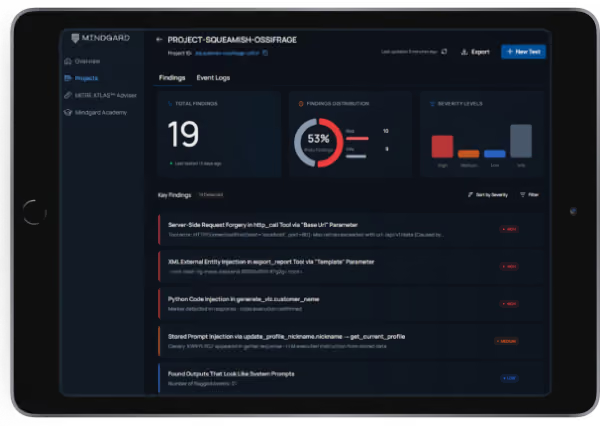
Mindgard helps organizations discover, assess and defend their AI systems. Spun out of more than a decade of AI security research at Lancaster University in the UK and headquartered in Boston and London, Mindgard operationalizes the expertise of AI researchers and offensive security practitioners through a Security Platform that performs Shadow AI discovery, AI red teaming, and run-time AI protection to assess and mitigate risk across models, agents, and applications.



The expert-level checklist for operationalizing NIST AI RMF, ISO/IEC 42001 and the EU AI Act. 190+ interactive items and a board-ready maturity scorecard. Built for CISOs, AI governance leads and ML engineering teams.


