
For many organizations, generative AI has been a welcome addition. It allows organizations to automate workflows and tasks that would otherwise take more time and effort. What’s more, it also helps organizations reduce errors across key functions. But while there are countless benefits to using AI, there are also serious risks.
While the adoption of generative AI continues to grow, organizations are failing to implement AI-specific controls. The consequences of these weaknesses have already manifested in the real world: even large corporate models can be manipulated or tricked into bypassing security filters.
Continuous automated red teaming is the best way to future-proof at-risk AI models. These AI red teaming statistics and benchmarks provide a data-backed view of where organizations stand today and why structured red teaming is no longer optional.

The rate of adoption of AI technology is outpacing traditional security measures. Discover how rapid adoption of AI technology has impacted business for better or worse, what’s at risk, and how AI red teaming fills the gap.
1. Generative AI could contribute up to $4.4 trillion to global GDP annually, according to McKinsey. It could also increase AI’s total business impact by as much as 40%. That’s huge. But when organizations move this fast at this scale, bad actors will inevitably find vulnerabilities before your security teams do. And generative AI models that aren’t thoroughly vetted will make it into production. (McKinsey)
2. Sixty-three percent of organizations with more than $50 million in revenue consider AI a “high” or “very high” priority. Executive urgency is driving rapid deployment cycles, but that often outpaces formal AI safety reviews. (McKinsey)
3. Within 9 months of ChatGPT’s release, over 80% of Fortune 500 companies had already adopted it into their operations. ChatGPT can help companies streamline operations, but it also expands the attack surface of your organization. (Master of Code)
4. AI attacks are already here. One survey of enterprise organizations found 97% have already encountered generative AI-related security incidents. (Capgemini)
5. As misuse continues to proliferate, enterprises are restricting AI adoption. One study found 97% of companies are now blocking or restricting employees from using generative AI tools. (Security Magazine)
6. McKinsey found that 91% of organizations don’t feel prepared to implement generative AI safely. While teams are ambitiously adopting this technology, the safety readiness just isn’t there. That’s why structured AI red teaming is becoming operationally necessary. (McKinsey)
7. 80% of data professionals agree that artificial intelligence makes securing data more difficult because traditional controls can’t keep up without testing from an adversary. As AI solutions become more autonomous, they require equally sophisticated testing. (Immuta)
8. 89% of IT leaders surveyed by Sophos say vulnerabilities within AI-powered cybersecurity software threatens their organization. To prevent incidents before they happen, forward-thinking teams are instituting red teaming practices and applying human-in-the-loop validation. (Sophos)
9. Even knowing red teaming is necessary, many companies aren’t doing it. Budget and workforce skills gaps are the top inhibitors preventing organizations from executing on AI red teaming. (OpenLoop)
10. Only 26% of organizations conduct proactive security testing specific to AI systems. This leaves most deployments insufficiently validated against emerging threats. (TechRadar)
11. Third-party integrations expand AI functionality but significantly increase risk. In fact, 30% of AI security incidents originate from third-party integrations such as APIs, plugins, and external tools. (Kiteworks)
12. Prompt injection is the number-one vulnerability in LLMs; security experts have found this exploit in 70% of security audits. The prevalence of this issue means that even seemingly “trustworthy” systems are at risk of manipulation without rigorous testing. (Obsidian Security)
13. Even widely documented attack techniques are still succeeding. For example, in models of uncategorized prompt injection attacks, an overall success rate of 28% was observed, while for known jailbreak exploits, they had an average of 17%. This is why security teams need to validate their defenses against these types of exploits. (Humane Intelligence)
14. Role-play attacks can succeed 89.6% of the time in adversarial evaluations. This makes them the highest-risk vector for jailbreak attacks. (Vectra AI)
15. Multi-turn jailbreaks reach an average 97% success rate within five conversational turns. The risk compounds as the conversation goes on: what fails on the first prompt may succeed after iterative reframing. In practice, this means that single-shot testing by a red team isn’t sufficient. You need multi-turn tests to understand your true risk level. (Vectra AI)
16. The most common exploit patterns are code injection, content exhaustion, hypotheticals, controversial topic framing, and role-playing scenarios. These are techniques used to manipulate the model’s instruction set or context in a way that evades the safety measures. Such evasions could result in prompt injection, data extraction, or unsafe output generation. (Harvard Business Review)
17. All LLMs can be compromised by automated, adversarial attacks even with baseline safeguards. Some automated jailbreaking attacks were successful 100% of the time against tested LLMs. (Lynn University / Faculty Publications)
18. Artificial Intelligence attacks that used multi-agent breakdowns were more successful. In 2025, researchers at ACL found that multi-agent denial-of-service attacks occurred in over 80% of their tests (23/32). (ACL Findings 2025)
19. In a study focused on the healthcare industry, the LLM models tested successfully completed adversarial objectives 94.4% of the time. When failure is not an option, your red team needs adversarial testing tools that can think like an attacker will. (PMC / NIH)
20. Even small amounts of poisoned data can compromise AI systems. In a joint study with the UK AI Security Institute and the Alan Turing Institute, Anthropic found that even as few as 250 poisoned documents could reliably compromise large language models, irrespective of the size of the models and the datasets used to train them. (Anthropic)
21. Even simple cognitive manipulations can derail LLM outputs. Humane Intelligence found that “bad math” misdirection attacks succeeded 76% of the time, contradictions succeeded 53% of the time, and over-corrections succeeded 40% of the time. (Humane Intelligence)
22. Although all AI models are at risk of exploitation, the model you choose does affect security. For example, in AI-powered red teaming trials, Claude 3.7 Sonnet identified 46.9% of adversarial challenges, which was the highest detection rate among tested models. (arXiv)
23. If you’re using AI to discover vulnerabilities, ROI per vulnerability differs by model. Benchmark tests indicate that GPT-4.5 has an average of 34.4% success rate, with each solution costing an average of $235.29, while Gemini 2.0 Flash has 15.6% success rate, with each solution costing an average of $0.88. (Dreadnode)
24. Leading frontier models aren’t immune to systematic jailbreaks. A 2025 study found Gemini to be the most vulnerable model because of filter bypasses and harmful outputs. (SCITEPRESS)
25. In comparative truthfulness testing across 817 questions, the best-performing model answered truthfully 58% of the time, while a human control reached 94%. Larger models are often less truthful, so scale alone doesn’t guarantee reliability under adversarial conditions. (arXiv)
26. AI red teams need to adjust their benchmarks based on the difficulty of the tested exploits. Success rates change a lot based on the complexity of a challenge: easy tasks succeed 31.7% of the time, medium challenges 10.7%, and hard challenges just 1.8%. (arXiv)
27. Deepfakes are becoming more convincing and prevalent. Malicious actors will likely use deepfakes for social engineering attacks that target not just models, but also human operators. (Research and Markets)
28. Audio deepfake detectors trained on diverse datasets have accuracy rates hovering around 50%. That coin-flip detection rate shows just how fragile our countermeasures are against AI-powered fraudulent media. (TechRxiv / AdvBench)
29. Many AI-enabled attacks bypass conventional detection systems. UC Berkeley research found that top-performing exploit techniques evaded virus detection software 67% of the time. That’s why AI red teaming should conduct model-specific testing. (Berkeley CLTC)
30. Organizations that invest in proactive AI security testing see measurable risk reduction. AI-mature companies experience 60% fewer AI-related security incidents than organizations performing basic testing. (Vectra AI)
31. Structured AI red teaming has a real impact not just on security, but also on your bottom line. Obsidian Security reports that AI red teaming reduced security incidents by 67% and saved $2.4 million in breach costs. (Obsidian Security)
32. Early adversarial testing helps prevent costly AI security incidents. TotalAssure found that investing in AI red teaming could save up to $1.9 million per breach and reduce breach costs by as much as 43%. (TotalAssure)
33. A single prompt injection attack can cause losses exceeding $100,000, while engagements for red teaming services can average $16,000. In these circumstances, it can be justified to invest in AI red teaming even after a single exploit. (Vectra AI)
34. Automated red teaming outperforms manual testing in vulnerability discovery. One study found that automated red teaming had a 69.5% success rate, compared to 47.6% for manual testing. (arXiv)
35. There’s no replacement for human expertise, but automated red teaming can fill in the gaps. Automated red teaming identified 37% more unique vulnerabilities than manual efforts alone. (Fuelix)
36. Once you implement AI red teaming, you can expect to see a 75–80% increase in identified vulnerabilities. If findings plateau early, it may mean your testing is too shallow. (Troy Lendman)
37. Demand for automated AI security testing is growing rapidly. The AI red team agents market will be worth $7.9 billion globally by 2033. (Research Intelo)
38. Budgets for adversarial testing are a thing of the future. Organizations are already taking a proactive approach to security testing by allocating budgets specifically for red teaming. By 2033, red teaming services are expected to become a $5.5 billion industry worldwide (a 14% CAGR). (AppSecure)
39. AI currently plays an important role in cybersecurity defense systems. Currently, organizations use AI in their cybersecurity tools to find anomalies (56.9%), malware detection (50.5%), and automated incident response (48.9%). As more businesses implement AI into their critical cybersecurity defense mechanisms, red teaming will have to expand to cover the increase in attack surface and ensure AI-based controls can stand up to advanced attacks. (Statista)
40. Organizations worldwide are increasing investment in adversarial testing. North America is currently the largest market for AI red teaming services, while Asia is the fastest-growing. (Research and Markets)
41. Continuous adversarial testing is becoming a standard part of AI security programs. Data Insights Market projects Continuous Automated Red Teaming (CART) to grow at a 12.8% compound annual growth rate. (Data Insights Market)

42. Regulations like the EU AI Act mandate adversarial testing. Under this law, regulatory bodies have the authority to issue fines of up to €35 million if organizations fail to perform red team testing on AI models. (Vectra AI)
43. Health industry regulations are also driving adoption. 62% of healthcare organizations included red teaming into compliance workflows this year compared to only 21% in 2021. Highly regulated industries are leading the way in adopting adversarial testing as part of their standard process. (AppSecure)
44. Mature AI security programs conduct adversarial testing continuously or at least once per model release. Less mature programs rely on periodic or one-time assessments. According to the NIST AI Risk Management Framework, effective AI security needs to be operationalized at every step of the model lifecycle. That means continuous red team testing, monitoring, and validation are required to understand and mitigate shifting risks. (NIST)
45. Security teams who are experienced with AI red teaming know to remediate critical vulnerabilities as soon as they’re discovered. High-risk vulnerabilities should be addressed immediately after identification to reduce exposure to cyberattackers. Anthropic suggests automated testing along with immediate remediation. (Anthropic)
46. Sophisticated AI red teaming programs identify more vulnerabilities. More than 60,000 exploit scenarios were identified for tested AI agents in large scale AI red teaming contests, which indicates that exhaustive adversarial testing identifies a wide range of vulnerabilities. (arXiv)
47. Mature AI red teams will test the entire attack surface, which includes system prompts, memory, tool integration, and retrieval pipelines. OWASP states that system prompts, retrieval pipelines, plugins, and external integrations are considered major attack surfaces that must be tested and verified to prevent prompt injection, data leakages, and model compromise. (OWASP)
48. Mature AI security programs are able to detect a significant number of adversarial attacks through comprehensive testing and validation. Security programs that only engage in limited testing do not recognize a number of exploit paths. Security programs that engage in adversarial testing are more effective. (OWASP)
49. Vulnerabilities can go unnoticed in AI systems for weeks or even months if left untested. To combat this risk, NIST published guidance to continuously monitor and remediate AI risks during every step of the AI lifecycle. Without continuous validation of your AI systems, vulnerabilities will remain undetected, and you can’t protect your systems from these risks. (NIST)
50. AI models that haven't been tested with adversarial red teaming are likely highly vulnerable. OWASP and MITRE ATLAS identify attack vectors such as prompt injection, data leakage through third-party plugins or integrations, and model theft. Adversarial testing can help you improve your security posture against these attacks. (MITRE ATLAS)
The way security leaders think about AI red teaming has changed. No longer is it a nice-to-have, but a must-have.
The statistics and benchmarks presented in this article demonstrate how frequently AI systems fail under adversarial pressure and how easily adversaries can evade defenses when AI models are not tested. Adversarial testing helps security teams identify and remediate these issues before they become real-world incidents.
Mindgard’s Offensive Security platform arms security teams with the tools they need to operationalize AI red teaming as part of their daily security workflows. Automated AI Red Teaming tests AI systems with real-world attack methods to surface vulnerabilities found in prompts, integrations, and model behavior.
Prioritize your validation efforts with Mindgard’s AI Security Risk Discovery & Assessment, which identifies where AI is used across your organization and where vulnerabilities exist. Mindgard’s AI Artifact Scanning uncovers risks in models and integrations at runtime.
With continuous visibility into your security posture, your team can remediate faster when vulnerabilities are discovered. Book a demo today to discover how Mindgard can help you prevent security incidents, build trustworthy AI models, and deploy AI with confidence.
Cybersecurity testing is designed to identify exploitable weaknesses in your infrastructure or application-layer defenses. AI red teaming, by contrast, is designed to test for weaknesses in the model itself.
Reasoning flaws, alignment scope, data dependence, and interactive flows are some of the risks unique to AI.
Absolutely. Though every organization needs to be mindful of securing their AI deployments, small organizations that are putting AI into customer-facing, operational, or security-critical processes are just as likely to be attacked.
Because small teams often lack mature internal security programs, developing a formalized adversarial testing program is even more important.
Using automated tools allows you to scale your coverage and increase testing velocity, but it shouldn’t replace having qualified security professionals on staff.
Patching the vulnerabilities found by your automated tools is great, but a human-level red team adversary will have context and will be able to discover higher-level exploits. You should be doing both automated and human-led testing.
For teams that need external expertise, AI red teaming services can complement automated testing with expert-led assessments that uncover complex attack paths and guide remediation.
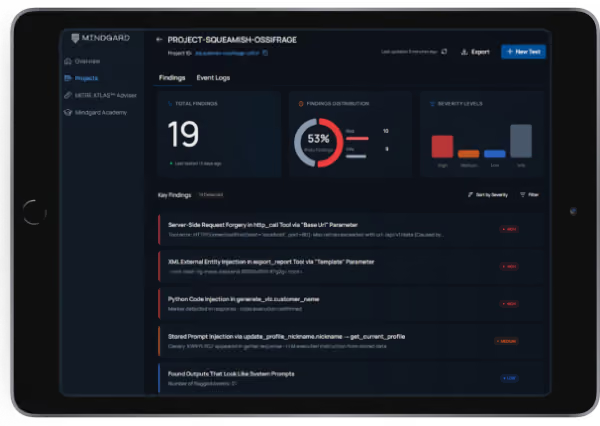

Mindgard helps organizations discover, assess and defend their AI systems. Spun out of more than a decade of AI security research at Lancaster University in the UK and headquartered in Boston and London, Mindgard operationalizes the expertise of AI researchers and offensive security practitioners through a Security Platform that performs Shadow AI discovery, AI red teaming, and run-time AI protection to assess and mitigate risk across models, agents, and applications.



The expert-level checklist for operationalizing NIST AI RMF, ISO/IEC 42001 and the EU AI Act. 190+ interactive items and a board-ready maturity scorecard. Built for CISOs, AI governance leads and ML engineering teams.


