AI-driven attacks rose 56% in a year, according to IBM's Cost of a Data Breach Report 2026. In AI security, red teaming is the offensive side: it attacks models, LLM applications and agents with prompt injection, jailbreaks, data poisoning and tool abuse to prove what an adversary can make the system do. Blue teaming is the defensive side: it monitors prompts, outputs and agent actions in production, enforces guardrails and responds when a model is pushed off policy.
The difference between AI red teaming and blue teaming is timing and ownership: red finds the exploitable failure before release, blue stops it in production and each side's output is the other's input.
Both roles come from conventional cybersecurity, but the target changes almost everything about how they work: a model is probabilistic, its attack surface is natural language and its blast radius includes every tool an agent can call. A breach that starts with an AI model inversion attack now costs $6 million on average, against a $4.99 million global average.
This guide explains what each side does for AI systems, how they differ, how red findings become blue defenses and how often to run both.
AI red teaming is adversarial testing of an AI system by a red team whose job is to make the model, application or agent do something its owner does not want.
In AI security the red team's targets are the model itself (jailbreaks, extraction, identifying vulnerabilities in the weights or training data), the application around it (direct and indirect prompt injection, system prompt leakage, retrieval poisoning) and the agent layer (tool abuse, excessive agency, MCP configuration flaws and privilege escalation through connected systems). The red team performs functions in phases: reconnaissance of the deployment, threat modelling against the OWASP Top 10 for LLM Applications and MITRE ATLAS, attack execution and a report of reproducible, ranked findings.
The method differs from conventional red teaming in three ways:
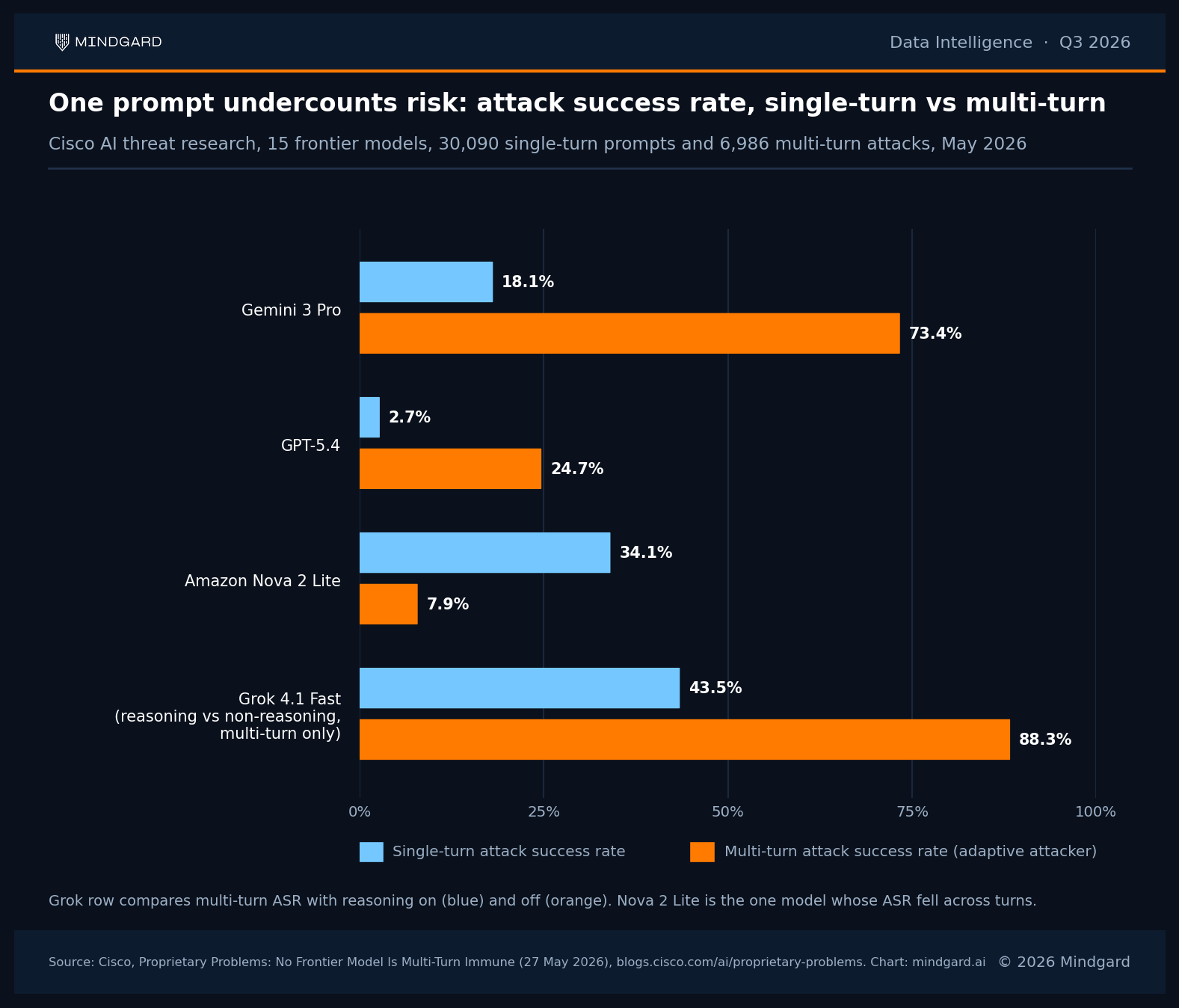
Cisco's AI threat research team tested 15 frontier models with 30,090 single-turn prompts and 6,986 multi-turn attacks and found single-turn results were not a reliable proxy for multi-turn behaviour, with gaps of up to 55 percentage points.
Cisco's AI security researchers put the case for adaptive testing in one line:
“Multi-turn evaluation matters for one reason: it is where attackers actually live. Real adversaries iterate.”
- Nicholas Conley and Amy Chang, AI threat and security research, Cisco. Cisco AI blog, May 2026.
That is the practical difference between an AI red team and a benchmark run. The red team reframes refusals, splits a task across turns and adopts personas until the model gives way, which is exactly what a motivated attacker does.
Mindgard's published vulnerability disclosures show the pattern across production systems, from coding agents to MCP configurations.
AI blue teaming is the defence of AI systems in production: detecting attacks against models, LLM applications and agents, containing them and hardening the system so the same attack fails next time.
Where a conventional blue team watches network traffic and endpoints with SIEM, EDR and intrusion detection, an AI blue team watches prompts, model outputs, retrieved context and agent tool calls. Its core controls are AI guardrails on inputs and outputs, prompt injection detection, session-level monitoring for multi-turn escalation, access control on what an agent can reach and runtime threat detection and response that can block or roll back an action before it lands.
The stakes are set by access. Gartner expects over half of successful attacks on AI agents by 2029 to exploit access control weaknesses and prompt injection. The same forecast puts spending on securing AI at $4.8 billion in 2027, a 68.7% rise on 2026.
Blue team work on AI systems therefore starts with inventory (which models, agents and tools exist, including shadow AI), moves to least-privilege for every tool an agent can call and only then to detection tuning. The blue team also owns the response playbook: what happens when a guardrail fires, when a model starts leaking system prompts or when an agent begins calling tools outside its task.
Google's threat intelligence lead argues the defender's edge is telemetry:
“When you feed this rich, multi-dimensional internal observability into security models, AI defense becomes inherently faster and more accurate than AI offense.”
- Sandra Joyce, VP, Google Threat Intelligence. Google Cloud CISO Perspectives, September 2026.
Observability is the blue team's raw material. Prompts, outputs, retrieved documents and tool calls need to be logged with enough context to reconstruct a session, because a multi-turn attack is invisible in any single record.
AI red teaming and AI blue teaming differ in objective, timing, target, tooling and output.
The table below lines the two up for AI systems specifically. The rows that matter most in practice are the last three: who owns the finding, what "done" looks like and what each side hands the other.
Red teaming and blue teaming change in three ways when the target is an AI system rather than a network:
Conventional red-versus-blue assumes a deterministic target with a defined perimeter. AI systems break both assumptions. The same prompt can succeed on the fifth attempt after failing four times, so a single clean test proves little and both teams have to think statistically.
The perimeter is wherever the model reads: an email an agent summarises, a web page a browsing tool fetches or a document in a RAG index can all carry an indirect prompt injection. OWASP's 2026 State of Agentic AI Security report maps prompt injection to six of the ten categories in its Top 10 for Agentic Applications. Gartner predicts 25% of enterprise GenAI applications will suffer at least five minor security incidents a year by 2028, up from 9% in 2025.
Microsoft's AI Red Team, after red teaming more than 100 generative AI products, summarised the consequence for both sides:
“LLMs amplify existing security risks and introduce new ones.”
- Blake Bullwinkel, Amanda Minnich, Shiven Chawla and colleagues, Microsoft AI Red Team. Lessons From Red Teaming 100 Generative AI Products, arXiv, January 2025.
For the red team that means the old playbook still applies (SSRF through a fetch tool, credential theft from an agent's environment) and a new one sits on top (jailbreaks, poisoning, extraction). For the blue team it means conventional controls remain necessary but stop being sufficient: a firewall does not read a prompt.
The Microsoft team's eighth lesson, "the work of securing AI systems will never be complete", is the argument for treating red and blue as a standing loop rather than a project.
Mindgard's own research on bypassing guardrails with invisible characters shows how quickly a blue control becomes a red target.
AI red teams and blue teams work together as a closed loop with four hand-offs.
The loop has a cadence trigger as well as a calendar. Any change to the model version, the system prompt, the retrieval corpus, the tool set or the agent's permissions reopens it, because each one changes what the model can be made to do.
Teams that automate the red side with continuous automated red teaming run the replay step on every deployment; teams that automate the blue side with runtime protection feed those results straight into policy. Some organisations label the collaboration purple teaming. The label matters less than the artefacts: a shared attack library, a detection coverage map against it and a change log that shows which attacks stopped working after which control.
Before you decide what to build next, it helps to know which side of the loop is weaker. The scorecard below asks four questions about adversarial testing and four about runtime defence, scores each side out of 12 and tells you whether your programme is red-heavy, blue-heavy, a closed loop or not yet started, with the next steps for each.
All answers stay in the browser; nothing is sent anywhere.

Eight questions, four on adversarial testing and four on runtime defence. Answer for your highest-risk model, LLM application or agent. Scores are computed from your answers only; nothing is sent anywhere.
Figures quoted in the results: Cisco, Proprietary Problems: No Frontier Model Is Multi-Turn Immune (May 2026); Gartner, securing AI market forecast (August 2026); IBM, Cost of a Data Breach Report 2026.
Should the blue team know about an AI red team exercise? Yes, that one is scheduled; no, not when it runs or which techniques the red team will use. Telling the blue team the window tests their attention; withholding it tests their controls. For AI systems the second is the more useful measurement, because most detections are automated (guardrails, classifiers, runtime policies) and an unannounced multi-turn red team campaign shows the blue team's real coverage rather than a rehearsed one.
There are two exceptions. Production systems with customer impact need an agreed kill switch and a named blue team contact who can distinguish the exercise from a live attack. Any test that touches regulated data needs the authorisation in writing from both sides before the first prompt.
After the exercise the transparency flips completely. The blue team gets every transcript, including the attempts that failed, because a technique that was blocked in a single-turn test may succeed after a persona switch or a 20-turn escalation.
Every organization that deploys a model, LLM application or agent to users needs AI red teaming; not every one needs an in-house AI red team. The obligation is increasingly written down.
NIST AI 100-2 E2025 catalogues the attacks (evasion, poisoning, privacy, misuse) that a test programme has to cover, the NIST AI Risk Management Framework expects the Measure function to include adversarial testing, ISO/IEC 42001 requires documented risk treatment for AI systems and Article 15 of the EU AI Act obliges high-risk systems to be resilient against attempts to alter their use, outputs or performance through adversarial data and model manipulation.
How to meet it depends on scale. A single internal chatbot can be covered by an AI red teaming service engagement before launch and after major changes. A portfolio of customer-facing agents needs an automated AI red teaming platform that re-runs the attack library on every deployment, with human red teamers reserved for novel targets.
Either way the blue side is not optional: once a system is live it needs AI runtime protection that turns those findings into enforced policy.
AI red team tooling splits into open-source attack frameworks (Microsoft PyRIT, NVIDIA garak, Promptfoo, DeepTeam, Giskard) that generate and score adversarial prompts and commercial platforms that add reconnaissance, agent and MCP coverage, continuous scheduling and reporting mapped to OWASP and ATLAS. We compare 41 of them in our guide to the best AI red teaming tools and the service-oriented options in top AI pentesting tools.
AI blue team tooling covers guardrail and content-safety layers (input and output classifiers, policy engines), LLM gateways that enforce authentication, rate limits and tool allow-lists, observability for prompts and tool calls and runtime detection and response that can block or roll back an action. MITRE ATLAS is the shared vocabulary: red teams tag attacks to ATLAS techniques, blue teams map detections to the same IDs and the gap between the two lists is the work. Mindgard's MITRE ATLAS Adviser does that mapping automatically.
AI red teaming finds the exploitable failures in models, applications and agents; AI blue teaming keeps them from being exploited once the system is live. The organisations that get value from either are the ones that run them as one loop, re-opened by every change to the model, prompt, data or tools and tracked against a shared attack library built on the OWASP Top 10 for LLM Applications and MITRE ATLAS.
Mindgard was spun out of a decade of AI security research at Lancaster University to run that loop end to end. Mindgard's AI red teaming as a service and automated AI red teaming platform find the attacks; runtime protection enforces the fixes in production. Book a demo to see both sides against your own AI systems.
AI penetration testing is a scoped, rules-based assessment of a defined AI system over a fixed period, producing a list of vulnerabilities. AI red teaming is objective-driven and adversarial: the team pursues a goal (exfiltrate the system prompt, make the agent call a forbidden tool) using any technique, including multi-turn and social-engineering style prompts. It reports what it achieved and how.
In short, pentesting answers "what is wrong"; red team testing answers "what can an attacker do".
AI red team members need offensive security fundamentals plus machine learning literacy:
AI blue team members need detection engineering and incident response plus the same ML literacy, so they can write guardrail policies, tune classifiers, read prompt and tool-call telemetry and tell a jailbreak from a false positive.
Blue teaming for AI is continuous: monitoring, guardrails and response run for as long as the system is in production. AI red teaming should run before every release and again after any change to the model version, system prompt, retrieval data, tool set or permissions, with a full manual campaign at least quarterly for customer-facing or high-risk systems. Automated red teaming makes the per-change retest practical by replaying the attack library on every deployment.
Purple teaming is the practice of running red and blue as one exercise, with attackers and defenders sharing findings in real time. In AI security it is the hand-off described above: red transcripts become blue controls and blue telemetry becomes red targets.
We cover the distinctions in red team vs purple team and red team vs blue team vs purple team.
The SOC is blue team. For AI systems the SOC's role extends to prompts, outputs and agent actions: triaging guardrail alerts, investigating anomalous tool calls and running the response playbook when a model is pushed off policy. Red teaming is a separate function, internal or contracted, that attacks the systems the SOC defends.
Neither works alone. An AI red team without a blue team produces findings nobody enforces; a blue team without red testing defends against attacks it has never seen. If budget forces a sequence, start with red teaming before launch to find the exploitable failures, then stand up runtime protection so the fixes are enforced, then close the loop with retests after every change.
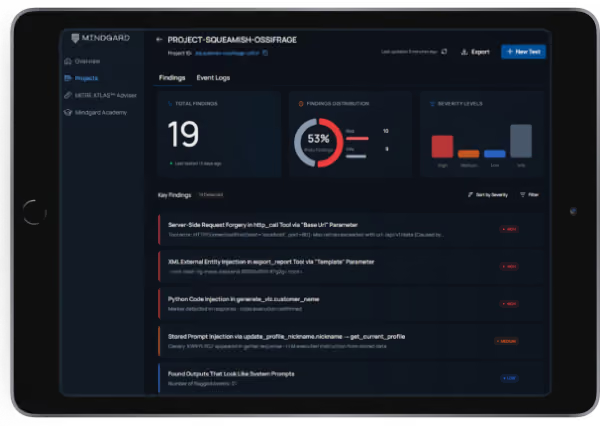
Mindgard helps organizations discover, assess and defend their AI systems. Spun out of more than a decade of AI security research at Lancaster University in the UK and headquartered in Boston and London, Mindgard operationalizes the expertise of AI researchers and offensive security practitioners through a Security Platform that performs Shadow AI discovery, AI red teaming, and run-time AI protection to assess and mitigate risk across models, agents, and applications.



The expert-level checklist for operationalizing NIST AI RMF, ISO/IEC 42001 and the EU AI Act. 190+ interactive items and a board-ready maturity scorecard. Built for CISOs, AI governance leads and ML engineering teams.


