
Prompt injection is a system-level risk that lets attackers manipulate LLM behavior by exploiting how models interpret mixed instructions across prompts, content, and tools. Mitigation requires layered controls like least privilege, adversarial testing, and strict separation of untrusted content.
Prompt injection is a system-level security risk. When successful, these attacks can cause LLMs to leak sensitive data, bypass authorization, execute unintended tool calls, or persist malicious behavior across sessions.
As LLMs are embedded into enterprise workflows, prompt injection becomes a control-plane failure, not a content issue.
Prompt injections have been around since at least 2022. Initially, these attacks against large language models (LLMs) focused on replacing trusted prompts with untrusted user input. While prompt injections have become more sophisticated, most generative AI have safeguards in place to prevent them.
Still, guardrails alone aren’t enough to prevent prompt injections. Attackers are creative, and even small changes to prompts or data sources can open new avenues for abuse. That makes prompt injection one of the most common and difficult risks to manage in LLMs.
In this guide, you’ll learn how prompt injection attacks work, the most common vulnerabilities attackers exploit, and the best practices organizations use to reduce risk.

Prompt injection works because LLMs treat all text in context as potentially actionable. These models don’t execute code. They predict the next token based on the input.
System instructions, user prompts, retrieved content, and tool output all converge into a single text stream. To the model, there’s no built-in distinction between them.
That design introduces several structural weaknesses that attackers repeatedly exploit:
Prompt injection is a structural problem. LLMs treat language as both data and control, and that makes manipulation unavoidable without external safeguards.
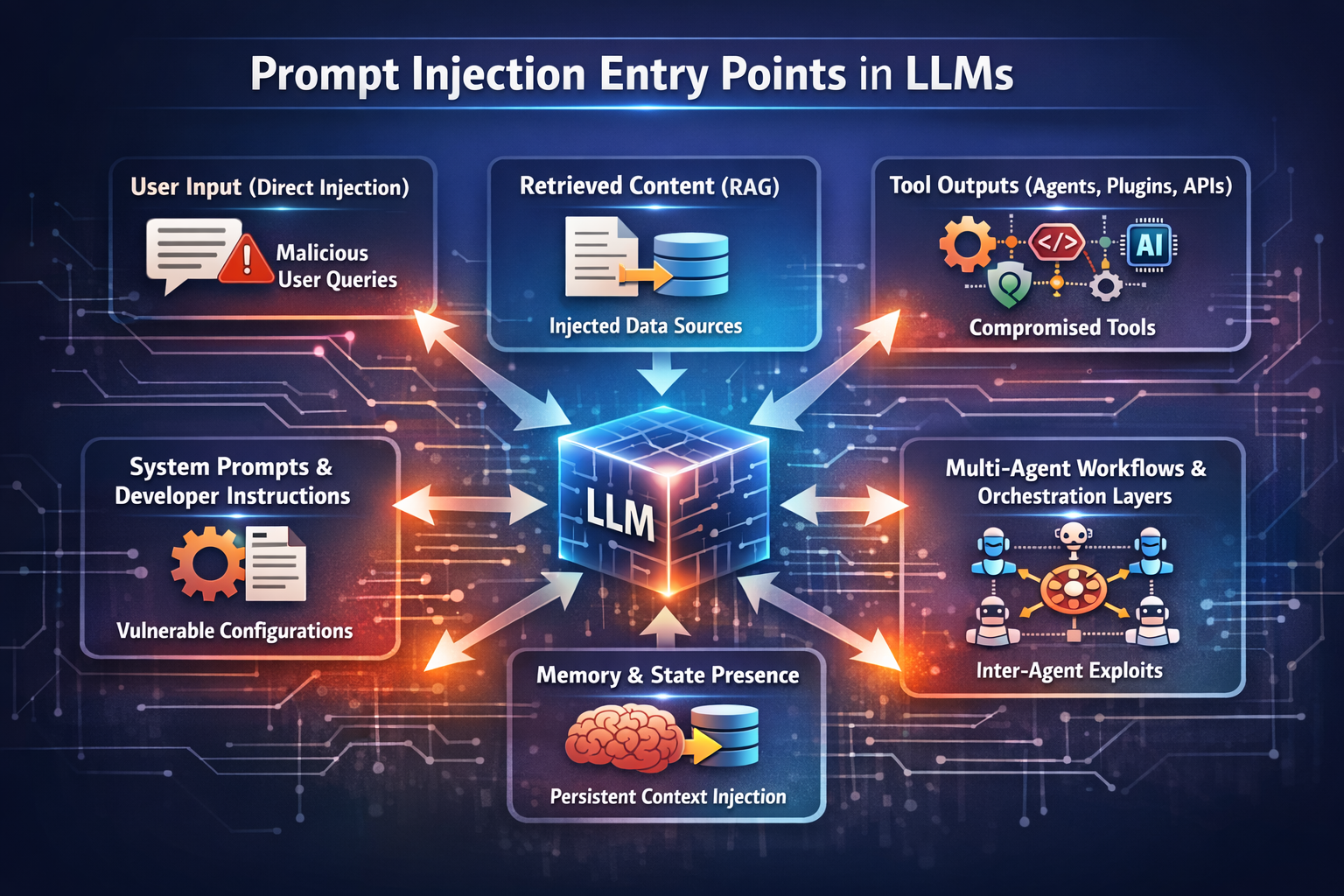
Prompt injection shows up anywhere an LLM accepts text and treats it as trustworthy. Modern systems expose many of these surfaces.
Attackers embed instructions directly into prompts, forms, messages, or uploads. The model treats the text as intent unless controls separate commands from content. This risk never disappears because user input is unavoidable.
RAG widens the attack surface fast. Articles, PDFs, internal docs, and tickets can all carry hidden instructions. If retrieved content looks official, the model has no built-in way to ignore it without application-level enforcement.
Tool responses become part of the model’s context. When those outputs guide decisions or trigger actions, a single poisoned response can cascade through the workflow.
For example, Mindgard’s technology identified vulnerabilities in the Cline coding agent where inadequately scoped agent chains and tool outputs could influence downstream behavior and execution logic, even in workflows that appeared safe.
These findings highlight that tool outputs and orchestrated agents are active attack surfaces that can be manipulated via prompt injection techniques.
If system instructions leak, get reordered, or mix with untrusted content, core behavior can shift. Models follow the strongest instruction they see, not the one developers intended.
Saved instructions turn a one-time injection into a persistent problem. The current prompt may appear clean, while its influence lingers across sessions.
Shared context and chained agents multiply injection paths. One weak boundary can steer downstream agents that trust upstream output. At that point, the failure is systemic, not just a model issue.
This risk becomes even more pronounced in standardized orchestration environments. Mindgard’s guidance on securing Model Context Protocol (MCP) servers shows how prompt injection can propagate across tools, sessions, and agents when trust boundaries are not explicitly enforced.
In MCP-based systems, injected instructions don’t stay local. They can influence downstream tools and workflows unless requests, context, and permissions are tightly constrained.
Identifying these entry points conceptually is straightforward. Identifying which ones actually exist in a live LLM deployment is much harder. Mindgard’s AI Security Risk Discovery & Assessment maps real-world LLM workflows to uncover where prompt injection can enter through prompts, RAG, tools, memory, and orchestration layers, especially paths teams often miss during design reviews.
Defenses only work when they match the full attack surface. That’s why securing the model alone doesn’t solve the problem.

What makes prompt injection especially dangerous is how sophisticated and varied these attacks have become. There are many types of prompt injection attacks that target LLMs, including:
In a jailbreaking exploit, the attacker persuades the model to break its own rules. Users typically frame requests as hypothetical situations to generate disallowed outputs.
Mindgard’s analysis of Pixtral Large Instruct showed how carefully encoded prompts could bypass safety constraints and influence model behavior, even when guardrails were in place. These findings illustrate how jailbreaking is achieved through prompt injection techniques that manipulate instruction interpretation and priority.
Prompt leaks try to extract hidden system prompts or developer rules. By carefully phrasing questions or combining them with other injection techniques, attackers can trick the model into revealing sensitive information about your organization or the model itself.
This prompt injection technique conceals malicious intent by writing instructions that replace letters with numbers, insert invisible characters, use synonyms, or split commands across lines. Attackers may also explicitly tell the model to “ignore” or “override” prior instructions in subtle ways that evade pattern-based filters.
Attackers hide malicious information in external content processed by LLMs rather than in direct user input. Webpages, documents, and emails are just some of the many avenues attackers can exploit for indirect prompt injection attacks.
Mindgard’s analysis of prompt injection attacks in DeepSeek and Copilot shows how content embedded in external workflows and deeply connected enterprise systems can steer model behavior toward unintended actions, even when those inputs are not part of the direct user prompt.
Indirect injection risk also extends beyond external content. Mindgard’s technology showed that model “leeching,” the leakage or cheap cloning of LLM skills and behavioral patterns, can expose indirect prompt injection vectors by enabling attackers to exploit leaked model logic or chained context influence.
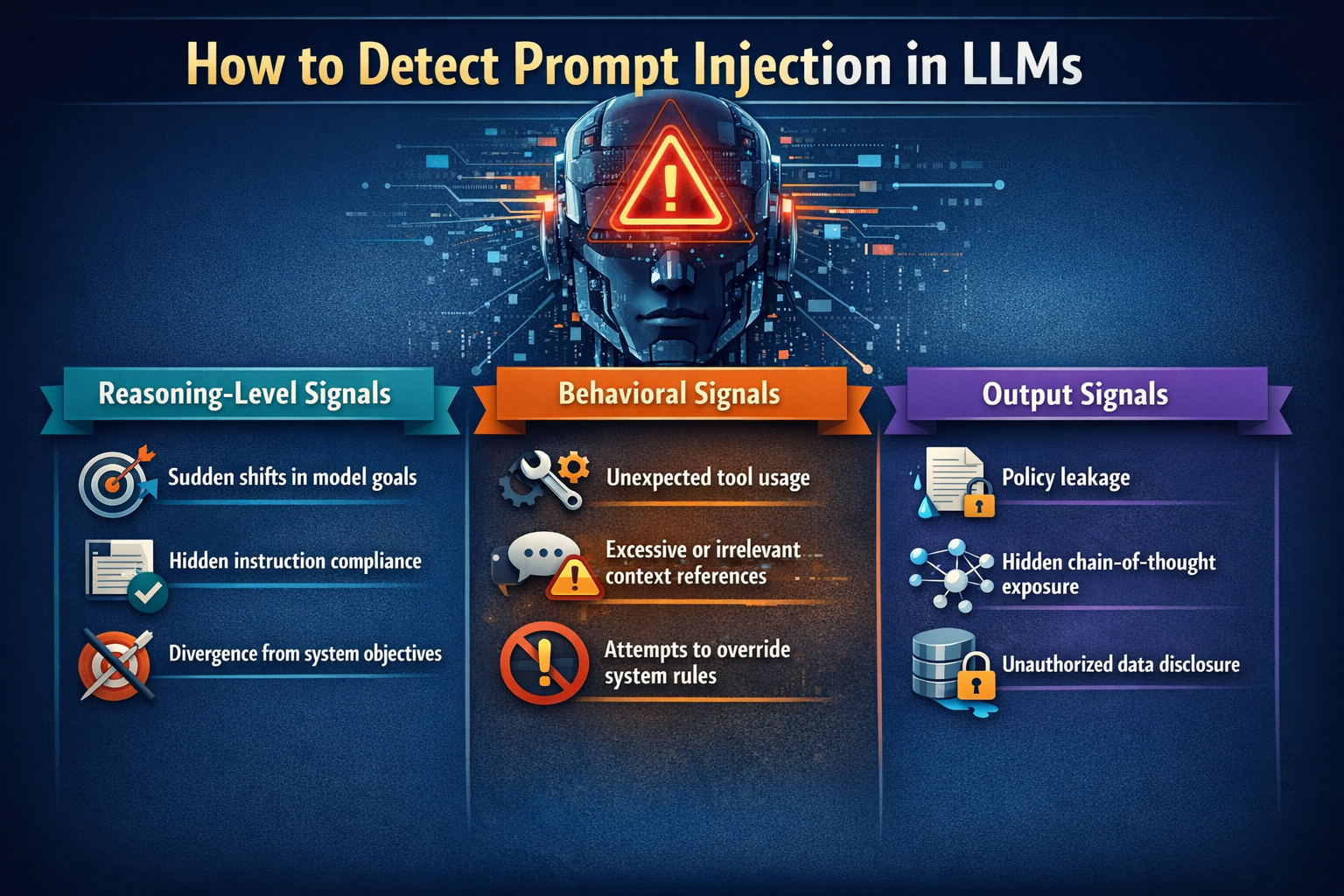
Prompt injection typically manifests as changes in intent, behavior, or output. Prompt injection detection works best when you watch all three. Here are common signals to look for.
Real-world research shows why guardrails alone are insufficient. Mindgard’s technology revealed that Azure AI Content Safety controls could be bypassed, allowing restricted outputs to be generated despite active moderation policies. This reinforces why prompt injection detection and layered defenses are critical.

It’s impossible to design an attack-proof LLM. However, developers and security teams can reduce real-world risk by applying layered controls that align with how prompt injection actually enters the system.
Primary attack surfaces addressed:
Tool outputs, agents, plugins, APIs, and automated workflows
LLMs should never have more authority than necessary. That means:
Prompt injection becomes high-impact when the model can trigger real actions. Limiting what the model is allowed to do limits how far an injected instruction can propagate.
For example, a compromised model that can only summarize text is far less dangerous than one that can call internal APIs or modify data.
Primary attack surfaces addressed:
User input, retrieved content (RAG), tool outputs, instruction conflicts
If you don’t actively try to break your own LLM, attackers will do it for you. Adversarial techniques, such as red teaming, help surface instruction conflicts, unexpected behavior, and indirect injection paths before deployment.
Because LLMs do not inherently know which text is safe to follow, testing must include:
The right tools for continuous adversarial testing can help make this process scalable, especially after model updates or new integrations.
Primary attack surfaces addressed:
Retrieved content (RAG), user uploads, emails, webpages, documents
Processing external content introduces indirect prompt injection risk. LLMs must not treat retrieved text as authoritative instructions.
Webpages, documents, emails, and user uploads should always be:
Attackers exploit ambiguity in instruction priority. Without enforced boundaries, models attempt to reconcile conflicting directives rather than rejecting malicious ones outright.
Prompt injections are a risk for any LLM. As attacks become more sophisticated, developers need to design their models with security in mind from the ground up.
What makes prompt injection especially challenging is that it doesn’t rely on a single exploit. That means traditional perimeter defenses aren’t enough.
Mindgard’s Offensive Security solution, including Run-Time AI Artifact Scanning and Continuous & Automated AI Red Teaming, is the best way to ensure your LLM guardrails are effective in the real world. Find where your model is vulnerable: Book a Mindgard demo now.
Not exactly. Jailbreaking is a type of prompt injection. Prompt injection is a type of attack that includes any attempt to manipulate an LLM’s behavior through malicious inputs.
Jailbreaks focus on persuading a model to ignore its guardrails, typically through social engineering or hypothetical framing.
Unfortunately, no. Strong system prompts are important, but they can’t prevent prompt injections by themselves.
Effective prevention requires multiple layers, such as permission controls, adversarial testing, content segregation, and monitoring.
No. Any LLM or application using LLMs is at risk of prompt injection. Since these attacks focus on the very core of how LLMs work, it’s unlikely that these models will become immune to prompt injections any time soon.
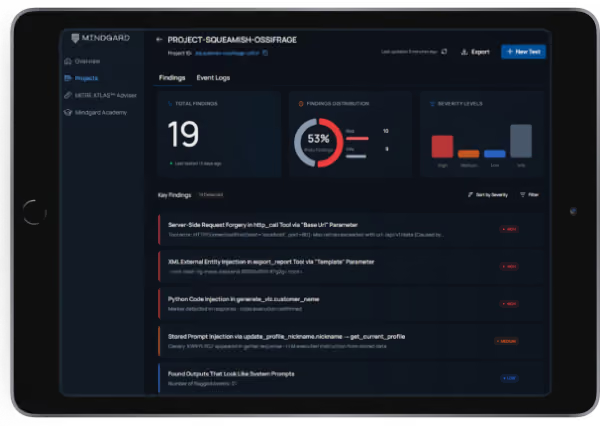

Mindgard helps organizations discover, assess and defend their AI systems. Spun out of more than a decade of AI security research at Lancaster University in the UK and headquartered in Boston and London, Mindgard operationalizes the expertise of AI researchers and offensive security practitioners through a Security Platform that performs Shadow AI discovery, AI red teaming, and run-time AI protection to assess and mitigate risk across models, agents, and applications.


The expert-level checklist for operationalizing NIST AI RMF, ISO/IEC 42001 and the EU AI Act. 190+ interactive items and a board-ready maturity scorecard. Built for CISOs, AI governance leads and ML engineering teams.


