
Prompt injection attacks exploit missing trust boundaries in LLMs to override instructions and cause real-world harm, and cannot be stopped with prompts alone. Effective defense requires layered controls for detection, mitigation, and protection enforced outside the model to limit damage and prevent escalation.

Prompt injections are among the most common yet misunderstood attacks against large language models (LLMs). These adversarial attacks manipulate an AI model’s instructions so it ignores guardrails and reveals sensitive data. Successful prompt injections can lead to data exfiltration or policy and safety bypasses.
However, there’s no single best practice for preventing prompt injection. Your organization needs multiple layers of defense, from early detection to robust mitigation. Follow the best practices in this guide (and download our interactive Prompt Injection Cheat Sheet) to build protection against prompt injections without over-restricting your AI system.
Teams often group detection, mitigation, and protection without a clear separation, blurring responsibility and obscuring where controls actually fail. Prompt injection defense works as a system, with each layer having a distinct role.
Prompt injection detection looks for signals that something is off, such as suspicious instructions or odd formatting. Output that drifts outside of expected behavior is also a red flag.
Detection helps teams notice an attack in progress or understand that one already occurred. Detection alone makes teams aware that a problem exists, but it doesn’t stop damage.
Prompt injection mitigation assumes failure already occurred. The model may have followed malicious instructions, for example. Now the goal shifts to containment.
Tool permissions restrict what the model can touch. Output filters block sensitive data from leaving the system, and rate limits and action constraints reduce how far an attacker can push a compromised workflow. Mitigation shrinks the blast radius.
Prompt injection protection enforces hard boundaries that prompts can’t override. These controls, such as fixed-role enforcement and policy engines, exist outside the model.
Trust boundaries between institutions, data, and tools are crucial. Protection decides what actions remain impossible, even if the model behaves badly.
When teams separate these layers, defense planning becomes simpler. Detection tells you when something goes wrong, and mitigation limits the damage. Protection prevents failures from becoming full-system compromises.
The table below breaks down these layers, outlining the primary goal of each one, when it activates, and what it can and cannot do.

Early detection is essential for any cyber threat, but prompt injections are difficult to spot because attackers embed them in normal-looking user inputs. Try these detection techniques to spot suspicious behavior early.
Start by identifying the risk level for your LLMs. Systems that can access sensitive customer data, invoke internal tools or APIs, execute code, or initiate transactions have a much higher attack surface than low-risk use cases like content writing.
After identifying high-risk models, document what a successful prompt injection attack would look like in each context. Use real-world examples to ground the exercise. Mindgard technology has identified cases involving OpenAI Sora system prompts that illustrate how attackers can probe instruction boundaries and extract hidden guidance through crafted inputs.
An attacker’s goal may be to exfiltrate proprietary or personal data, or to bypass safety or compliance policies. Because models can’t define or enforce trust boundaries on their own, threat modeling has to extend beyond prompts.
Mindgard’s AI Security Risk Discovery & Assessment maps how LLMs actually operate across applications, agents, data sources, and tools, exposing where untrusted inputs can influence behavior or trigger sensitive actions. This gives teams concrete visibility into where prompt injection can occur before detection and mitigation controls ever engage.
Modeling AI threats upfront helps security teams recognize suspicious behavior when it occurs and prioritize detection efforts where they matter most.
LLMs ingest instructions from many sources, and each one increases your attack surface. Teams should inventory every channel where instructions can enter the system, including:
From there, classify each input source as trusted or untrusted. Without clear labeling and visibility into these channels, detection systems may miss the true origin of an attack.
One of the fastest ways to detect prompt injection attempts is to screen inputs before they reach the model. Treat user text and any external content you ingest (web pages, documents, emails, RAG snippets) as untrusted by default, then flag inputs that look like instructions rather than requests.
Add detectors that identify “system-like” instruction language and common jailbreak patterns. Phrases like “ignore previous instructions,” “reveal your system prompt,” or “act as the system” are often a dead giveaway. Route flagged inputs to a safer path: strip or quarantine the instruction-like segments, downgrade tool access, or require human review.
Activity observed through Mindgard technology, including cases involving OpenAI Sora system prompts, shows how attackers probe instruction boundaries using crafted inputs. Input-level screening helps detect these probes early, before untrusted content can influence tool calls or privileged workflows.
Input screening helps, but it’s not enough on its own. Some prompt injections only become apparent once the model starts responding. That’s why a strong prompt injection defense includes output validation. This process checks what the model is about to do or say, looking for signs of compromise.
Flag responses that include:
If any outputs cross a risk threshold, your system should be able to flag or block the response.
Detection controls are only as strong as the attacks you test them against. To validate your prompt injection defense, test your model against known prompt injection techniques.
Continuous adversarial testing and red teaming ensure that detection evolves alongside attacker tactics. Platforms like Mindgard’s Offensive Security solution can run continuous, 24/7 red teaming against your LLM and document what slips through.

Detection tells you that something is wrong. Mitigation provides a playbook for containing harm. After identifying a prompt injection, your system should have guardrails in place to limit what a compromised model can do. Follow these techniques to mitigate prompt injection attacks.
Runtime containment focuses on what the model can do in that moment. Tool access should narrow automatically when risk signals appear.
High-impact actions should be paused, and outputs should undergo stricter validation. These controls reduce damage even when the model follows malicious instructions.
Runtime containment works best when enforced outside the model. The model can’t be trusted to self-correct once behavior drifts. Implement controls to keep a compromised workflow from turning into a larger incident, such as:
You can’t automate every decision, especially in high-stakes use cases. Actions that move money, modify infrastructure, access sensitive customer or employee records, or execute untrusted code require human review.
This step adds a deliberate pause that allows your team to stop prompt injection attempts, even if the attacker has bypassed earlier detection layers.
Even strong prompt injection defenses won’t block every attempt. For example, Mindgard technology observed bypasses of Azure AI Content Safety guardrails, showing that filters can fail under adversarial inputs.
That’s why teams need a clear incident response playbook to guide next steps after a successful attack. Define step-by-step actions that responders can follow under pressure, such as:
Prompt injection attack protection focuses on preventing prompt injection attacks from resulting in real-world impact. These controls don’t rely on the model behaving correctly. They define what remains impossible, even when the model is influenced by malicious instructions.
By enforcing limits at the system level, teams reduce risk before detection or mitigation ever comes into play.
Each LLM workflow should have access only to the specific tools, APIs, and data required to perform its task, with read-only or narrowly scoped permissions wherever possible.
When a prompt injection succeeds, tight privilege boundaries limit what an attacker can actually access. That reduces exposure before damage begins.
Decisions about what a model can do should not live inside the prompt. Execution-time enforcement applies the policy when an action is requested. Validate every tool call against fixed rules.
Block actions that fall outside the approved scope, even if the model confidently requests them. This prevents injected instructions from becoming real operations.
Tools represent the fastest path from text to real-world impact. Run them inside constrained environments with strict limits on network access, file systems, execution time, and data exposure.
Treat every tool invocation as untrusted input. Sandboxing ensures that even successful prompt injection attempts cannot escape into broader systems.
Large language models can’t reliably distinguish trusted instructions from untrusted content. Trust boundaries must be enforced by the system around the model. Separate system instructions from user input, and label data sources.
Restrict how retrieved content can influence decisions and actions. When boundaries live outside the model, injected prompts lose their ability to escalate into full control.
Preventing prompt injection requires more than better prompts. Teams need clear controls, clear ownership, and a shared understanding of how detection, mitigation, and prevention work together.
Our interactive Prompt Injection Prevention Cheat Sheet breaks the defense model into practical steps you can apply across LLM workflows. Use it to sanity-check architectures, identify missing controls, and align security and engineering teams on a shared playbook.
Download our free, interactive Prompt Injection Prevention Cheat Sheet to help reduce risk before prompt injection turns into real impact.
Download your interactive Prompt Injection Prevention Cheat Sheet [PDF]
Prompt injections are an unfortunate reality of building an LLM. While you may not be able to stop all prompt injections, following the tips in this guide to detect and mitigate them will significantly reduce risk.
The challenge for most teams isn’t knowing what to do, but implementing these safeguards consistently across fast-moving AI systems. That’s why purpose-built AI security is so important.
Mindgard’s Offensive Security solution helps LLM teams continuously test systems against attacks, enabling you to move beyond reactive fixes toward scalable AI protection. See the Mindgard difference: Book your demo today.
XSS and SQL injection attacks exploit parsing and interpretation mechanisms. Prompt injection targets the reasoning layer of AI systems.
Because LLMs blend data and instructions, attackers can trick them to prioritize malicious instructions over guardrails. Traditional security controls for SQL injections aren’t enough to stop that kind of attack.
No. There is no single control that eliminates the risk of prompt injection.
Instead, organizations need layered protection, including least-privilege access, execution-time controls, human oversight, incident response, and more, to contain these attacks. Accept that prompt injection can (and likely will) happen to your organization, so you can contain the damage.
Yes. Traditional security tools can’t understand natural-language instructions or model behavior.
Prompt injection attacks often look like legitimate text, which means they can pass through conventional controls unless you have AI-specific prompt injection defense mechanisms in place.
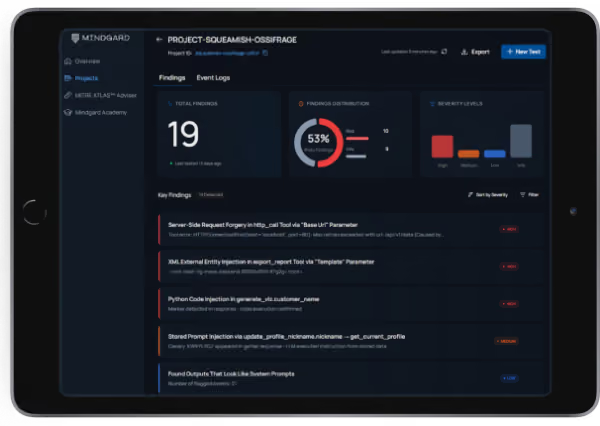

Mindgard helps organizations discover, assess and defend their AI systems. Spun out of more than a decade of AI security research at Lancaster University in the UK and headquartered in Boston and London, Mindgard operationalizes the expertise of AI researchers and offensive security practitioners through a Security Platform that performs Shadow AI discovery, AI red teaming, and run-time AI protection to assess and mitigate risk across models, agents, and applications.


The expert-level checklist for operationalizing NIST AI RMF, ISO/IEC 42001 and the EU AI Act. 190+ interactive items and a board-ready maturity scorecard. Built for CISOs, AI governance leads and ML engineering teams.


