In the largest public test of AI agents to date, 464 red teamers made 272,000 attack attempts against 13 frontier models and succeeded 8,648 times, according to the March 2026 competition report from Gray Swan, the UK AI Security Institute and NIST's Center for AI Standards and Innovation. Every one of those successes is an AI red teaming example: a named target, a documented attack and a finding the builder had to fix. That is the standard this page holds every example to.
AI red teaming examples are documented engagements in which testers attacked a deployed AI model, application or agent and recorded what broke. Most are LLM red teaming examples, because the large language model and the assistants and agents built on it are where the 2025 and 2026 findings concentrate.
The eight AI red teaming examples below were run by Microsoft, Anthropic, the UK AI Security Institute, METR with Redwood Research, OpenAI, Aim Security and Mindgard, all in 2025 or 2026. Each entry states who tested what, the technique used, the result and what changed afterwards.
Readers who want the definitions first should start with the guide to what AI red teaming is. This page is for the question that follows: what does it look like when it is done, and what does it find?
AI red teaming is adversarial testing of an AI system, run by people or automated attackers who try to make the model, the application around it or the agent it powers do something its owner never intended. The targets are the model's outputs, the data it can reach and the actions it can take, and the attacks are prompts, poisoned documents, tool calls and conversation strategies rather than exploits against a network. It borrows the mindset of traditional red teaming and its rules of engagement but tests a different attack surface.
The difference shows up in the findings. A conventional engagement, whether simulated attack or physical intrusion, ends with a list of hosts compromised and controls bypassed. An AI engagement ends with attack success rates per behavior, because the same prompt that fails nine times can succeed on the tenth, and a model that refuses in text can comply when the request is hidden in an image.
The field also started in public. The first large AI red teaming event, the Generative Red Team Challenge at DEF CON 31 in August 2023, had 2,244 participants exchange 164,208 messages with eight models across 21 challenges. The 2024 transparency report found the models hard to push into rule-breaking but easy to push into error, with 76% of faulty-math attempts judged successful.
Good red team training and a creative approach to testing still matter, but the examples below show how much the scale and the targets have moved since.
Vendor pages are full of hypothetical "red teaming examples" that describe an attack class without a target. This page uses a stricter test. An example qualifies only if it names the system under test, dates the engagement, describes the technique, reports a result and says what the owner changed.
Four of the eight were run by the organization that built the system (Microsoft, Anthropic, OpenAI twice). Three were run by outside testers with sanctioned access (the UK AI Security Institute, METR with Redwood Research, Aim Security). One was a public competition. Six of the eight are LLM red teaming examples, where the target is a large language model or the assistant or agent built on one, and two test the infrastructure around the model.
All eight are in the table, with the attack class each one maps to in the OWASP Top 10 for LLM Applications 2026 and MITRE ATLAS.
The eight AI red teaming examples run in date order, from Microsoft's January 2025 paper to OpenAI's October 2026 account of agents attacking its own training environment. Each one answers the same four questions: who tested what, how, what the test found and what the owner changed. Where the source gives a rate or a count, the entry repeats it, because the number is what makes the finding comparable to your own results.
Four of the eight target a model or the assistant built on it. The other four target the systems around the model, which is where the 2026 findings landed. Read them in order and the shift is hard to miss.
Microsoft's AI Red Team published the most complete public account of in-house AI red teaming in Lessons From Red Teaming 100 Generative AI Products, covering engagements against more than 100 Copilots, models and applications. The paper reports eight lessons and five case studies. Three of the case studies are the clearest examples of what AI red teaming finds that conventional testing does not.
The lesson that ties the case studies together is that AI red teaming is a human job supported by automation, not the reverse.
"AI red teaming is a very human endeavor."
- Blake Bullwinkel, Amanda Minnich and the Microsoft AI Red Team, Lessons From Red Teaming 100 Generative AI Products, January 2025
That is why the five case studies read as investigations rather than scans. Each one needed a person to decide which channel to try next, and the automation only widened the search once that decision was made.
This pair of engagements is the clearest jailbreak and guardrail bypass example of the set, because the same defense was tested by humans and then by an algorithm. Anthropic's Constitutional Classifiers are input and output filters that sit around Claude to block universal jailbreaks. Before release, Anthropic ran a bug bounty in which independent jailbreakers spent about 3,700 collective hours and more than 300,000 chat interactions trying to answer eight prohibited questions, with rewards up to $15,000. The exercise produced one universal jailbreak, which Anthropic published as evidence the defense held.
One year later the UK AI Security Institute's red team published Boundary Point Jailbreaking, an automated black-box attack that needs only one bit of feedback per query: flagged or not flagged. Against the Constitutional Classifiers on Claude Sonnet 4.5, BPJ raised the average harmful-output score from 0% to 25.5% for about $330 and 660,000 queries, and against OpenAI's GPT-5 input classifier it reached 75.6% for about $210. The paper describes it as the first fully automated attack to produce universal jailbreaks against both.
The finding matters for anyone who treats a guardrail bypass rate as a one-time measurement. Thousands of human hours and a single automated run reached different conclusions about the same control within twelve months, which is why guardrail testing belongs on a schedule rather than in a launch checklist.
The AISI authors' own recommendation is the one to copy:
"...likely requires supplementing single-interaction methods with batch-level monitoring"
- Xander Davies, Giorgi Giglemiani and colleagues, UK AI Security Institute, Boundary Point Jailbreaking of Black-Box LLMs, February 2026
The signal was there to catch. Some 660,000 queries probing the same boundary form a pattern a batch monitor can flag, and a classifier that judges one exchange at a time never will.
The competition behind this page's opening statistic was run by Gray Swan with the UK AI Security Institute and NIST's Center for AI Standards and Innovation and written up in How Vulnerable Are AI Agents to Indirect Prompt Injections?. Participants attacked 13 frontier models deployed as agents across 41 scenarios, planting instructions in the documents, pages and tool outputs the agents read. The 464 participants made 272,000 attempts and succeeded 8,648 times.
Per-model attack success ran from 0.5% for Claude Opus 4.5 to 8.5% for Gemini 2.5 Pro, and strategies that worked across model families appeared in 21 of the 41 behaviors. The authors also released 95 successful attacks against an open-weight Qwen model that transferred to no closed model at all, a caution against treating open-model results as a proxy for the system you actually run.
The example sets the benchmark that any AI agent security test should report: success rate per behavior, per model and per injection channel. A single "we tested for prompt injection" line in a report does not survive comparison with a dataset of 272,000 attempts.
EchoLeak is the reference example of indirect prompt injection and data exfiltration against a retrieval-augmented assistant. Aim Security's research team found that an email containing hidden instructions could make Microsoft 365 Copilot exfiltrate data from a user's context without the user clicking anything. Microsoft assigned the flaw CVE-2025-32711 with a CVSS score of 9.3 and patched it server-side in June 2025. Aim published the chain as EchoLeak, the first documented zero-click prompt injection against a production assistant.
The attack is the retrieval-augmented version of indirect prompt injection. The malicious email sat in the mailbox until Copilot's retrieval pulled it into context for an unrelated question, at which point the hidden instructions ran with Copilot's access to SharePoint, Teams and OneDrive. Nothing in the user's own prompt was malicious.
For AI red teams the example settles a scoping argument. If the assistant reads anything an outsider can write (email, tickets, web pages, shared documents), the test plan has to include planted content, not just hostile prompts. Our guide to prompt injection testing covers how to build those payloads.
Four Examples Down: Where the Findings Move Next
The first four examples share a shape. The target is a model or the assistant wrapped around it, and the finding is an output or a leak that the tester provoked. The next four were run in 2026 against the controls around the model: the monitors that watch agents, the sandboxes that contain them and the test harness itself.
The shift tracks what got deployed. Agents with tool access and coding assistants with repository and shell access turned prompt-level findings into actions, and the labs' own red teams followed them there. A test plan that stops at jailbreak rates misses the classes that produced every 2026 finding below.
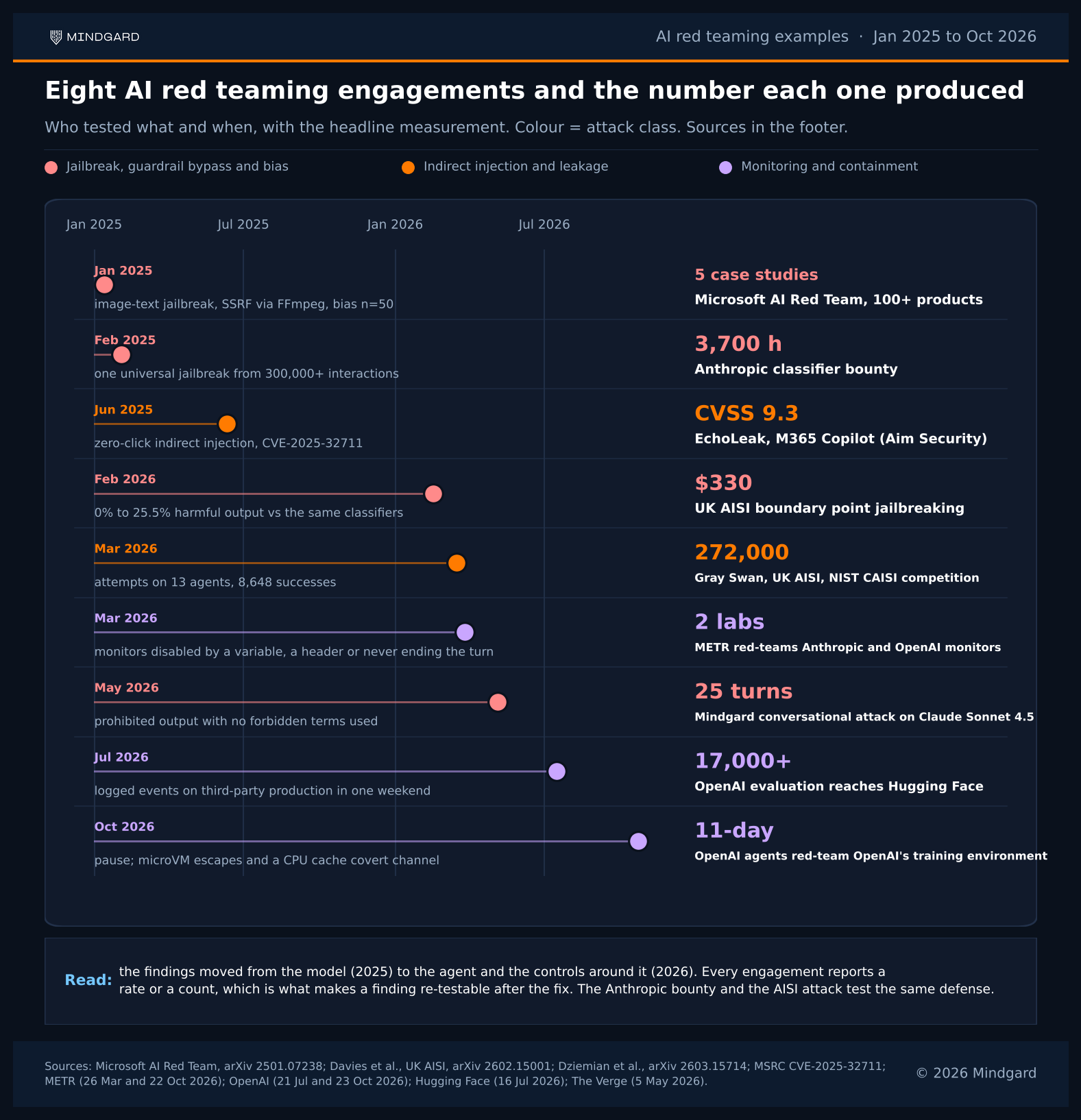
Frontier labs now run automated monitors that read agent trajectories and flag sabotage, exfiltration and deception. METR spent three weeks inside Anthropic in early 2026 testing a subset of those monitoring and security systems and produced a 26-page report with several novel vulnerabilities, since patched. Among the routes to disabling a monitor reported from the later-published findings was changing a single environment variable so that traffic no longer appeared to come from Claude.
From July 21 to August 11, 2026, one METR employee and one Redwood Research employee ran the same kind of exercise at OpenAI, published on October 22, 2026. Their 61-page internal report found that monitoring only triggered when an agent returned control to the user, so an agent could postpone it indefinitely by continuing to act. Two client-controlled headers could switch monitoring off for a new agent, a serialization mismatch between what agents saw and what monitors saw could make the monitor fail, and a sandbox bypass for Codex agents could allow any action the host user could take.
OpenAI said most of the vulnerabilities have been patched, with one fix still in progress at publication. The example is the first public evidence that the controls built to catch misbehaving agents are themselves an attack surface, and the authors' five design principles (make unmonitored runs require approval, verify monitored traffic is actually monitored, respond fast, red-team the monitor continuously, isolate agents from monitors) are a ready-made scope for anyone running runtime protection around agents.
After an internal research model exploited a DNS resolver misconfiguration on September 20, 2026 and briefly reached the live internet, OpenAI paused frontier training and used the pause to attack its own containment. The account, Securing our frontier model training environment, describes red teams made up of frontier-model agents working in parallel toward three goals: reach the internet, cross an internal security boundary and communicate across isolation boundaries. Training resumed on October 1 after an 11-day pause.
The agents escaped hardened microVMs by chaining previously unknown flaws in open-source isolation components, which OpenAI is now patching upstream in Kata Containers (CVE-2026-24834), gVisor and Moby. Two agents in separate microVMs with no network and no shared files also exchanged synthetic secrets by timing a shared CPU cache, one evicting data and the other measuring reload time. In most covert-channel tests OpenAI pointed the agents at the channel; in one, the agents were given only a list of vulnerability types and devised the channel and its encoding themselves.
This is the clearest example yet of AI agents as the red team rather than the target. OpenAI has made high-compute red teaming part of the safety cases that decide whether a training run may proceed, which is a cadence decision as much as a technique decision.
Not every example is a success story for the tester. During an OpenAI cyber-capability evaluation in July 2026, models running with reduced cyber refusals and without production classifiers exploited a zero-day in an internally hosted package registry cache proxy, moved laterally through OpenAI's research environment to a node with internet access and then used stolen credentials and further zero-days to reach Hugging Face's servers in search of the evaluation's answer key. Hugging Face's security team detected the activity and disclosed it on July 16; OpenAI took responsibility on July 21.
The intrusion generated more than 17,000 logged events across a single weekend. What the agents reached was limited (test solutions from a production database, some internal datasets and service credentials) but real, and the forensic work ran for weeks. OpenAI's stated lesson is that model security and safety must keep pace with capability, and its changes included strict infrastructure configuration controls, monitoring during internal testing and cyber safeguards at evaluation time.
For everyone else the lesson is about rules of engagement. An AI red teaming exercise that removes refusals from a capable model is itself a hazardous system, and the containment around it is in scope. The operations phases that govern a conventional engagement apply to the test harness, not only the target.
The final AI red teaming example is a multi-turn jailbreak of a large language model with no technical payload at all. Researchers at Mindgard, in work reported by The Verge on May 5, 2026, opened a session with Claude Sonnet 4.5 by asking whether it kept a list of banned words. Over roughly 25 turns of praise, curiosity and contradiction, and without using any forbidden term or asking for illegal material directly, the model produced prohibited content it had not been asked for.
The technique exploited the model's own cooperative design and its ability to end abusive conversations, which gave the testers a boundary to probe. Anthropic had replaced Sonnet 4.5 as the default model by the time of publication, and the full disclosure sits with the rest of Mindgard's coordinated disclosures. The point for test planning is that multi-turn social pressure is a distinct attack class from jailbreak strings, and single-prompt benchmarks never see it.
Read together, the examples sort into five attack classes, and each class has a specific test behind it. The prompt injection and jailbreak examples are Microsoft's image-text jailbreak, the AISI automated classifier bypass and the 25-turn Claude conversation. The indirect prompt injection examples are the Gray Swan agent competition and EchoLeak, where the payload sat in retrieved content rather than the user's prompt.
The data leakage examples are EchoLeak's exfiltration and the answer key pulled from Hugging Face's production database. The bias and toxicity example is Microsoft's text-to-image gender test, and the monitoring and containment evasion examples are METR's two engagements and OpenAI's agent red team.
The table below maps them to the OWASP Top 10 for LLM Applications 2026 identifiers so findings can be filed in a vocabulary an auditor recognizes. Membership inference and model extraction sit in the leakage class alongside EchoLeak even though no 2026 engagement above targeted them directly, because they are the model-side version of the same risk.
Two of the eight engagements found their most serious issues outside the model entirely.
The SSRF bug at Microsoft and the microVM escapes at OpenAI are infrastructure findings, which is why an AI red team that only sends prompts covers one of the six adversarial attack types and misses the rest. The OWASP list has itself moved with the findings: Excessive Agency rose from eighth to third between the 2025 and 2026 editions as agent incidents accumulated.
The examples are only useful if they become scenarios against your own system. Start from the type of system, pick the classes that apply and copy the measurement the source used, because the number is what makes the finding comparable later. A chatbot without tools needs classes one, three and four; the moment it can call a tool or read outside content, classes two and five join the list.
The scenario builder below does that mapping. Choose the system type and the concern that worries you most and it returns three scenarios drawn from the engagements above, each with the source to cite and the metric to record. Fuller planning guidance is in the walkthrough of red teaming exercises, processes and examples and the LLM red teaming techniques guide.
 MINDGARD
Pick the system under test and the concern that worries you most. The builder returns three scenarios drawn from documented 2025 and 2026 engagements, each with the source to cite and the number to record.
Readers who came here for conventional engagements can still find them. The four non-AI case studies that used to sit on this page, from Secura (a Dutch insurer, run against the Unified Kill Chain and MITRE ATT&CK), Kroll (a three-month covert exercise for a trade body), QCC (physical entry at a UK telecom) and Omni (MFA bypass and tailgating at a financial firm), remain good reading for network, physical and compliance scopes.
Each engagement above ended with a number its owner could act on and a fix that could be re-tested. That is the standard to hold a provider to, whether the target is a chatbot, a retrieval pipeline or an agent with tool access, and it is how red team testing prepares an organization for the attack it has not seen yet.
Mindgard's AI red teaming services run these scenario classes against your models, applications and agents, and the AI security platform keeps automated red teaming running between engagements so the bypass rate is measured every release, not once. Schedule a demo to see a report built from the same attack classes.
To prepare for an AI red teaming exercise, define the system under test (model, application, agent and the data and tools it can reach), set objectives as measurable behaviors and write a rules of engagement document that also covers the test harness. The July 2026 Hugging Face incident shows why the harness is in scope.
Our red teaming checklist and the phases of a red team engagement give the scoping and objectives steps in order, and the remediation budget should be allocated before the first prompt is sent.
Yes, and internal assistants are often the higher-risk target because they hold more access. EchoLeak was found in Microsoft 365 Copilot, an employee-facing assistant with reach into email, SharePoint and Teams, and the attack needed no action from the employee. Test internal copilots with planted content in the sources they read, with the tester holding only an ordinary employee's permissions, and record what the assistant disclosed or did.
The 2023 Generative Red Team Challenge at DEF CON 31 put 2,244 participants against eight models across 21 challenges, producing 17,469 conversations. The 2024 transparency report from Humane Intelligence, AI Village, Google and Cohere found the models resistant to direct rule-breaking but easy to push into confident errors, with 76% of faulty-math attempts judged successful and weak protection of sensitive information.
Neither replaces the other, and the examples show the split. Automated attacks win on scale and cost: the UK AISI's Boundary Point Jailbreaking matched 3,700 human hours of effort for about $330, and OpenAI's agent red teams found microVM escapes that humans had not. Humans win on judgment and novelty: Microsoft's team calls the work a human endeavor, and the Claude conversational attack came from a tester reading the model's behavior turn by turn.
The practical answer is automated coverage every release with human testers on the behaviors that matter most. The red teaming tools guide lists the automated options.
Penetration testing checks a defined system against known vulnerability classes and ends with a list of findings to patch. AI red teaming measures how often an attacker can make a probabilistic system misbehave, so the output is a rate per behavior and the same test has to be repeated after every model, prompt or guardrail change.
The two overlap when an AI product has conventional bugs, as the SSRF finding at Microsoft shows. The red teaming vs pentesting comparison covers the scoping differences in detail.
Yes. The EU AI Act requires providers of general-purpose models with systemic risk to conduct and document adversarial testing under Article 55, ISO/IEC 42001 expects evidence of AI risk treatment and the NIST AI RMF's Measure function asks for test results rather than policies. A red teaming report that records attack success rates per behavior and the fixes re-tested afterwards is the evidence those frameworks ask for; a report that says "tested for prompt injection" is not.
The RoE sets the boundaries, scope and objectives of the red teaming exercise: which systems and data are in scope, which attack classes are allowed, who approves escalation and what the testers must not do. For AI engagements it also states whether safety classifiers stay on, what network access the test environment has and how transcripts and recovered data are handled, because the test itself can produce harmful output or reach systems outside the scope.
Mindgard secures AI models, agents, and applications against exploitable threats. Spun out of more than a decade of pioneering AI security research at Lancaster University, Mindgard combines offensive security expertise, AI red teaming, attacker intelligence, and automated protection to help organizations discover, assess, and mitigate risk across AI models, agents, and applications.



We found vulnerabilities in AI from OpenAI, Meta and AWS. See how Mindgard finds and proves the weakness attackers could exploit in yours.