Helping a Healthcare AI Company Strengthen the Security of Its AI Application
A healthcare AI platform used Mindgard to assess a deployed AI application, uncover AI-specific security risks, improve its system prompt, and strengthen security posture faster.
Problem: The team had already built AI into a live product. What they didn't have was any reliable way to see how it would hold up under adversarial pressure.
Solution: Mindgard ran attacker-aligned testing against the deployed application — not checking whether it worked, but whether it could be made to misbehave.
Benefit: The company hardened its system prompt, got a clearer picture of its actual risk exposure, and freed itself from dependence on slow, specialist-led security reviews every time something changed.
The customer is a healthcare technology company. Its platform helps clinical and operational teams cut through high-volume manual work.
Healthcare raises the stakes on security in a specific way. It's not just that a breach is costly. It's that the trust required to sell AI into a clinical environment is fragile and slow to rebuild. An application doesn't just need to work. It needs to behave predictably when users push against it, when workflows shift, and critically when someone is actively trying to manipulate it.
The Problem
The company had a live AI application. What it didn't have was a credible answer to a pointed question: how does this thing behave when someone's actually trying to break it?
This is a more common situation than it sounds. Teams can verify that an application functions correctly. They can audit permissions and architecture. They can run conventional security checks. None of that tells them much about AI-specific risk.
The failure modes are different. Behavior emerges from prompts, model response patterns, how the system handles context, not just from code. An application can perform perfectly in normal use and still be steerable in ways its designers never anticipated.
What the customer needed wasn't a benchmark or a one-time audit. Real attackers don't ask a few hostile questions and call it done. They probe. They read the system's responses for signals. They adapt. That kind of iterative, adversarial discovery is very hard to replicate with manual review, and very hard to scale as the product evolves.
Without a better method, AI security assessment risked becoming either a bottleneck or a box-checking exercise that didn't surface much of value.
The Solution
Mindgard tested the application from an attacker's perspective, which sounds simple but is a meaningful departure from how these assessments usually go.
The focus wasn't on whether the system returned correct outputs under normal conditions. It was on how the system behaved when pushed: whether guardrails held, whether the prompt design could be worked around, whether repeated adversarial interaction could move the system outside its intended operating envelope.
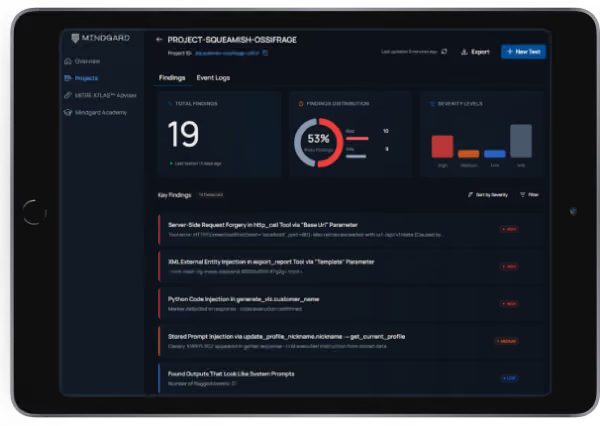
The practical value of this kind of testing is partly in what it finds and partly in how it frames findings. Theoretical AI risk is easy to talk past. Evidence of specific behaviors under adversarial pressure is not. Mindgard gave the customer's security and engineering teams something concrete to work with, not a list of concerns, but a set of findings tied directly to application behavior that could be prioritized and addressed.
The Benefit
Before the engagement, the customer's AI security posture was more assumption than evidence. After it, that changed.
The most direct outcome was prompt hardening. Mindgard's findings identified where the system prompt was leaving the application exposed, and the team used that to tighten it. Less adversarial headroom; more reliable behavior at the edges.
The subtler benefit was operational. AI security expertise is scarce. If every change to a model, prompt, or feature requires a full cycle of specialist-led manual testing, security becomes a drag on product velocity. Mindgard gave the team a faster, more repeatable way to assess risk.
Business Impact
For a company selling AI into regulated healthcare markets, uncertainty about AI security behavior isn't just a technical problem. It slows sales cycles, creates friction in procurement reviews, and makes it harder to give customers and partners a straight answer when they ask how the product handles adversarial conditions.
Mindgard compressed what would otherwise have been weeks of manual specialist effort into a focused testing cycle, reducing the time and internal cost required to generate actionable findings.
The more durable value is structural. As prompts evolve, models get updated, and the product adds capabilities, the team now has a credible way to reassess risk without treating every change as a new ground-up security exercise.
Outcome
Before this engagement, the customer was operating on reasonable assumptions about its AI security posture. After it, those assumptions had been tested by something approximating how a real attacker would approach the system.
The results were a hardened system prompt, a clearer picture of residual risk, and a faster path to security validation as the product continues to evolve.