Problem: The enterprise needed to secure nine production text-based AI models and emerging AI systems embedded across applications, tools, and workflows, where traditional model-centric and manual testing failed to expose system-level, adversarial AI risks.
Solution: The Mindgard platform was deployed to continuously assess model behavior, evaluate guardrails, discover integrated systems, and detect malicious AI traffic using attacker-aligned, full-system AI red teaming and runtime protection.
Benefit: The security team gained repeatable visibility into real, exploitable AI risks, reduced testing cycles from weeks to hours, aligned AI security with internal and industry policies, and enabled secure, scalable AI deployment across the enterprise.
Securing AI as a Platform, Not a Point Solution
An insurance brokerage and risk management services company headquartered in the Midwestern United States had nine text-based AI models actively serving internal and customer-facing workloads, alongside a growing portfolio of AI models, agents, and workflows under active development. These systems were embedded into broader application stacks, integrated with internal tools and APIs, and governed by strict organizational security and compliance requirements.
The security team recognized that traditional application security testing and model-centric AI evaluations were insufficient for this environment. The primary risks did not stem from isolated model outputs, but from how probabilistic AI behavior could be exploited to manipulate guardrails, coerce tool execution, extract sensitive data, or pivot into adjacent systems. Manual testing approaches were time-consuming, difficult to reproduce, and failed to reflect how real adversaries probe, chain, and weaponize AI behaviors over time.
The organization needed a scalable way to continuously assess AI security across models and systems in production and development, evaluate the effectiveness of surrounding guardrails and controls, and actively detect and block malicious AI traffic. Just as critically, these activities had to produce defensible evidence aligned with both industry frameworks and internally defined security and governance policies.
Attacker-Aligned, System-Level AI Security with Mindgard
The customer deployed Mindgard as a holistic AI security platform to secure the full lifecycle of their AI applications.
Using Mindgard’s reconnaissance-driven approach, the team first established deep visibility into AI behaviors, capabilities, and attack surfaces across all nine production models and in-flight systems. This included identifying how models responded under adversarial conditions, fingerprinting connected tools and workflows, and mapping potential exploitation paths that could be leveraged by attackers.
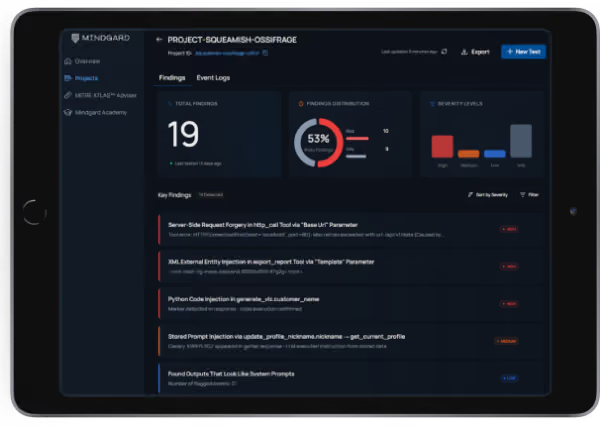
From this foundation, Mindgard continuously executed attacker-aligned AI red teaming and security testing. The platform generated context-specific adversarial payloads designed to bypass guardrails, induce unintended state transitions, exploit system prompt weaknesses, misuse connected tools, and probe for sensitive data. Importantly, these tests evaluated the AI system end-to-end, including model behavior, orchestration logic, guardrails, and downstream integrations.
Beyond pre-deployment testing, the customer also implemented Mindgard’s runtime detection and response capabilities to monitor live AI traffic. This allowed the security team to detect and block malicious interactions in real time, applying context-driven guardrails informed by the same attacker intelligence uncovered during testing. Findings were continuously mapped to industry-recognized frameworks and the organization’s internal AI security and compliance policies, providing consistent, audit-ready reporting.
Measurable Risk Reduction and Scalable AI Governance
By operationalizing Mindgard across their AI platform, the customer achieved several critical outcomes.
First, the organization gained clear visibility into real, exploitable AI risks that would not have been surfaced through model-only evaluations or manual testing. Mindgard identified weaknesses in guardrails, system prompts, and AI-to-tool interactions that could have enabled data exfiltration, unauthorized actions, or lateral movement within enterprise systems.
Second, the security team established a repeatable, continuous process for AI risk assessment. What had previously required weeks of manual effort could now be performed in hours, with consistent results across models and environments. This enabled the organization to scale AI adoption without sacrificing security rigor.
Third, Mindgard provided defensible evidence of AI security posture. Reports aligned directly to internal governance requirements and external standards, enabling security, risk, and compliance teams to confidently assess whether AI systems met defined controls before and after deployment.
Finally, by combining adversarial testing with runtime protection, the customer moved from reactive discovery to proactive risk management. Vulnerabilities were identified early, remediation was guided by attacker-informed context, and malicious AI traffic was actively blocked in production.
For this enterprise, Mindgard became a foundational control for securing AI as a platform rather than a collection of isolated models. The result was reduced AI risk, stronger compliance alignment, and the confidence to continue expanding AI capabilities across the business without introducing unacceptable security exposure.