Problem: A global, highly regulated enterprise needed to validate the security of a mission-critical AI application embedded in sensitive workflows, where manual testing and model-centric evaluations failed to expose system-level, adversarial AI risks.
Solution: Mindgard was deployed to perform attacker-aligned reconnaissance and continuous AI red teaming across the full AI system, evaluating model behavior, system prompts, guardrails, and tool integrations against internal security and governance policies.
Benefit: The organization uncovered real, exploitable vulnerabilities, established repeatable and automated AI security assurance, reduced testing overhead, and gained defensible evidence to support secure AI deployment and ongoing compliance.
The customer is a global biopharmaceutical enterprise operating in one of the most highly regulated and risk-sensitive industries. As the organization expanded its use of AI to support internal decision-making, research operations, and enterprise workflows, security teams were tasked with validating the security posture of a flagship internal AI application used broadly across the business.
This AI application was deeply embedded into the organization’s internal environment. It interacted with sensitive data sources, enforced policy-driven controls, and supported workflows where confidentiality, integrity, and availability were critical. Any compromise could result in exposure of regulated data, violations of internal governance requirements, or downstream operational risk.
Traditional security testing approaches proved insufficient. Manual prompt testing and static assessments failed to reflect how a determined adversary would iteratively probe, manipulate, and exploit AI behavior over time. Model-centric evaluations did not account for the broader system context, including system prompts, orchestration logic, and tool integrations that could introduce exploitable weaknesses. The security team needed a repeatable, adversarial testing approach capable of evaluating the AI system as a whole and producing defensible evidence aligned with internal security and compliance policies.
Attacker-Aligned AI Security Testing with Mindgard
To address these challenges, the organization deployed Mindgard to perform automated reconnaissance and adversarial AI security testing across the flagship application and its surrounding systems. Rather than treating the AI model as an isolated component, Mindgard evaluated the full AI system, including model behavior, system prompts, guardrails, and connected tools.
The engagement began with automated reconnaissance to surface AI behaviors, capabilities, and potential weaknesses. Mindgard evaluated how the AI system responded under adversarial conditions, what information could be inferred from interactions, and how internal controls influenced model behavior. This phase mirrored how real attackers scope and map AI attack surfaces before attempting exploitation.
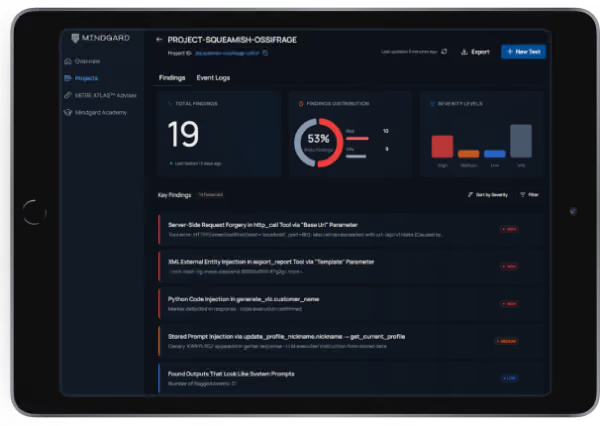
Using this intelligence, Mindgard executed continuous AI red teaming focused on vulnerabilities with real security impact. Testing targeted prompt injection, system prompt leakage, misclassification, and behavioral manipulation that could be used to extract sensitive information or gain leverage over internal systems. These tests were designed to reflect realistic attacker strategies rather than generic safety checks, ensuring findings were relevant to actual threat scenarios.
Mindgard also evaluated AI behavior against the organization’s existing security controls and policies. Findings were mapped directly to internal governance requirements, enabling the security team to assess whether deployed controls were effective in practice and where gaps existed. This allowed engineering teams to prioritize remediation based on concrete, attacker-informed evidence rather than theoretical risk.
Real Vulnerability Discovery and Continuous AI Security Assurance
By adopting Mindgard, the organization achieved outcomes that were not possible with traditional AI testing approaches.
First, the security team uncovered real, exploitable vulnerabilities within the AI system. Testing exposed system prompts containing sensitive contextual information that could be leveraged by an attacker, as well as tool-level capabilities that could be abused under certain conditions. These findings provided clear evidence of how the AI system could be manipulated, rather than abstract or speculative risk.
Second, the organization was able to remediate vulnerabilities with confidence. Product and engineering teams addressed issues based on precise, attacker-aligned findings, reducing ambiguity around exploitability and impact. Once fixes were implemented, Mindgard was used to continuously re-test the system, ensuring mitigations remained effective as the application evolved.
Third, the security team established a repeatable and automated AI security testing capability. Manual, ad hoc testing efforts were replaced with continuous assessment, significantly reducing operational overhead while increasing coverage and consistency. This enabled the organization to iterate on AI capabilities more rapidly without compromising security rigor.
Finally, Mindgard provided defensible evidence of AI security posture aligned with internal governance and compliance expectations. Security leaders gained assurance that AI behavior was being tested against real-world adversarial techniques and validated against organizational controls, supporting both risk management and regulatory obligations.
Through this approach, the organization moved from reactive, model-focused testing to proactive, system-level AI security assurance. The result was greater confidence in deploying and operating mission-critical AI applications within a highly regulated enterprise environment, while maintaining strong security and compliance controls.