
Prompt injection attacks exploit LLMs’ lack of trust boundaries, allowing malicious instructions to override safeguards in ChatGPT, especially in RAG and agentic systems. Reducing risk requires layered defenses such as policy enforcement, prompt hardening, continuous testing, and output filtering.
ChatGPT processes over two billion queries every day, making it one of the most popular chatbots in the world. However, this tool is far from secure. Prompt injection attacks are a common but dangerous risk for any chatbot.
Large language models (LLMs) can’t reliably distinguish between instructions they’re supposed to follow and malicious text from an attacker. That makes them uniquely vulnerable to manipulation.
While the benefits of LLMs still outweigh the risks, you must understand how to prevent prompt injections. Learn common examples of prompt injection attacks in ChatGPT and how to avoid these issues with your own chatbot.
Unfortunately, yes. All LLMs are vulnerable to prompt injections. Previous versions of ChatGPT (particularly GPT-4 at launch) were prone to these attacks. OpenAI dedicates significant resources to safety research and defenses, but no LLM is fully immune to prompt injection attacks.
Prompt injections happen when a user intentionally tries to manipulate the model’s behavior, usually by:
Because LLMs treat all text as part of the same sequence, it’s hard for them to distinguish between real instructions and untrusted content. This risk is even more serious in agentic systems, where the model can autonomously act on the user’s behalf.
There are four main types of prompt injection attacks, each with distinct mechanics and risk profiles. Understanding these differences helps security teams make decisions about exposure and controls.
Direct prompt injection is the simplest form. The user types malicious instructions directly into the chat:
The attacker relies on the model following the most recent instruction. Direct prompt injections still work more often than they should, especially when guardrails are weak or overly broad.
Indirect prompt injection is more dangerous. The model consumes untrusted external content that contains hidden instructions, such as:
The user never actually types anything into the chatbot to initiate the attack. The model reads it. For example, an instruction buried in a PDF or web page tells the model to change behavior:
This class of attack is more difficult to detect and easier to scale.
These attacks unfold over time. One prompt sets the context, while another triggers the exploit. This is common in agent workflows, such as:
Each step looks harmless in isolation, but the combined effect is anything but. Mindgard technology has observed this in real-world AI coding agents, in which context accumulates across the planning and execution phases. Security controls that only inspect single prompts tend to overlook this.
These attacks exploit authority and context. For example:
The attacker pushes the model into a new role where safeguards feel inappropriate. Restrictions loosen, and sensitive behavior follows.
These attacks mirror classic social engineering. The target, however, is the model instead of a human. Mindgard technology has shown that carefully framed context can even coax models into revealing internal system instructions.
ChatGPT isn’t the only LLM affected by prompt injections. All models are vulnerable in different ways, as Mindgard technology has shown.
Our team demonstrated that attackers can bypass AI guardrails using invisible characters and subtle adversarial prompts. In many cases, the input looks harmless to humans but still changes how the model behaves. That same pattern shows up across common prompt injection techniques.
Here are just a few ways attackers generate prompt injection attacks:
Many of the most serious prompt injection attacks don’t happen in chat windows at all. Attackers exploit RAG systems, in which LLMs ingest enterprise knowledge sources not meant to act as instructions.
Many teams assume read-only sources are safe. There’s no execution and no code. They don’t have write access.
However, this assumption is incorrect. Prompt injection doesn’t require execution, just influence. That means text alone can redirect behavior.
That’s why organizations need to assess not just models, but the data paths feeding them. AI discovery tools like Mindgard’s AI Discovery & Risk Assessment help teams map RAG sources, integrations, and downstream actions so hidden injection risk doesn’t go unnoticed.
OpenAI invests in multiple defenses to keep ChatGPT safe and helpful. Follow these tips to keep your own chatbot responses safe from prompt injection attacks.
Strong system-level policies help ensure the model never has the final say on what it’s allowed to do. These policies include:
Think of policy layers as additional AI guardrails that keep the LLM’s flexibility from becoming a liability. Even if prompt injection bypasses one layer, others remain intact.
Prompt hardening is the practice of structuring messages and instructions to minimize the risk of override. That might mean breaking instructions into smaller components, using explicit refusals, and always marking user content as “untrusted.”

Even if you think your chatbot is immune to prompt injections right now, vulnerabilities change almost daily. You need to conduct regular red teaming exercises to discover new vectors for prompt injection.
Red teaming tests your system against a variety of attack patterns, including indirect, hidden, or roleplay–based prompts. Solutions like Mindgard Offensive Security automate red teaming by mimicking adversarial behavior. Continuous red team testing helps your LLM evolve and stay ahead of new attack methods.
Even well-hardened prompts will fail occasionally. Always allow post-processing filters that evaluate the model’s output before it reaches the user or triggers an action. These filters detect harmful or suspicious content, protect your data, and stop AI agents from executing unsafe commands.
Prompt injection attacks in ChatGPT happen, despite OpenAI’s best efforts. If the world’s most popular LLM is at risk, your organization’s likely is, too. The only practical defense is creating a layered security strategy that evolves over time.
LLM security is a must for deploying AI confidently. If you don’t have a clear inventory of where LLMs run and what data they consume, Mindgard’s AI Discovery & Risk Assessment is a practical starting point.
See how your system holds up to these adversarial attacks: Book a Mindgard demo to see how automated red teaming discovers vulnerabilities before attackers do.
Yes. Prompt injection can cause the model to produce harmful, biased, misleading, or sensitive outputs. Agentic capabilities raise the stakes, but they’re not the only way users will exploit an LLM.
Both exploit the same underlying weakness. Prompt injection manipulates the model through hidden or embedded instructions. Jailbreaking is a type of prompt injection that bypasses safety restrictions to create prohibited content.
Ideally, continuously. LLMs evolve, prompts drift, and attackers invent new injection patterns weekly. Automated tools like Mindgard help teams test systems continuously rather than relying on one-off audits.
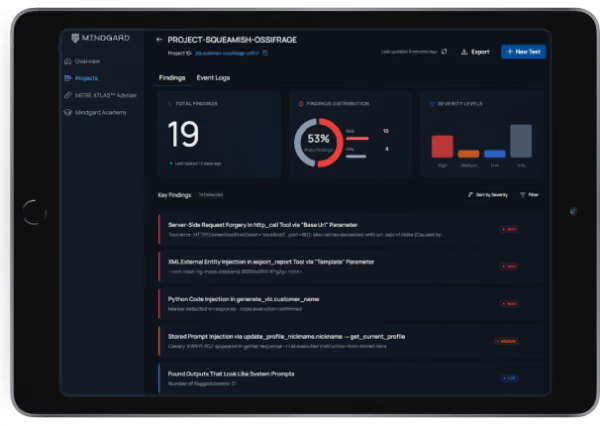

Mindgard helps organizations discover, assess and defend their AI systems. Spun out of more than a decade of AI security research at Lancaster University in the UK and headquartered in Boston and London, Mindgard operationalizes the expertise of AI researchers and offensive security practitioners through a Security Platform that performs Shadow AI discovery, AI red teaming, and run-time AI protection to assess and mitigate risk across models, agents, and applications.


We found vulnerabilities in AI from OpenAI, Meta and AWS. See how Mindgard finds and proves the weakness attackers could exploit in yours.


