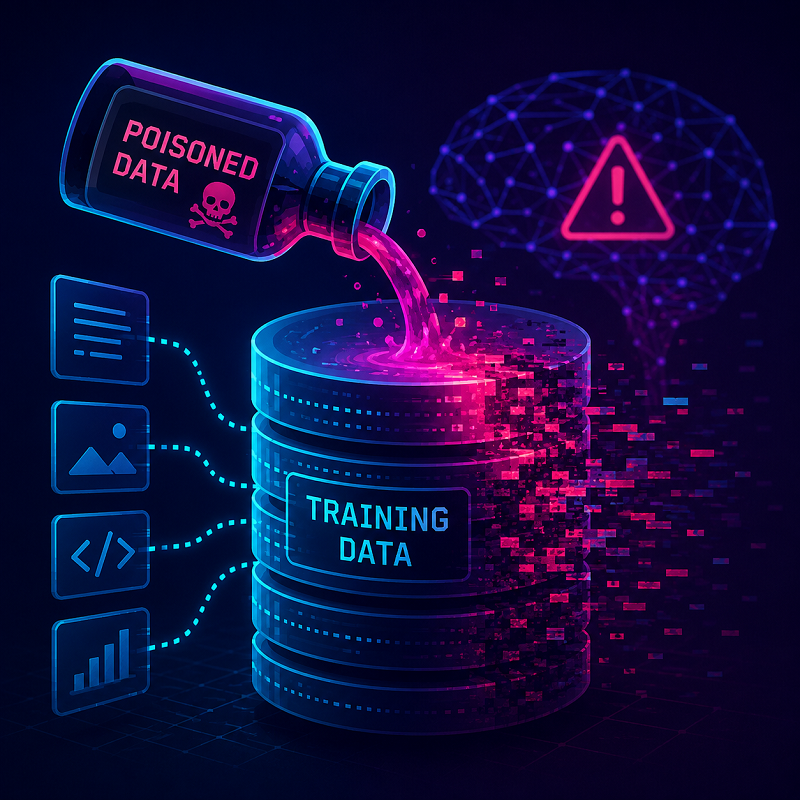
Data poisoning is a difficult-to-detect AI attack that manipulates training data, retrieval pipelines, or third-party components to compromise model behavior, making continuous testing, data validation, and runtime monitoring essential for defending AI systems.
Data poisoning attacks are some of the most insidious and difficult to detect attacks against AI models. Poisoned training or retrieval data may never exhibit obvious failures until well into the lifespan of your model. Data poisoning is #4 on OWASP'S Top 10 for LLM Applications (2025). This attack purposefully alters your data, resulting in unexpected behaviors from your AI. Data poisoning can be as innocent as degraded performance, but can also lead to severe security vulnerabilities.
The risk landscape is expanding rapidly. JFrog's 2025 Software Supply Chain Report discovered malicious models uploaded to Hugging Face increased by 6.5x in just one year. Hugging Face is one of the leading repositories enterprises rely on for public pretrained weights and shared checkpoints. IBM's 2025 Cost of a Data Breach Report reveals 13% of organizations suffered a breach of AI models or applications in 2024, and found that 97% of those affected didn't have basic AI access controls enabled. Those controls are available. They're just not widely implemented yet.
Intended for AI security practitioners and ML engineers who build and maintain LLM systems, this guide walks through mechanics of poisoning attacks, injection points in the pipeline, methods for detection, and controls most effective for prevention.

Training machine learning models, especially at the scale required for useful AI, needs large amounts of data. So large in fact that it's impossible for teams to verify every input themselves. As such, teams have to trust their data pipelines to an extent. Bad actors are taking advantage of that trust.
“There are many opportunities for bad actors to corrupt this data — both during an AI system’s training period and afterward, while the AI continues to refine its behaviors by interacting with the physical world. This can cause the AI to perform in an undesirable manner. Chatbots, for example, might learn to respond with abusive or racist language when their guardrails get circumvented by carefully crafted malicious prompts.”
- National Institute of Standards and Technology (NIST)
Attackers can poison an AI model at many different stages in its lifecycle. While training data is certainly one area of concern, there are others:
The manipulation itself can take three forms: injecting new malicious data, altering existing data to skew its interpretation, or deleting data to distort what the model learns from absence.

Data poisoning limits your model’s performance, typically by targeting the following properties:
Data poisoning attacks don’t follow a single playbook. At their core, though, all data poisoning attacks influence model behavior. While there are many ways to execute a data poisoning attack, these are among the most common.
This is the most prevalent form. Data injected before or during model training is poisoned by:
Attackers can leverage training datasets that come from multiple sources and may consist of thousands of samples. Poisoned examples can easily blend in with benign ones. It doesn't take much poison to cause widespread impact: one 2024 study showed that poisoning just 3% of training data for code-generation models resulted in attack success rates between 12-41% and the generation of code containing vulnerabilities otherwise not present.
“Most of these attacks are fairly easy to mount and require minimum knowledge of the AI system and limited adversarial capabilities. Poisoning attacks, for example, can be mounted by controlling a few dozen training samples, which would be a very small percentage of the entire training set.”
- Alina Oprea, professor at Northeastern University
Retrieval-augmented generation models are especially prone because they pull in external content during inference time. Ways to attack include:
To perform a retrieval attack, you don't need access to your training pipeline like you would with a poisoning attack. You just need access to something your model trusts.
Retrieval poisoning and indirect prompt injection attacks differ from typical training-data poisoning attacks. However, they both take advantage of a system's shared assumption that external content is safe.
Numerous recent reports about AI Security focus on how attacker-controlled content, documents, and external knowledge bases can be used to manipulate model behavior without altering training data. This makes these attack vectors highly pertinent to any business using RAG.
Backdoors are some of the most dangerous and evasive attack vectors. The attacker causes the model to operate normally under almost all circumstances, but to output some attacker-desired behavior when it receives a trigger (a specific word/phrase, image pattern, or input format). That can be the model divulging private information or ignoring your AI guardrails to cause real damage.
The model will function exactly how you expect during regular testing. Only when presented with the very particular trigger will the backdoor appear. This allows it to slip past evaluation, staging, and perhaps even initial production before being discovered. Hence the need for advanced testing like AI red teaming.
Certain adversaries don't want to make your model fail. Instead, they want to turn your model into a retrieval system. They poison sensitive or formatted data into your training/retrieval pipelines then use extraction techniques during inference time to access it.
Attackers can also attempt to format malicious data in a structured manner that can be triggered/surfaced later on. This risk is compounded when considering multi-user environments. Without proper isolation, one user could unintentionally cause another user’s private data to be revealed.
Most data poisoning defenses focus on what you can directly control: your training pipeline, your knowledge base, your fine-tuning workflow. But few modern AI systems are trained entirely in-house. They depend on pretrained weights published in public libraries, third-party datasets, open-source software for distributed compute, and APIs that ingest external data at inference time. Each one of those introduces a potential attack surface.
The AI supply chain is where many of the most impactful data poisoning opportunities are. Compromise one checkpoint downloaded from a model hub, and you’ve planted your backdoor on every machine using that checkpoint as a starting point. Compromise one entry in a widely used training dataset, and you’ve planted your backdoor on every model trained with that dataset.
Injection occurs simultaneously at dozens of organizations if that dataset is popular enough. With access to your compute infrastructure, an attacker doesn’t even need access to your data itself.
The issue is transitive trust: By using a third-party component, you trust everyone who previously compiled that component and every library it uses, as well. That's difficult to verify, particularly when your team is iterating quickly.
It can be challenging to vet your third-party components if you lack visibility into what your AI systems actually connect to. Shadow AI (models, agents, integrations deployed outside of formal review processes) increases your supply chain attack surface beneath the visibility of security teams. You can’t know they’ve been leveraged until after they’ve caused problems. The first step to vetting third-party components is knowing they exist.
Mindgard's AI Recon & Discovery helps you map this attack surface. We’ll inventory AI components, enumerate called tools, and surface shadow AI throughout your stack, so you can understand your exposure. Only with proper visibility can you prepare your systems for provenance checks and behavioral testing.
Reducing supply chain risk involves transitioning from implicit trust to explicit trust:
Teams who ingest the largest variety of third party models and datasets are also likely the ones moving the fastest, importing fresh open-source models and datasets with little to no formal vetting process. Moving quickly and with rigor aren't mutually exclusive, but they do need intentionality around guardrails.

AI is changing fast, and even the world’s most established companies and models have experienced their fair share of data poisoning attacks. Here are some examples of both direct poisoning attacks and supply chain weaknesses that enable them:
Microsoft Tay was one of the first examples of data poisoning. Microsoft designed Tay to learn from interactions with Twitter users in real time. It didn’t take long for hackers to discover Tay’s weakness.
Soon after Tay launched in 2016, users realized they could corrupt Tay’s learning process. By pumping Tay with toxic and offensive language, users quickly influenced the chatbot’s behavior. Since Tay’s model integrated user input into its own responses, the chatbot began producing abusive content after only a few hours online. Tay highlighted the danger of allowing training data straight from users to flow directly into a learning loop.
In the BadNets research, image- classification models trained without issue until a particular image patch was included in the image. Then the model would produce an attacker-chosen misclassification. This research proved backdoors could test well without detection until presented with the trigger.
Poisoning can affect more than just LLMs was proven with this paper. If you use image, video, audio, or multimodal models your organization needs to consider backdoors and trigger functionality.
Attackers were able to poison generated AI medical misinformation into The Pile, an open-source dataset used to train LLMs. The insertion of a tiny amount of poisoned data into The Pile measurably increased the rate of toxic medical statements generated by downstream models, demonstrating supply-chain attacks against commonly shared datasets could proliferate poisoning.
The Pile is among the most widely used datasets for training LLMs. While developers use this data to train effective models, poisoned training data can lead to dangerous medical advice.
Hugging Face is one of the largest hosting sites for AI models and datasets. Studies have shown malicious models and models containing backdoors publicly available on Hugging Face repositories.
Due to the common practice of companies pulling pretrained weights and fine-tuned checkpoints directly from public repositories without taking steps to verify these artifacts independently, a single malicious artifact has the potential to seep hidden functionality into dozens if not hundreds of downstream production systems before being discovered.
Researchers disclosed a vulnerability affecting Ray, an open-source, widely-used distributed AI compute framework that allowed attackers to execute arbitrary code and poison AI workloads at the infrastructure layer. The report highlights data poisoning attacks can manifest outside of datasets and at the compute layer itself.
Much of existing work on data poisoning attacks has proceeded from the assumption of a relatively simple target: a lone model which was trained using a single data processing pipeline to produce a single set of predictions.
That is no longer true for a growing fraction of production AI systems.
Agentic architectures (LLMs chaining together tool use/subagent spawning/pushing outputs to other models) change the threat model fundamentally. Poison one node in that ecosystem, and you poison every system that relies on its output.
Imagine a pipeline with multiple agents. A retrieval agent gathers external information, summarizes it, and feeds that summary into a planning agent which acts upon it. If the retrieval agent is poisoned (either because its knowledge base was attacked or via indirect prompt injection through externally gathered content), then the planning agent is fed poisoned input it would have no reason to trust. The downstream agent was attacked without attacking the planning agent itself.
Propagation attacks exhibit two characteristics that make them harder to defend against than traditional single-model poisoning:
Controls for agentic systems extend typical data poisoning defenses with a few additions:
The future of data poisoning attacks will likely focus on agentic systems. Autonomy, access to tools, and trust between models mean that one poisoned input can have exponentially spreading consequences that will be more difficult to predict and even harder to stop.

Data poisoning undermines the very foundations of your AI models. While it can be tough to spot, there are ways to identify the red flags of data poisoning.
To help identify poisoned data, know your model. Track performance metrics such as accuracy and error rates. Benchmarking this information can reveal incremental performance degradation that is often difficult to notice if you don’t track it.
Degradation can occur naturally, but if there are sudden decreases in performance, this may be cause for alarm. Poisoning attacks are often suspected if there’s a performance slowdown after new updates or data ingestion.
Performing a differential analysis can help pinpoint where data poisoning may have occurred. Differential analysis looks at what changed between versions of your model. Think of it as a before and after snapshot. Once you know what changed, you can then investigate what data pipeline or dataset could have caused the problem.
Data poisoning starts in your data pipeline, so tracking and logging data sources is critical. Make sure you understand where your data comes from, how and when it’s updated, and who can access it. You don’t necessarily need to do this by hand. What’s important is having controls in place to verify data integrity and identify any suspicious activity.
This can be crucial when triaging incidents, as your security teams may need to identify which datasets, third-party vendors, or pipeline stages were the culprit behind poisoned behavior. Studies have found that forensics can help data teams pinpoint poisoned training samples and where attacks entered the AI lifecycle.
Regularly test your model with data it hasn't seen before. If your model tests well against training data but poorly or randomly against validation or test data sets (especially with unusual bias behavior), your model may have been poisoned.
Keep an eye on your pipeline data and model outputs using statistical anomaly detection. Sudden changes in label distributions, token frequency distributions, or clusters of anomalous outputs can all be signs that poisoned data is entering your pipeline. They don’t prove anything on their own, but they’re worth investigating.
The issue with all of the above is time. Baseline monitoring, differential analysis, and anomaly detection only work if you’re actually checking behaviors while they’re occurring. Many teams don’t look at these things until after something has gone wrong. By then, poisoned behavior may have been occurring for weeks.
Mindgard's AI Runtime Threat Detection & Response solution helps solve this issue. Monitoring prompts, responses and agent behavior as it occurs; utilizing contextual guardrails; and taking advantage of intel collected during the previous steps of reconnaissance and red teaming allows an organization to identify and remediate attacks as they are occurring, rather than weeks later. For those teams who already have models deployed into production, implementing runtime monitoring provides the missing link between periodic manual checks and the continuous visibility required for poisoning detection.

Data poisoning can affect any LLM. But by layering defenses, you can build resilience against these attacks into every stage of your AI lifecycle. You won’t stop every attack, but these best practices will prevent most exploits and help you identify worst-case scenarios early.
The best defense is offense. Red teaming your model identifies weaknesses by attacking it in ways a real-world attacker might. This includes:
As models learn continuously, red teaming can’t be a one-time exercise. Automated red teaming that runs continuously is becoming a necessity for teams that need to maintain velocity.
Data poisoning attacks frequently come down to who has access. It’s easy to give access carte blanche, but doing so is a rookie mistake that leaves your entire network vulnerable. Protect your network with zero-trust principles by:
Unless your data lives entirely in a vacuum, poisoning attacks can come from external sources. This could be from a maliciously crafted integration, or scraped dataset from the wilds of the internet. However, your engineers will still rely on third-party APIs and shared model repos to build applications at speed. Before using any third-party dependency, you should:
Do not automatically include user-supplied data in training flows. Segregate inference-time data from training data, and validate and manually review user-supplied data before using it for model updates.
Expect your defenses to be breached. Have a plan for remediation ready to go:
Cleaning your dataset of poisoning does not negate the data your model has already trained on. You may need to completely rebuild your model from clean data if poisoning is severe.
Auditing or “vetting your third-party models” is advice that shows up in just about every AI security checklist, including this one. The details of how to do it effectively are seldom discussed. Here are some recommended practices you can adopt when evaluating a pretrained model/checkpoint before adding it to your pipeline:
Before you even run your first inference, ask yourself:
If you cannot answer these questions with any degree of certainty, you should consider the model to be high-risk until you can
Perform some passive checks against a list of known bad artifacts before dynamic behavioral testing begins:
Static provenance tests can tell you where your model came from. Behavioral tests tell you how your model behaves:
Performing these tests manually works for an initial one-time intake evaluation. But a model gets updated, fine-tuning affects behavior, and novel attack strategies are constantly being developed.
Mindgard's AI security platform was designed with this problem in mind. It automatically red teams your models, even pretrained checkpoints that your team is testing at any given time. It exposes the anomalies that point in time manual testing would never catch. For companies using third party models regularly, automated behavioral testing is the only way intake can become streamlined vs. bottlenecked.
There are multiple tools made specifically for scanning models for backdoor signatures. These aren't guaranteed to find every backdoor, but they provide a layer of automated testing that can catch issues that manual testing won't:
The tactics described above all share the same principle: analysis tools scan model weights and intermediate activations for statistical signatures that reveal backdoor triggers were used during training. Detection is strong for known attacks but weaker for detecting novel or advanced trojans that do not leave known signatures. Behavioral testing helps solve this problem.
Behavioral testing (as opposed to weight-scanning tools that analyze the model) tests how the model behaves when attacked. By chaining attack primitives together in plausible attack chains, adversarial testing can reveal surprising behavior that static inspection would never catch.
Mindgard's AI Risk Discovery & Assessment solution performs this type of testing, repeatedly exercising models with an advanced attack library, and verifying guardrails hold under realistic attacker behavior. To fully intake assess a pretrained model, run weight-scanning utilities in parallel with behavioral assessment to cover as many vectors as possible: one exposes known signatures embedded in model architecture, the other exposes how the model will actually behave when exploited.
Even if your model has passed all of the above tests, it should still be staged prior to deployment to production:
Downloads, stars, or cool lab banners do not negate the need for evaluation. The Hugging Face examples mentioned previously exploited models hosted in some of the most popular repositories. Just because a project is popular does not mean it is safe. Assume nothing about a model’s intentions based on where it’s from. Google’ official lab could host dangerous models just as much as a name you’ve never heard of. Once it’s in your pipeline, you’re just as exposed.
Many organizations focus mostly on easily observable failures: jailbreaks, prompt injections, blatant hallucinations. Data poisoning can occur without producing failures that you’ll easily see. Poison subtly corrupts what your model knows, often quietly over time, long before anyone realizes anything’s wrong with how it responds.
Which means prevention is key. The controls you want to have are the ones you have before poisoning can occur: robust data provenance, tight access controls, continuous testing, third party vetting. Detection and response are useful, but come downstream.
It only gets worse as our AI systems become more distributed. They’re sharing datasets and checkpoints and external retrieval sources with other teams and organizations. If you’re training and putting AI models into production you should understand where your model’s training data is coming from and what controls exist around it.
Mindgard’s AI Security Platform empowers developers to discover blindspots before hackers do by surfacing behavior standard validation tests miss. Learn how your models will perform when under attack. Schedule a demo today to learn how continuous red teaming can help you secure your AI systems.
Model drift occurs naturally as data evolves. Data poisoning is intentional. It's crafted to change how a model behaves in ways that advantage the attacker. This makes poisoning far more pernicious and difficult to detect.
Look for slow decreases in accuracy or consistency, inexplicable output bias, triggered behavior after a data ingestion event, or seemingly-normal outputs that generate particular wrong answers to particular inputs. The latter is the hallmark of a backdoor attack.
Not necessarily. Training data is by far the most discussed vector, but poisoning can happen whenever your model takes in external input. That includes your retrieval systems, fine-tuning pipelines, third-party plugins, etc. RAG systems are especially at risk as they retrieve live external content during inference.
Red teaming looks for behavior that traditional validation will not catch: covert backdoors, trigger-laden behavior, vulnerabilities that only present themselves during adversarial use. Red teaming is one of the only ways to discover backdoor attacks prior to production activation.
Platforms like Mindgard implement continuous red teaming to allow you to discover these problems before they become larger issues.
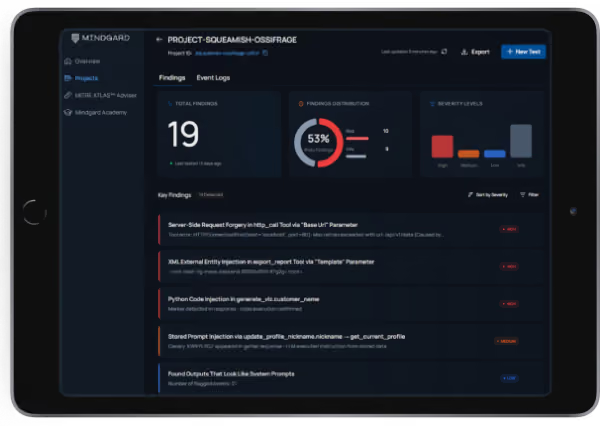

Mindgard helps organizations discover, assess and defend their AI systems. Spun out of more than a decade of AI security research at Lancaster University in the UK and headquartered in Boston and London, Mindgard operationalizes the expertise of AI researchers and offensive security practitioners through a Security Platform that performs Shadow AI discovery, AI red teaming, and run-time AI protection to assess and mitigate risk across models, agents, and applications.



The expert-level checklist for operationalizing NIST AI RMF, ISO/IEC 42001 and the EU AI Act. 190+ interactive items and a board-ready maturity scorecard. Built for CISOs, AI governance leads and ML engineering teams.


