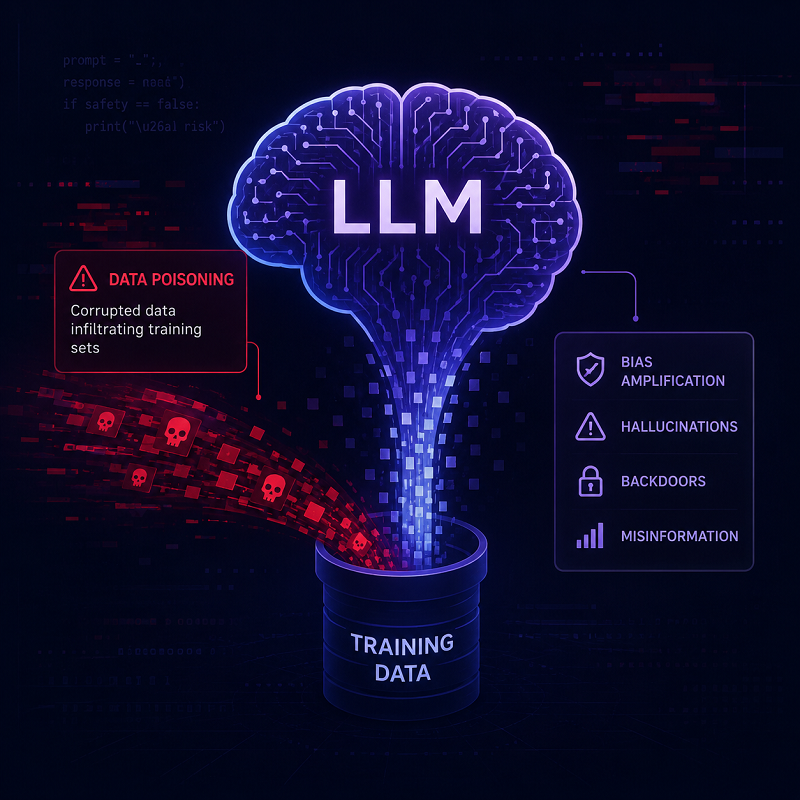
LLM data poisoning can silently manipulate model behavior through subtle changes such as unusual outputs, performance degradation, stealth backdoors, and metadata tampering, making continuous monitoring and adversarial testing essential for early detection and mitigation.
Data poisoning attacks are among the most effective attacks against large language models. Unlike other attack forms, poisoning attacks don’t outright break a model; they subtly alter its behavior. By inserting malicious inputs into a model’s training data, attackers can cause it to output particular responses if given certain triggers. These modified responses might not be caught by standard model protections.
After poisoning a model, attackers can reliably activate their modifications. Security researchers have discovered that by manipulating just 0.1% of a language model’s training data, they can create backdoors that persist through continued training.
It’s logical to think that it should be more difficult to poison larger models. But in fact, larger LLMs are more susceptible to certain types of poisoning. LLM data poisoning can harm a company's brand reputation, decrease customer loyalty, and cause physical harm should the poisoned model drive real-world decisions in applications such as healthcare or finance.
Poisoning can be very difficult to detect, so it's important for developers to watch out for indications that poisoning has occurred. Below are five red flags your model may be experiencing LLM data poisoning.

Did your model suddenly start generating unexpected outputs? There are a few different AI attacks that could cause this behavior. However, you’ll want to rule out data poisoning first. Models produce outputs based on their data, so poisoned data can change expected outputs. The effects can be subtle or readily apparent.
There are a few indicators that your model has been affected by data poisoning such as:
You should pay special attention to outputs relating to retrieved documents if your model uses retrieval-augmented generation (RAG). Since RAG accesses external knowledge during inference time, there is potential for attackers to poison the knowledge base your model has access to without altering the underlying training data.
If unusual outputs can be correlated with specific topics that your model queries externally, start by looking at the retrieval layer. As Dr. Peter Garraghan, CEO of Mindgard, puts it:
“The model alone is rarely the sole point of failure. Red teams must assess orchestration layers, retrieval mechanisms, external data sources, access controls, and downstream actions.”
All models can suffer from performance degradation. If you’ve ruled out other causes, consider data poisoning. Data poisoning attacks commonly manifest as a loss in performance. Most specifically, attacks can cause:
Declining performance can be challenging to catch since it can occur gradually over time and may have some other innocuous explanation. Sudden and unexpected decreases to performance, however, combined with some of the other indicators, are a sign of tampering.
Similar to dips in performance, model drift can occur over time as well. Model drift occurs when your LLM gradually starts to shift away from its baseline. That’s why developers need to monitor AI models closely during all phases of deployment. However, model drift can also be indicative of larger issues if you are unable to account for why the model is behaving a certain way with new data or updated prompts.
Potential signs of model drift include:
Note: model drift alone does not necessarily mean that your LLM is being poisoned. However, it is something to investigate further by looking at your model and its training data.

Data poisoning attacks will often use triggers buried within noisy input samples that resemble legitimate training data, evading your typical detection techniques. These covert attacks won't resemble typical backdoors you may be familiar with. However, they will still lead to inconsistencies with generally slower reaction times from conventional security measures.
Consider re-examining your model’s training data if you see:
Stealth backdoor attacks are difficult to identify without AI red teaming. With Mindgard’s Continuous & Automated AI Red Teaming, you can aggressively test models with adversarial inputs to reveal unknown triggers your typical testing won’t catch.
Metadata can seem like administrative minutia. But metadata is one of the easiest parts of your training pipeline to manipulate, and it’s often the first indicator of data poisoning.
A model isn’t learning from text alone. A model is learning from text coupled with whatever metadata you provide to indicate what matters in that text, such as weights, labels, annotations, etc.
Metadata is frequently the weakest part of your training pipeline because it’s rarely considered part of your security surface. Models learn from text and its labels, but they also learn from texts' weights and annotations. Texts marked as “high quality” or “authoritative” are given more weight during training than text marked “low confidence.”
If an attacker can trick your system into labeling/categorizing documents differently without changing the text, they can impact what your model learns while bypassing content-based defenses.
Keeping this in mind, here are some examples of metadata discrepancies that you can look for:
The risk is much worse than most teams are prepared for. Attackers do not need massive reach into your data pipeline or the ability to poison high percentages of your data to mount effective attacks that persist. In fact, poisoning as little as 0.1% of your training data has been proven to create backdoors that will remain after model retraining. Retraining your model will not necessarily make it secure.
The threshold is even lower if your model is a RAG system. At USENIX Security 2025 researchers showed that they were able to achieve a 90% success rate by simply adding five malicious documents for each target query to a dataset containing millions of documents. This finding has been corroborated by multiple independent follow ups.
Even more recently, research presented in a paper from EMNLP 2025 demonstrated how this bar has been lowered even further: needing only an average of one carefully crafted poison document to be successful, even for complex queries, and being less likely to be detected by traditional defenses.
Keep in mind that larger models, even powerful ones, are not immune to these attacks either. In fact, they’re susceptible to more forms of poisoning as you scale up.
Like most attacks against AI systems, LLM data poisoning is difficult to detect, particularly at scale. Performance issues and unusual outputs may be the only indicator that something isn’t right. While each signal can be written off in isolation, together they paint a different picture.
There’s no such thing as a 100% secure AI model. Your ability to quickly react and remediate data poisoning attacks is critical to safety and security. The faster you can identify data poisoning, the easier it is to remediate. And that all starts with testing beyond the standard.
"Automation can help scale adversarial testing across thousands of variants, but human expertise remains critical to interpret emergent behavior and design novel attack paths. Results must be measurable and mapped to impact. AI red teaming should produce evidence that informs governance and remediation, not anecdotal observations that lack operational relevance."
Mindgard’s AI Security Platform allows you to confirm what your model is truly learning. Think beyond checking-the-box evaluations with testing that reveals attempts at manipulation. Stress test your model before the attacker does: Schedule a Mindgard demo today.
Normal model drift happens when users and environments change organically. In poisoning, attackers are consciously trying to steer that change. Poisoning often results in directional drift that steer a model in specific directions.
On the contrary, post-training data poisoning is becoming quite common in practice these days. In addition to in-training data poisoning, there are some post-training methods of poisoning like fine-tuning, reinforcement learning (RL) workflows, and third-party tools.
RAG architectures, for example, query external sources of information at inference time. In this case, your training data is irrelevant to a poison attack. All that the attacker needs to modify is the documents or database that your LLM draws from during a RAG process.
If you suspect data poisoning, don't dismiss it as random noise in your model. Try to isolate why your model is producing this behavior by comparing current behavior to known baselines, recent data sources and metadata, and look for repeating patterns of failure. After isolating the cause, conduct targeted red team testing to verify if it is just model drift or something nefarious.


Mindgard secures AI models, agents, and applications against exploitable threats. Spun out of more than a decade of pioneering AI security research at Lancaster University, Mindgard combines offensive security expertise, AI red teaming, attacker intelligence, and automated protection to help organizations discover, assess, and mitigate risk across AI models, agents, and applications.



We found vulnerabilities in AI from OpenAI, Meta and AWS. See how Mindgard finds and proves the weakness attackers could exploit in yours.


