
Training data poisoning can silently embed backdoors, biases, and security vulnerabilities into AI models, making early detection through red teaming, data lineage tracking, and version control essential to prevent widespread downstream impact.
Artificial intelligence is transforming how businesses operate. But with the widespread adoption of AI comes increased risk. Training data poisoning is a type of cyberattack that can go undetected for months manipulating an AI model’s behavior.
It's scary how little data is needed. Poisoning attacks against large language models have succeeded with as few as 250 malicious documents. That's only 0.00016% of the size of a training dataset, no matter how big the target model is. Injecting only 0.001% poisoned tokens into sensitive datasets (e.g., medical records) can increase malicious outputs by 4.88%. Poisoning just 3% of a large language model's training dataset for code generation caused attack success rates of 12-41%. This isn't an outlier. On average, advanced content poisoning assaults have managed to succeed 89.6% of the time against specific large language models.
The risk extends beyond the training process. Retrieval-augmented generation (RAG) systems, third-party plugins, and synthetic data pipelines have also been shown to contain vulnerabilities exploitable by attacks in 2025. There is no step in the AI lifecycle that is safe from security risks. Data poisoning has also been shown to result in a 27% decrease in accuracy for image recognition AI and 22% loss for fraud detection use cases. Regulators are starting to take notice: AI-related fines at banks and fintechs rose 150% in 2024 as regulators began to crackdown.
It's the covert way this attack operates that's so alarming. Your poisoned models will have performance on par with clean models when queried on typical benchmark datasets. This means the attack can go undetected by typical model validation techniques. By time of discovery, the poisoned model can already be many layers deep in the organization.
If you build or deploy AI, you need a system for detecting training data poisoning as early as possible. In this article, we’ll outline why this attack is so detrimental and go over three critical safeguards you should have in place.
In a training data poisoning attack, the adversary adds false or malicious information to your training data. The attacker's aim is to skew how your model learns and acts, typically to the attacker's advantage and/or your organization's (and your users') detriment.
In a 2024 report, the National Institute of Standards and Technology (NIST) explains: “There are many opportunities for bad actors to corrupt this data — both during an AI system’s training period and afterward, while the AI continues to refine its behaviors by interacting with the physical world. This can cause the AI to perform in an undesirable manner. Chatbots, for example, might learn to respond with abusive or racist language when their guardrails get circumvented by carefully crafted malicious prompts.”
As more companies implement agentic AI, poisoning their training data can lead to consequences in the real world. Since they act on their own decisions, they could cause damage if their information is poisoned from the onset.
Once training data poisoning occurs, it can be difficult to detect, let alone reverse, once a model has been deployed. Some examples of how malicious data can affect your model include:
Training data poisoning isn’t contained to just this AI model. It carries over into any system that relies on the model, too. Although it’s more common during training, data poisoning can also happen at any stage of the AI lifecycle. That’s why teams need a strong security protocol in place before development even starts.

Training data poisoning can be nuanced, meaning that you likely won’t detect it by putting just one control in place. Instead, you’ll need a multi-layered approach to identify malicious inputs before they become harmful. Make sure your team has these detection best practices in place to validate training data quality.
Red teaming purposefully attacks your model with adversarial prompts and attack simulations. When you conduct these exercises regularly, you’ll learn whether poisoned data introduced any hidden weaknesses. However, even monthly simulations aren’t enough to keep up with attackers. Solutions like Mindgard’s AI security platform provide 24/7 AI red teaming to see how resilient your model really is to poisoned training data.
Dr. Peter Garraghan, CEO of Mindgard and Professor of Computer Science at Lancaster University, warns organizations about getting the fundamentals of red teaming wrong. “Many organizations underestimate AI risk by applying legacy testing assumptions. Asking a model a series of harmful questions and observing refusals is not equivalent to red teaming. It does not reflect how real adversaries operate, nor does it account for indirect or multi-step exploitation,” he cautions.
Instead, Garraghan advises red teams to begin with adversary emulation and progress to intent, persistence and financial motivation. In reality, an exploitation scenario you discover in the wild probably won’t translate neatly to a single prompt anyway. You can test the model itself as well as orchestration layers around it, retrieval techniques, external content providers, permissioning systems, and downstream behaviors.
Granted, red teaming is only part of the solution. While it can help you identify poisoned data, you also have to purify the sources that bad data is coming from. Otherwise, you’ll never stop playing defense.
“Most organizations are not training their own models,” says Michael Lieberman, CTO and co-founder of Kusari. “Instead, they rely on pre-trained models, often available for free. The lack of transparency regarding the origins of these models makes it easy for malicious actors to introduce harmful ones, as evidenced by the Hugging Face malware incident.” Around 100 malicious LLMs hosted on Hugging Face were found by security researchers in October 2024. These LLMs had been compromised with backdoors allowing remote callers to execute arbitrary code on victims' machines.
Cybersecurity experts at Purilock agree: “Organizations often start with models trained on public datasets or use foundation models trained by third parties, inheriting whatever vulnerabilities might lurk in that training data. The supply chain for ML models has become as critical as the supply chain for software—and potentially more opaque.”
Knowing your sources will allow you to pinpoint where the problem is coming from. Data lineage will tell you:
If you identify suspicious activity, having your data lineage readily available for cross-reference can help you locate poisoned data faster. This process shouldn’t be relegated to training, however. Data provenance should be checked regularly, especially when updating or adding to datasets.
Datasets are always changing, and they’re often distributed across teams and tools. Pinpointing where your data became poisoned is nearly impossible without a well-organized dataset history. That’s the problem Data Version Control (DVC) was built to solve.
DVC is an open-source version control platform built specifically for machine learning projects. DVC enables you to treat your datasets and ML models like you would source code within an application, similar to how a software engineer versions control code with Git. Data scientists can use DVC to do the same for data assets. Every change made to a training dataset is versioned and recorded, providing a history of your data for every single model version.
Simply putting detection practices into place, like DVC, is only one piece of the puzzle. They also need to be enforced by the organization. However, many organizations are still behind the curve. While conducting a benchmark survey in May 2026, the American Arbitration Association found that although 87% of organizations surveyed (from senior legal and business executives) have some variety of AI governance framework in place, only 22% think their systems are operating successfully.
"Governance is a cross-functional business imperative, not just a technical or legal concern,” explains Bridget McCormack, AAA president and CEO. “Without effective collaboration and oversight, organizations expose themselves to regulatory scrutiny, reputational harm, and loss of trust."
Your model could contain poisoned training data without throwing any red flags. Even if it looks fine on the surface, you might be at risk of biased outputs and security weaknesses. Early and continuous detection are key.
Red teaming rigorously stress-tests your model against data poisoning attacks as well as other threats, including model extraction and prompt injection attacks.
Mindgard’s AI security platform allows you to move from reactive damage control to proactive defense. Uncover your blind spots: See how Mindgard reduces your exposure to AI attacks.
The key difference is intent. Training data poisoning is an intentional attack. Someone is purposefully trying to poison your model by changing the data you use to train it. What we call model drift is basically your model's performance becoming less in sync with user inputs as time goes on. Model drift happens naturally over time, so it isn’t always malicious like poisoning, but you still want to look into it.
Yes. In fact, that's one of the primary reasons why data poisoning attacks often go undetected for months. Malicious data can allow a model to pass typical validation testing based on accuracy metrics, despite containing backdoors or biases.
Not necessarily. Deleting poisoned records won't help if you've already trained a model with them. You may need to roll back to a known-good version of your dataset, or retrain your model.
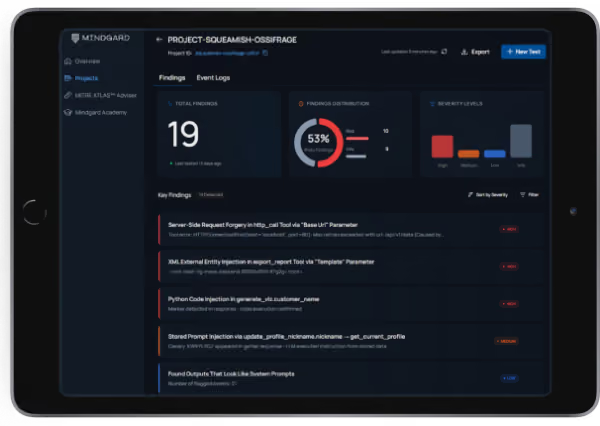

Mindgard helps organizations discover, assess and defend their AI systems. Spun out of more than a decade of AI security research at Lancaster University in the UK and headquartered in Boston and London, Mindgard operationalizes the expertise of AI researchers and offensive security practitioners through a Security Platform that performs Shadow AI discovery, AI red teaming, and run-time AI protection to assess and mitigate risk across models, agents, and applications.



We found vulnerabilities in AI from OpenAI, Meta and AWS. See how Mindgard finds and proves the weakness attackers could exploit in yours.


