Like other LLMs, ChatGPT is vulnerable to data poisoning attacks. Organizations can reduce the risk by using trusted datasets, validating inputs and outputs, monitoring for anomalous behavior, conducting AI red teaming exercises, and implementing strong AI governance practices.
AI is rapidly becoming part of our everyday lives, and no application demonstrates this better than ChatGPT. ChatGPT currently has more than 1 billion estimated weekly active users, and over 2.5 billion prompts are sent every day. The platform reached 1 million users just five days after its launch and 100 million monthly active users within just two months post-launch. At the end of 2025, OpenAI announced that a majority of Fortune 100 and Fortune 500 companies are using AI, firmly establishing the AI chatbot as critical business technology.
However, this explosive growth comes with an important drawback that’s easily missed: susceptibility to poisoning attacks. Researchers from the UK AI Security Institute, the Alan Turing Institute, and Anthropic found that adding just 250 poisoned files to a model’s training data can facilitate a backdoor attack. That can result in the model producing false or harmful output. The problem is exacerbated by the fact that most popular LLMs are trained on openly available text from around the web, including personal sites and blog posts, which are hard to verify at large scale.
The risks downstream are very real. When Harmonic Security analyzed 22.4 million enterprise prompts, they discovered that ChatGPT was responsible for 71.2% of all AI-related data exposures. This is significant given ChatGPT’s share of usage was only 43.9%. IBM’s 2025 Cost of a Data Breach Report revealed that 16% of all breaches involved threat actors exploiting AI which will only increase as AI becomes further adopted.
In this article, we discuss data poisoning and what it means for ChatGPT, including how it works, how it can affect your organization, and (most importantly) what you can do about it.
Yes, ChatGPT can fall victim to data poisoning attacks just like any other LLM. As Dr. Peter Garraghan, CEO at Mindgard, puts it: "AI is not magic. It's still software, data and hardware. Therefore, all the cybersecurity threats that you can envision also apply to AI." Every large language model can be poisoned at some level because data poisoning directly targets what they are built upon: data.
Most data poisoning occurs during training when models consume massive amounts of data sourced from:
It doesn’t matter if the data is compromised or inaccurate. It doesn’t matter if it’s malicious or not. The model ingests all data it’s provided. Data poisoning happens most often during training, but it can also happen during fine-tuning and updates. That’s why ChatGPT displays the caveat, “ChatGPT can make mistakes,” in every chat window, albeit in very small text.
ChatGPT data poisoning, along with other types of attacks like prompt injection, can happen to the commercially available model most users see. But it’s also a threat if you license OpenAI’s model for something like an internal knowledge base. If you feed the model poisoned data, you’ll see issues like:
Garraghan has emphasized that data poisoning attacks “are not theoretical — they are happening in production environments, often triggered by simple, benign-seeming user interactions."

ChatGPT itself isn’t inherently dangerous to use. However, risk increases depending on your use case. If you connect ChatGPT to private information sources like proprietary data or knowledge bases, then risk increases. There’s also risk if you augment ChatGPT with third-party data or build generative AI assistants that leverage user-created content. While using any LLM carries risk, here are some ways to avoid ChatGPT data poisoning.
Garbage in, garbage out. Take care to curate datasets, and never use scraped or otherwise unverified data to train your model. Unverified data is more likely to contain manipulations that will be difficult to identify after the fact.
Accept nothing at face value. Design your implementation to validate input where appropriate and model outputs if they will be used for mission-critical applications. This could take the form of programmatic validation rules, human-in-the-loop verification, or validation against a set of known-good outputs.
But as Garraghan notes, purpose-built defenses still leave significant blind spots: "If one took a step back and asked anyone in security, ‘Would I feel comfortable relying on a WAF (Web Application Firewall) as my critical defence to protect my organization?’, the answer would (hopefully) be a resounding no." The same is true for guardrails surrounding LLMs such as ChatGPT. They are part of the solution, but not the entire solution.
Monitor model behavior throughout its lifecycle, not just when you first deploy it. Continuous monitoring allows you to identify issues early before they become bigger problems. Things like abrupt shifts in tone, accuracy, or output styles can indicate deeper issues such as data poisoning attacks.
Conduct red team exercises by attacking your own AI systems with adversarial inputs. An AI security platform like Mindgard is designed to help identify weaknesses in your models. By mimicking real world attack scenarios, like data poisoning, you can patch vulnerabilities before bad actors exploit them.
Those actions are important, but only if AI adoption is measured and managed at the executive level. In Garraghan’s words: "AI is already embedded in enterprise workflows and it's accelerating faster than most organizations can govern it. Shadow AI isn't a future risk. It's happening now, often without leadership awareness, policy controls, or accountability." He concludes: “Establishing a dedicated AI governance function is not a nice-to-have. It is a requirement for safely scaling AI and realizing its full potential."
ChatGPT is an accessible, user-friendly chatbot that can help employees do better work, faster. However, it also isn’t without its risks.
Aside from the technical damage, Garraghan notes that the risk of reputational damage is significant. If you have a model that’s quietly giving biased recommendations or exfiltrating sensitive data, it can cause you to lose trust with your customers and stakeholders forever.
Securing AI should be top of mind if you’re putting AI solutions into production in mission-critical environments. Don’t wait for data poisoning attacks to show up in production. Mindgard’s AI security platform allows you to hunt for weaknesses in your AI defenses before the bad guys do. Schedule a demo with Mindgard today and get ahead of real world attacks
Data poisoning doesn’t hack machine learning models like ChatGPT in the typical sense of “hacking” into something. But it can be used to control them. Data poisoning affects a model's behavior by changing the information it learns. Rather than breaking in, attackers get the model to write what they want by manipulating what it reads.
They're similar, but distinct. Data poisoning attacks affect a model's training/fine-tuning data, which alters the model on a long-term basis. Prompt injection attacks occur at runtime, where input from a user is written with the intention of altering the model's immediate behavior.
Your individual chats do not directly retrain the model as you type. But if data from user-generated-content made it into a training or fine-tuning dataset later on without filtering, then yes. Hence the need for careful data curation and validation.
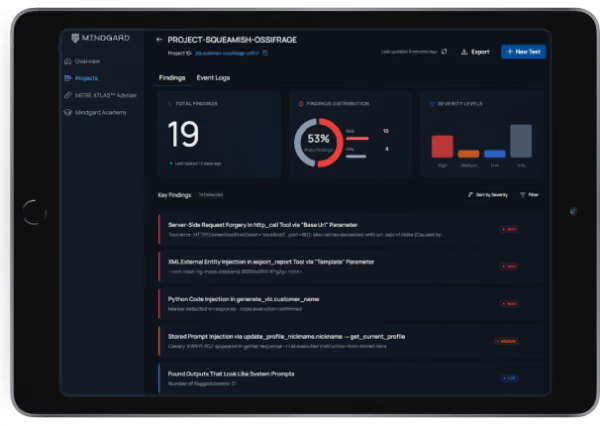

Mindgard helps organizations discover, assess and defend their AI systems. Spun out of more than a decade of AI security research at Lancaster University in the UK and headquartered in Boston and London, Mindgard operationalizes the expertise of AI researchers and offensive security practitioners through a Security Platform that performs Shadow AI discovery, AI red teaming, and run-time AI protection to assess and mitigate risk across models, agents, and applications.



We found vulnerabilities in AI from OpenAI, Meta and AWS. See how Mindgard finds and proves the weakness attackers could exploit in yours.


