
AI is transforming data security by expanding the attack surface, accelerating threats, and creating new risks across prompts, agents, APIs, models, and supply chains. Explore 11 trends shaping AI data security in 2026 and how organizations can better protect sensitive data.
With more organizations relying on it to work faster and better, AI helps workers work with vast volumes of data. Unfortunately, the speed and amount of data exchange have consequences for AI data security.
Sensitive data now moves through prompts, agents, APIs, and model pipelines so quickly that most security teams can’t keep up. Meanwhile, attackers use AI to launch more phishing attacks, automate their methods, and take advantage of security weaknesses.
Staying aware and taking action early are the best ways to defend against data security risks. The following trends show how AI is changing risk, response, and prevention.
To security leaders running enterprise security programs, the trends discussed in this article are realities that are shaping how CISOs are redesigning their data protection programs for 2026.
Visibility is the common thread that connects them all. The more sensitive data that AI systems ingest compared to any prior generation of enterprise software, the more security leaders are having to challenge assumptions about what they can actually see. "Because AI depends on large volumes of high-quality, sensitive data, organizations will need better visibility into how that data is accessed, classified, and protected," says Michael Garvin, CISO at Jaggaer.
The problem is that blind spot explains why so many companies are rapidly de-emphasizing writing policy in favor of AI-driven detection. "The surface area is orders of magnitude larger than it was three years ago. Writing more policies is not a response to that and it doesn't scale. The only way to keep up with AI-driven exposure is with AI-driven detection," said Nitay Milner, Co-Founder and CEO of ORION Security.
Attackers are evolving just as quickly. Gergana Winzer, a partner and cyber security mid-market lead at KPMG, said AI is providing threat actors the same productivity boost that defenders are seeking: "Everything can be automated today, not only on the side of companies, but also on the side of the criminals." AI is not only increasing the attack surface defenders are responsible for; it’s accelerating how fast hackers can identify and leverage vulnerabilities.
Cumulatively, these viewpoints lead to the same observation that the data is already telling us: the tools and assumptions governing enterprise data prior to AI were never designed for systems that operate this quickly, handle this much data, or autonomously decide where to route it next.
While 68% of organizations have already faced data leaks related to employee use of AI tools, only 23% have AI security policies that govern employee use. Adoption is outpacing data protection efforts: Employees are sharing sensitive information with AI tools and causing data leakage. That’s according to Metomic’s 2025 State of Data Security survey of more than 400 CISOs and security leaders. (Metomic)
AI risks aren’t just possibilities. They’re already happening, and they’re more common than you think. 59% of security leaders say they’ve experienced (or strongly suspect they’ve experienced) an AI-related security incident. (Teleport)
Threats are only going to increase. The FBI’s Internet Crime Complaint Center reported AI-related crime for the first time ever in its annual report. In 2025 alone, the IC3 received 22,364 AI-related complaints from victims that cost Americans almost $893 million. (FBI IC3)
When attacks target AI systems, enterprises feel it where it hurts: their data. In IBM’s study, 60% of AI-related security incidents resulted in data being compromised, and 31% caused an operational disruption. (IBM)
The economic ramifications are equally alarming. According to IBM’s Cost of a Data Breach Report 2025, data breaches cost companies $4.4 million on average worldwide. (IBM)
AI increases both the likelihood and size of data losses, which come with a price tag. Total losses from cybercrime reported to the FBI amounted to nearly $21 billion in 2025, a jump from $16.6 billion in 2024. (FBI IC3)

A large portion of AI use involves sharing sensitive information. Nearly 40% (39.7%) of total interactions with AI tools include prompt text, copy-paste functions, and file uploads that contain sensitive data. (Cyberhaven Labs)
This activity happens frequently. Employees input sensitive data into AI tools once every three days on average. (Cyberhaven Labs)
Much of this occurs beyond employer visibility: Employees are using personal accounts for 32.3% of ChatGPT interactions and 60.9% of Perplexity interactions. These personal accounts bypass SSO, logging, and bring-your-own-data restrictions. (Cyberhaven Labs)
Generative AI is exacerbating insider risk. Darktrace has gone so far as to say that agentic AI will be the next form of insider risk because helpful but judgment-free agents can be manipulated into disclosing or disseminating sensitive data at massive scale. (Darktrace)
The behavior is already causing breaches: 32% of the data security incidents that surveyed organizations have experienced this year now involve generative AI tools. (Microsoft Data Security Index)
AI-enabled workflows are forcing sensitive data into entirely new channels that traditional DLP just can’t reach. Prompts, model training, automated agents: these are new leak vectors that you need to consider. (Cyberhaven)
“Shadow AI” occurs when employees use models, plugins, and agents that aren’t approved by your organization. Shadow AI occurs even if you outright ban employees from using AI, and is now a quantifiable breach cause: 1 in 5 organizations cited shadow AI as the cause of a breach, and heavy usage of shadow AI added $670,000 to average breach costs. (IBM)
AI agents with API access will be new data exfiltration and privilege escalation vectors. 7 in 10 security decision makers believe AI systems have greater access privileges than a human counterpart would. (Teleport)
Securing AI adoption will require agents to be treated as “first-class identities.” Agents will need to be tracked, restricted, and scored based on behavior with defined permissions and continual oversight. (Darktrace)
AI-driven integrations facilitate sharing of information in real-time between organizations, SaaS applications, and APIs. While this has its benefits, today’s software is built on complex networks of dependencies, cloud services, and APIs. That interconnectivity can introduce security weaknesses and data leakage. (IBM X-Force)
At the same time, AI agents and tools are moving data between systems at the OS level. This allows them to circumvent traditional network monitoring and sync data to infrastructure beyond the visibility of security teams. (Cyberhaven Labs)

AI phishing and deepfake impersonation are now most common AI-related attack vectors: AI tools were used by attackers in 16% of breaches analyzed, with phishing and deepfake impersonation attacks being by far the most common use. (IBM)
Phishing attacks are also accelerating. During 2025, analysts encountered a malicious email every 19 seconds. To compare, in 2024 analysts logged a new phishing email every 42 seconds. As AI empowers attackers to generate and test huge volumes of campaigns, we’re seeing attack volumes increase rapidly. (Cofense)
Deepfake-based attacks increased 880% in 2024, while AI-powered fraud increased by another 1,210% in 2025. (Pindrop)
Attackers can run entire end-to-end attack chains, powered by AI, with limited human intervention, from reconnaissance to exfiltration. (Kiteworks)
Tools exist that can read vulnerability feeds (CVEs), produce exploit code that actually works and then allow an attacker to orchestrate attacks from the same platform. One LLM-powered tool produced exploit code based on CVE data in less than 15 minutes. HexStrike is an AI framework that can orchestrate approximately 150 attack tools. (Northwave)
Phishing has also expanded beyond spammy emails. Today’s AI-driven phishing includes real-time, conversational attacks that now make up 18% of all malicious emails. These attacks use grammatically flawless messaging tailored to mirror legitimate internal communications and establish rapport before they try to phish credentials. (Cofense)
Credential-based attacks are still pervasive, too. AI-assisted phishing and infostealer malware are automating and amplifying credential theft. IBM X-Force researchers identified over 300,000 ChatGPT credentials available for purchase on the dark web in 2025. (IBM X-Force)
Systems with too much privilege lead to higher risk with AI systems. Organizations that experienced incidents and had over-privileged AI systems reported a 76% incident rate, while organizations that limited AI systems to only what was needed reported an incident rate of 17%. (Teleport)
Identity-led attacks are growing faster because of AI. Identity-led exploits occur when bad actors use compromised credentials (including those with access to AI platforms) to view data they’re not entitled to see versus finding holes in software. IBM X-Force reports attackers “do not need zero-days, they just need valid credentials and a little bit of patience”. (IBM X-Force)
Weak authentication will always be a problem. However, it’s particularly troublesome when it comes to AI data security. Organizations experiencing fewer credential-based incidents are those who continuously enforce phishing-resistant MFA and other strong identity practices such as conditional access, least privilege and rights management, and behavioral monitoring of authentication attempts. (IBM X-Force)

Prompt injection and data/model poisoning rank among the top risks to both data integrity and confidentiality in generative AI systems, according to the OWASP Top 10 for LLM applications. (OWASP)
Large, blatant attacks grab headlines. Poisoned data is dangerous because it’s stealthy. Clean-looking training data that modifies outputs under malicious intent can slowly degrade outputs, and America’s top cyber security agencies estimate that successfully poisoning a public training data set can cost as little as $60. (NSA/CISA/FBI joint guidance)
Data drift is not just an operational concern, either. NSA, CISA, and the FBI recently listed data drift as one of the three most concerning areas of data security risk in AI systems, along with the data supply chain and poisoned data due to its ability to change data flows and decision-making. (NSA/CISA/FBI joint guidance)
AI enables system connections in ways previously never possible. For that reason, AI model supply chains and third-party integrations represent not only software dependencies but data-risk surfaces as well. At over 90 organizations, CrowdStrike saw attackers leveraging approved GenAI applications by inserting malicious prompts, allowing their intrusions to proceed through trusted identities, SaaS applications, and cloud environments. (CrowdStrike)
Attackers are even targeting the AI development layer itself. They have abused vulnerabilities in AI development platforms to gain persistence, and published malicious AI servers masquerade as legitimate services to steal sensitive information. (CrowdStrike)
To mitigate this, organizations are embedding security into the AI infrastructure layer. Sensitive data used to train and tailor models is guarded by encryption, monitoring, and access controls. The percentage of organizations that evaluate their AI products and/or services for security risks nearly doubled from 37% in 2025 to 64% in 2026. (World Economic Forum)

AI-specific governance frameworks will be required by law. For example, the EU AI Act goes into full effect in August 2026. We'll also see state level laws as well as industry-specific requirements. (Risk Management Magazine)
Expect the burden of proof to increase. Regulators are increasingly going to want independently verifiable technical documentation (model cards, centralized versioned catalogs of AI models, etc.) as proof of due diligence, not just policy docs. (Risk Management Magazine)
AI technologies are now being treated as participants in regulated conversations: AI-generated communications related to regulated business activity must be recorded, monitored and stored, just as you would any human participant. (Theta Lake)
This is easy for regulators to mandate but difficult for organizations to actually do. In fact, 88% of financial services organizations are already struggling with AI governance and data security issues, according to a survey Theta Lake conducted with 500 IT and compliance professionals. (Theta Lake)
AI also represents a data protection solution. Companies are increasingly turning to AI-based classification and anomaly detection. Deep-learning algorithms tag sensitive data, while unsupervised models can identify anomalous access patterns that evade rule-based systems. (Hyperproof)
Enterprises are even taking preemptive measures: 82% of organizations intend to integrate generative AI into their data security operations, compared to 64% from the previous year. They will be using it to identify sensitive information and classify potential critical risks prior to incidents happening. (Microsoft)
Enterprises are using AI to augment data cleansing and quality maintenance. Data lineage is also getting more attention for its role in security and data accuracy. (Data Foundation)
AI is also being used in conjunction with privacy-preserving infrastructure that broadens access to data insights but keeps sensitive, personal and proprietary data secure by limiting exposure of real data to AI systems. (Data Foundation)

Zero-trust architectures were becoming more popular before AI-driven data issues exacerbated the need for them. Security operations teams are now applying zero-trust principles to expressly define policies for AI agents, plugins, and API-driven data interactions. According to the Cloud Security Alliance’s Agentic Trust Framework, there should be no implicit trust granted to any AI agent. Trust must be earned through demonstrated behavior and then continually validated by monitoring. (CSA)
Privacy and trust extend beyond boxes to be checked for compliance. They have a measurable return on investment: 44% of cyber-loyal organizations say that having robust security and regulatory practices in place leads to higher customer trust and brand reputation. This compares with only 20% of organizations that fall below average in cyber resilience. (World Economic Forum)
Attackers are leveraging seemingly benign AI components and agent tooling to stealthily exfiltrate data. Cisco's State of AI Security 2026 report highlights how vulnerable the modern AI supply chain is (datasets, open source models, tools) and how threat actors can leverage agents to automate attack campaigns with robot-like persistence. This includes malicious integrations that send sensitive data to destinations controlled by the attackers. (Cisco)
These attacks also circumvent typical controls because they piggyback off appropriate AI integrations and service-to-service communication channels. Many rushed the adoption of LLMs into critical functions without performing security vetting steps traditionally required, opting for speed over security. This malicious activity becomes visible only at the data-flow layer. (Cisco)
One theme unites these 11 trends: AI is dramatically increasing both the amount of sensitive data flowing through systems and the attack vectors available for data exfiltration. Think of an employee copying and pasting a customer contract into their personal ChatGPT account, an agent permitted to perform actions far beyond those of its human predecessor, or a tainted dataset that cost the attacker $60 to seed. Many organizations understand this, but relatively few have bridged the gap: only 23% have established AI security policies, yet 68% have reported AI-related data breaches.
Traditional data loss prevention and perimeter security tools were not designed for this. They can’t see into a prompt. They don’t know what files, APIs, or datastore an agent is privileged to access. Legacy tools can’t mark “legitimate-looking” prompt content that’s really sending your data to an attacker-owned endpoint. Bridging this gap means you need to secure your AI systems just as you would any other high-privilege and high-change system within your environment: through continuous testing, not annual audits.
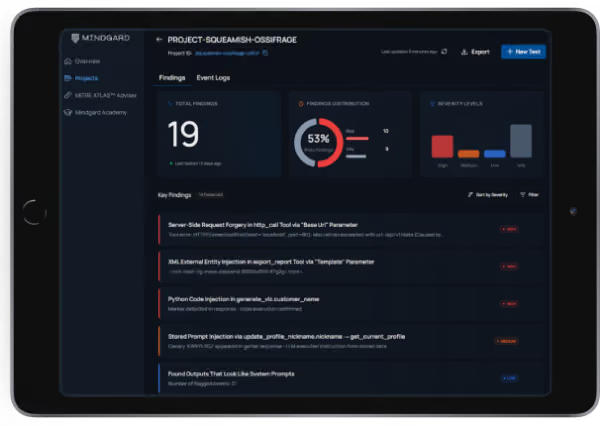
That’s the security problem Mindgard was designed to solve. Built on more than ten years of AI security research at Lancaster University, Mindgard’s Offensive Security platform is a self-directed red team that tirelessly tests your models, agents, and applications for exactly those failure modes described in this article, including prompt injection, data leakage, over-privileged agents, supply chain exposure, and others, before a malicious actor does. It also finds shadow AIs and rogue agents behind so much of today’s unauthorized data traffic, providing security teams with visibility they didn’t have before and audit-ready proof regulators are increasingly requiring.
Achieving data security during the AI era is not something you can set and forget. This evolving target must be re-tested each time there is a change to a model, prompt, or integration. Schedule a demo today to see how Mindgard can discover and remediate exploitable AI data risk before it becomes next week's breach headline.
Red teaming reveals how an attacker can manipulate your AI system. You can test for any type of vulnerabilities, such as prompt injection, data leakage, and unsafe outputs. AI is moving at breakneck speed, so red teaming never sleeps. It must continuously occur as models, data, and use cases evolve.
Think about systemic exposure, not just individual apps. AI risk heavily intersects with your identity and third-party integrations, and it increases as you weave AI more deeply into your workflows. Try approaching AI like you would core infrastructure. You’ll be far ahead of the game for what comes next.
Not necessarily. Smaller companies tend to adopt AI quicker and with less controls. They also frequently lack dedicated security resources. This makes small businesses a top target for AI-facilitated attacks.

Mindgard helps organizations discover, assess and defend their AI systems. Spun out of more than a decade of AI security research at Lancaster University in the UK and headquartered in Boston and London, Mindgard operationalizes the expertise of AI researchers and offensive security practitioners through a Security Platform that performs Shadow AI discovery, AI red teaming, and run-time AI protection to assess and mitigate risk across models, agents, and applications.



The expert-level checklist for operationalizing NIST AI RMF, ISO/IEC 42001 and the EU AI Act. 190+ interactive items and a board-ready maturity scorecard. Built for CISOs, AI governance leads and ML engineering teams.


