
Continuous AI Red Teaming: Why S&P Global Says It’s Critical to Securing the AI Era
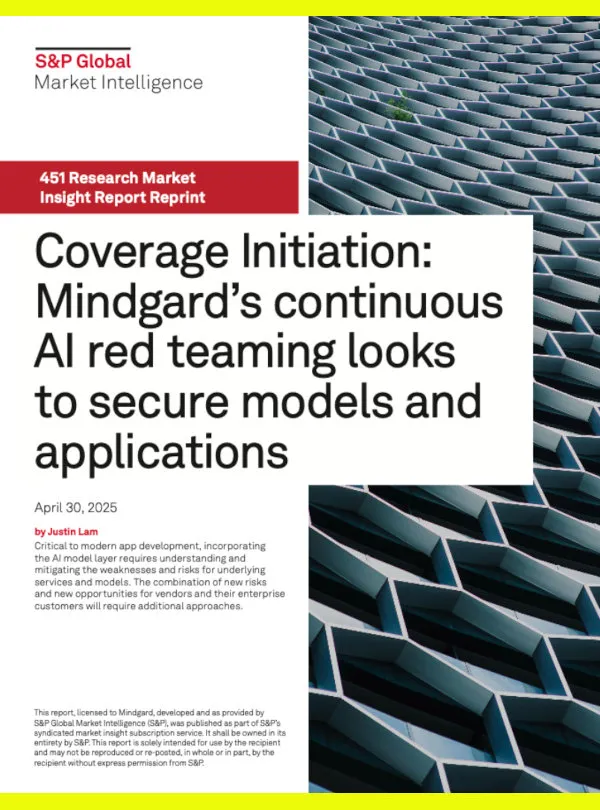
S&P Global Coverage Initiation: Mindgard’s continuous AI red teaming looks to secure models and applications

AI guardrails and gateways are becoming a core part of the enterprise AI security stack. They are designed to monitor, detect and block malicious instructions sent to and from large language models (LLMs), AI applications and agents.
They can provide a valuable layer of defence. But they should not be treated as infallible.
In a recent Mindgard webinar, I discussed one of the most important questions facing security teams evaluating these technologies: how can buyers tell whether a guardrail will actually hold up against a motivated attacker?
The answer cannot be reduced to a single accuracy score.
Some guardrail vendors report detection accuracy of 95–98% or higher. On the surface, these numbers sound compelling. But an accuracy figure is only meaningful when you understand how it was calculated.
What attacks were included in the test? Which datasets were used? Were the prompts obvious or adaptive? Did the evaluation measure false positives as well as successful detections? Was the guardrail tested in a generic lab environment or against the buyer’s actual AI system?
These details matter because the typical evaluation process can flatter the control being tested.
A vendor-led evaluation will often include a combination of:
Each approach can provide useful information. None is sufficient on its own.
Many benchmark datasets contain well-known and relatively obvious attempts, such as instructions to disregard previous prompts or generate prohibited content. A competent guardrail should detect these attacks. But blocking the most recognisable examples is not the same as resisting a determined adversary.
An attacker does not stop when an obvious jailbreak fails.
They paraphrase instructions. They translate them. They fragment attacks across multiple turns. They exploit context, manipulate role assumptions and test how the system behaves when instructions are obfuscated or disguised as legitimate requests.
In agentic systems, the stakes are even higher. The risk is not limited to what the model says. An attacker may also attempt to manipulate tool access, permissions, retrieval systems and downstream workflows.
This creates a credibility gap. Buyers may be shown strong benchmark results during an evaluation, only to discover that the same guardrail performs very differently when exposed to more realistic attacker behaviour.
The problem is not that benchmarks are useless. The problem is treating benchmark performance as proof of real-world resilience.
When evaluating a guardrail or AI gateway, security teams should ask:
Ask which datasets, attack categories and thresholds were used. Understand whether the reported score reflects a narrow benchmark or a broader evaluation of realistic adversarial behaviour.
Static prompts are not enough. Evaluations should include techniques such as multi-turn manipulation, contextual obfuscation, character-level evasion and attempts to disguise malicious intent.
A generic lab test cannot fully reflect the behaviour of your models, prompts, tools, data flows, permissions and agentic workflows. Guardrails should be evaluated in context.
Vendor-led testing has an obvious limitation: the vendor controls the methodology. Independent testing can help buyers understand where the control performs well and where its defences begin to break down.
AI systems change. Models are updated. Applications gain new capabilities. Attack techniques evolve. A point-in-time evaluation is not enough. Guardrails require continuous testing against emerging threats.
The conclusion is not that organisations should avoid guardrails or gateways. These controls can play an important role within a layered AI security architecture.
But buyers should be wary of treating a high detection score as a substitute for evidence.
A guardrail that performs well against familiar benchmark prompts but fails against adaptive attackers can create something more dangerous than an obvious security gap: a false sense of confidence.
Security teams should expect vendors to demonstrate how their controls perform under realistic conditions, against the systems they are intended to protect.
Download the slides from the webinar: Who Guards the Guardrails?
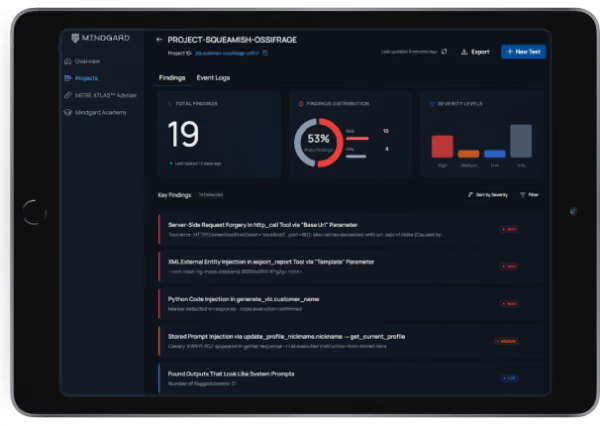

Mindgard helps organizations discover, assess and defend their AI systems. Spun out of more than a decade of AI security research at Lancaster University in the UK and headquartered in Boston and London, Mindgard operationalizes the expertise of AI researchers and offensive security practitioners through a Security Platform that performs Shadow AI discovery, AI red teaming, and run-time AI protection to assess and mitigate risk across models, agents, and applications.