Nightshade is an open-source tool that protects artists from unauthorized AI training by poisoning scraped image data, causing AI models to learn incorrect associations and making unlicensed training datasets less reliable.
Each piece of art uploaded to the internet can be scraped and used to train an AI. Approximately 70% of training data used for large AI models was scraped. Artists have noticed. A 2024 survey conducted by the Design and Artists Copyright Society (DACS) showed that 74% of professional artists in the UK were very concerned about their art being used to train AI without permission. 89% of artists believe current safeguards and regulation around AI are ineffective for combating this problem.
If data is online, generative AI (GenAI) models can find it and train on it. That includes both text and artwork or photography. The problem is that most GenAI models train on this data without consent, and that can hurt the livelihoods of the artists who post their work online. While opt-out mechanisms exist, they’re difficult to verify and even harder to enforce in practice.
Billions of dollars hang in the balance. Sales of AI art generated were projected at $5.3 billion in 2025 and are expected to grow to $40.4 billion by 2033. All of those sales will be driven by artists’ works they never agreed to license. In court artists have started pushing back: groups of visual artists filed a class action lawsuit against major companies that power image generators in 2023, claiming generative AI was “created to facilitate infringement by design.” In August 2024, a judge ruled that artists could move forward with copyright infringement claims against Stability AI, Midjourney, DeviantArt and Runway. In Congress, bipartisan legislation to help musicians, artists and writers take bad actors to court when their copyrighted works are used to train AI systems was reintroduced in July 2025 (the TRAIN Act).
Litigation and legislation are processes that take time. If artists want to take action today, Nightshade is an app that offers them a solution: court-free protection.
Nightshade is an open-source data poisoning tool released by University of Chicago's SAND Lab which enables artists to practically protect themselves against unauthorized AI training. Instead of attempting to outright prevent AI companies from scraping artwork, Nightshade poisons the dataset itself.
Nightshade was downloaded over 250,000 times in the first five days after its launch.
Nightshade is what researchers call a data poisoning tool. It modifies images to include poisoned data. The changes made to the image are imperceptible to humans.
Once it’s used to train an AI model, the model learns improper associations. Ben Zhao, a computer science professor at University of Chicago and leader of the project, explains one example of a painting of a cow in a meadow to TechCrunch: “By manipulating and effectively distorting that association, you can make the models think that cows have four round wheels and a bumper and a trunk. And when they are prompted to produce a cow, they will produce a large Ford truck instead of a cow.”
What sets Nightshade apart is the permanence of these changes:
This isn’t some watermark that can be removed with software. It works at the data level, making Nightshade hard to detect. This is great for artists, but adds another layer of risk for model devs who use scraped datasets.

Data poisoning attacks are typically deliberate attacks meant to target AI models. Nightshade is meant to poison data deliberately, but its purpose is not to steal information or manipulate a model into generating harmful outputs, but to defend artists.
“Nightshade itself is not meant as an end-all, extremely powerful weapon to kill these companies,” says Zhao. “Nightshade shows that these models are vulnerable and there are ways to attack. What it means is that there are ways for content owners to provide harder returns than writing Congress or complaining via email or social media.”
Nightshade gives artists more leverage by:
“I am not fundamentally opposed to Generative AI. But AI needs to be fair, and ethical for everybody—and not only for the companies that make AI products,” said concept artist Karla Ortiz, who testified before the U.S. Senate in 2023. “AI needs to be fair to the customers who use these products, and also for creative people like me who make the raw material that these AI materials depend upon.”
Nightshade isn’t only a concern for artists and model trainers. It also speaks to larger questions about data privacy and information trustworthiness. If you work with AI models, Nightshade should make you think carefully about:
Long-term, Nightshade might lead to cleaner, more responsibly sourced data for AI training. Scraped data will always be a wild card when it comes to model trustworthiness. If that becomes too risky for AI companies, licensed data is going to look like a much cheaper and safer alternative. That’s great for artists, but it is a significant shift that teams should be prepared for.
Nightshade shifts the power relationship between makers and AIs. Rather than depending on difficult-to-maintain opt-outs, Nightshade imposes real costs on those who ignore consent. Nightshade uses positive data poisoning. Developers should be aware of how Nightshade affects your data integrity and consent if you incorporate third-party software or data into your tools.
If Nightshade can surreptitiously manipulate models this way, you might be wondering: how can you trust the data your models depend on? Mindgard’s AI security platform helps you gain confidence by benchmarking your models against real-world adversarial threats such as data poisoning before they affect your production systems.
Challenge your AI defenses. Start red teaming with Mindgard today.
Nightshade is an open-source application that enables artists to make nearly undetectable changes to their images at the pixel-level to "poison" AI algorithms. If scraped and fed into an AI training system, that poisoned data will trip up artificial intelligence models during training, making it far less valuable as training data.
Nightshade attacks the correlations made between a text prompt and an image. Train enough poisoned examples into a model, and it'll start creating images that have nothing to do with the prompts given, severely diminishing the usefulness of that model and giving AI companies a reason to avoid scraping artists' work without permission.
Nightshade alters an image in ways that are virtually undetectable by the human eye but are very distinct to artificial intelligence platforms analyzing them. This allows it to protect artists' intellectual property while minimizing changes to the aesthetics of the image that people can see.
No. Nightshade poisons training data, so it can only affect models that are trained after the images have been poisoned. If a trained AI model ingested poisoned images, it would probably have to be re-trained without the corrupted images. Models that have already been trained before the poisoned images are ingested won’t be impacted.
Researchers note Nightshade is hard to protect against because it requires the AI model's developers to identify any images containing poisoned pixels (which aren't meant to be detectable by the human eye, or even by software data scraping tools) and remove them from training data. Doing this at scale would be incredibly difficult, as every poisoned image used would have to be found and removed from a company's data pool.
Nightshade could be weaponized to harm image-creating AI models. Attackers with agendas beyond protecting their work could cause serious harm with it. In the academic community, Nightshade is considered a type of "data poisoning attack," which is an attack vector that targets an ML model's training data to induce novel behavior during training. The group that developed Nightshade describes it not as an attack, but as a way for artists to defend their work.
Data poisoning can also target generative AI models outside of image generation. Retrieval augmented generation (RAG) is an increasingly popular method to improve the performance of LLMs, which obtain data from numerous sources making them also potential targets for poisoning. Additionally, LLMs are already experiencing their own level of model collapse due to AI-generated content being fed back into their datasets. While researchers behind Nightshade state that theoretically data poisoning concepts could be applied to text-based and multimodal models, Nightshade was built with image-to-text generation systems in mind.
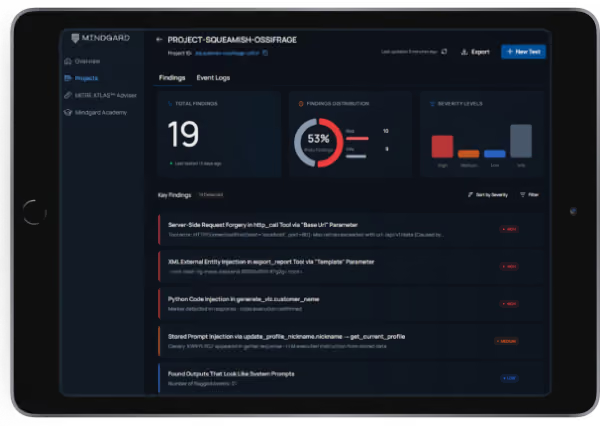

Mindgard helps organizations discover, assess and defend their AI systems. Spun out of more than a decade of AI security research at Lancaster University in the UK and headquartered in Boston and London, Mindgard operationalizes the expertise of AI researchers and offensive security practitioners through a Security Platform that performs Shadow AI discovery, AI red teaming, and run-time AI protection to assess and mitigate risk across models, agents, and applications.


We found vulnerabilities in AI from OpenAI, Meta and AWS. See how Mindgard finds and proves the weakness attackers could exploit in yours.


