
Artificial intelligence changed how organizations do their work, but it also introduced significant risk. Data is particularly vulnerable, largely in ways that traditional security frameworks just can’t handle.
From shadow AI and model-layer vulnerabilities to AI-powered phishing and deepfake fraud, threats are evolving fast. Learn where expert studies predict risk will increase and how you can respond to AI data security concerns.
AI data breaches aren’t tomorrow’s problem. They’re happening right now. Here are some alarming statistics that will give you insights into where businesses are most vulnerable, how attacks are changing, and what makes proactive teams stand out.

1. Modern AI systems face a wide range of attack techniques that target both the model itself and the surrounding infrastructure. OWASP Machine Learning Security Top 10 lists highlights input manipulation, data poisoning, model inversion, membership inference, model theft, supply chain attacks, transfer learning vulnerabilities, model skewing, output integrity failures, and model poisoning as the top AI threats. (OWASP)
2. AI attack surfaces are expanding. Security incidents linked to AI applications rose sharply from 27% of total incidents in 2023 to 40% in 2024. (Threatscape)
3. Most enterprises don’t know which attack vectors are the most risky. In fact, 46% of enterprises believe APIs are their most secure threat vector, which is far from the truth. (Netacea)
4. Most organizations take months to detect AI-related data breaches, especially those caused by third-party attacks. A SpyCloud report found that organizations took an average of nine months to identify supply chain and third-party AI-related compromises. (SpyCloud)
5. AI is spreading faster than controls can be put into place. IBM found that 13% of organizations have already suffered a data breach involving either an AI model or application. (IBM)
6. Some organizations still lack basic visibility into AI-specific security risks. Eight percent of organizations admit they have no way of knowing whether their AI systems have been compromised. (IBM)
7. Uncontrolled AI usage is emerging as a major source of enterprise risk. One in five organizations reports experiencing a breach from shadow AI, which is unauthorized or unregulated AI usage by employees and vendors. (IBM)
8. Shadow AI has real consequences. Twenty percent of organizations experienced breaches directly linked to unauthorized AI use. (SpyCloud)
9. Most shadow AI incidents happen in companies without formal controls or policies. Since only 37% of businesses have formal AI governance policies, failing to have one in place can lead to more data breaches. (IBM)
10. Data visibility is a persistent blind spot for businesses. Eighty-four percent of organizations want greater control over the data their teams feed into AI tools. (Threatscape)
11. Employees using generative AI are a serious security risk that businesses are struggling to control. 96% of companies expressed concern over employees using generative AI. (Threatscape)
12. Companies simply can’t see most AI attacks. AI-powered cyberthreats are continuing to evolve faster than companies can implement effective detection capabilities. Just under a quarter of organizations (26%) feel very confident in their ability to detect AI-powered cyberthreats, especially those that leverage agentic AI. (Auxis)
13. Leaders’ concerns about employee AI use aren’t unfounded. Fifteen percent of employees access generative AI tools at least once every 15 days on corporate devices, often using personal email accounts to bypass restrictions. (Verizon DBIR)
14. Lack of access controls contribute to nearly all AI-related breaches. Ninety-seven percent of organizations that experienced an AI-related breach did not have controls over who could access AI models/applications at the time of the breach. (SpyCloud)
15. The majority of organizations lack formal processes in place to monitor/control AI usage. Just 34% of organizations perform regular audits to detect unauthorized AI use. (Network World)

16. AI is a fantastic tool for preventing data breaches, but attackers are also using it to design more damaging exploits. Sixteen percent of studied data breaches involved attackers using AI tools, primarily for phishing (37%) and deepfake impersonation (35%). (Baker Donelson)
17. AI is accelerating the scale and effectiveness of social engineering attacks. AI-generated phishing accounts for more than one-third of AI-enabled breaches, and deepfake impersonation accounts for roughly another third. (Baker Donelson)
18. AI-generated content is being leveraged to launch highly targeted attacks. 46% of respondents say there’s been an increase in targeted phishing emails as a result of AI language models, many of which include deepfakes intended to legitimize the malicious campaign. (Deep Instinct)
19. Most security leaders think they’ll be facing AI attacks daily within months. 93% of security leaders surveyed by Netacea expect they’ll be hit with daily attacks that leverage AI in some capacity in six months or less. (Netacea)
20. AI is significantly increasing the volume and effectiveness of email-based attacks. Email isn’t immune to AI-based threats. Link threats surged 74% YoY from 2023 to 2024 as attackers increasingly leverage malicious AI-powered links. (VIPRE)
21. AI is being used to quickly create spam on an industrial scale. 40% of spam emails sent globally are AI-generated. That number is expected to increase as generative AI models make it easier for attackers to adopt AI. (VIPRE)
22. High-value industries like finance are at a greater risk of AI deepfakes. In fact, deepfake incidents in fintech surged 700% in 2023 alone. (Deloitte)
23. AI deepfakes are much more likely to target lucrative industries. Research published by Harvard Business Review finds that large language models have reduced the cost of launching phishing attacks by about 95%. (HBR)
24. Data breaches are getting more expensive. The average cost of a data breach globally was $4.88 million in 2023, an increase of just shy of 10% YoY. (Cobalt)
25. Losses from cybercrime continue to hit new highs nationally. In the FBI’s 2024 Internet Crime Report, cybercrime victims reported $16.6 billion in losses to law enforcement and filed complaints that were 9% higher than the year prior. (FBI IC3)
26. Fraud is responsible for the majority of losses. Cyber-enabled fraud made up 83% of all losses reported to the FBI in 2024. The top schemes reported included call center scams, emergency scams, toll scams, and gold courier fraud. (FBI IC3)
27. Law enforcement took significantly more action against cybercrime criminals. Arrests were up a reported 700% from 2023 to 2024. (FBI IC3)

28. To mitigate potential data loss, organizations are implementing controls at different levels. 43% prevent uploads of sensitive data into AI applications, 42% log all AI-related activities and content, and 42% block access to unauthorized AI tools. (Threatscape)
29. Reactive approaches won’t protect data from exfiltration. That’s why 82% of organizations are implementing prevention-first cybersecurity strategies. (Deep Instinct)
30. Companies are expected to spend more on security measures as breaches increase. Gartner analysts predict generative AI risks will drive a 15% increase in security software spending overall, with spending on CASB and cloud workload protection products hitting $8.7 billion in 2025. (Gartner)
31. With cyber risks on the rise, businesses are spending more on security. The average organization spent 8.6% of its budget on cybersecurity in 2020. That percentage is expected to grow to 10.9% by 2025. (Auxis)
32. Company culture influences business resilience. By 2026, enterprises that provide cybersecurity training will experience 40% less cybersecurity incidents caused by employees, according to Gartner. (Gartner)
33. Cybersecurity companies are using AI to help protect against data exfiltration. Between 60-70% of businesses say they’re using AI-enabled cybersecurity products. (Middlebury Institute)
34. Automated security drastically reduces breach costs. Organizations with high levels of security automation experience average breach costs of $3.84 million versus $5.72 million for companies without AI deployments. That’s 31% less spending on breaches (or about $1.8 million) thanks to AI. (Digitalisation World)
35. More mature AI security deployments deliver even greater reductions in breach costs. In a separate report, fully deployed AI environments reported average breach costs of $2.45 million, compared with $6.03 million without AI, cutting breach costs by half. (Bitdefender)
36. Automation improves breach lifecycles. Security automation cuts the average breach lifecycle to 249 days versus organizations without AI, which experienced lifecycles of 323 days. That’s a 74-day improvement. (Kaseya)
37. AI-secured organizations see improvement in breach lifecycles. Security organizations using some form of AI and automation to detect and contain breaches saw average lifecycle improvements of close to 100 days. (Digitalisation World)
38. AI-driven security significantly reduces the financial impact of breaches. Cost reductions from full security AI deployment range from 30% to 65%, translating to approximately $1.8 to $3.6 million in savings per breach. (Bitdefender)
39. Even partial AI deployment yielded measurable gains. Some organizations reduced the average lifecycle from 323 days to 299 days—a 24-day acceleration. (Kaseya)
40. Security AI and automation can dramatically reduce the financial impact of breaches. IBM data shows that fully deployed security AI and automation reduced breach costs by approximately $3.81 million compared to environments without automation. (IBM)
41. Automation helps detect and contain breaches faster. Not only does automation help identify breaches faster (184 days vs. 239 days without AI), but teams can also contain breaches faster (63 days vs. 85 without AI). Overall breach lifecycles were also shorter for organizations with automation technology deployed. (IBM)
42. Most organizations realize financial returns quickly after deploying security AI. Among enterprises deploying security AI, 74% report positive ROI within the first year, and 88% of early adopters achieve positive ROI in year one. (TotalAssure)
43. AI security reduces breach costs at both the incident and individual record level. After implementing AI defenses, organizations in one study saw breach costs drop from $234 to $128 per record. That’s a 45% improvement in cost. (TotalAssure)
44. AI-driven breach detection improves both response speed and financial outcomes. Teams using AI to detect breaches shortened breach lifecycles by an average of 80 days and saved approximately $1.9 million in breach costs compared to non-AI detection approaches. (Network World)
45. 87% of executives believe AI vulnerabilities are their fastest-growing cyber risk through 2026. They now rank data leaks as their top AI security concern over attacks from adversarial machine-learning models. (Forbes)
46. 54% of boards do not consider AI governance in their top five security initiatives. Organizations that don’t prioritize AI governance are 26-28 percentage points behind their peers on foundational AI security capabilities. (Kiteworks)
47. 63% of organizations can’t enforce purpose limitations on deployed AI agents. Other areas where organizations lack confidence: 60% say they lack reliable kill‑switches to shut down misbehaving AI systems at will and 55% say they cannot isolate AI systems from critical networks. (Kiteworks)
48. Organizations are rapidly planning to embed AI into security operations. Eighty-two percent of organizations now have plans to use generative AI in their data security programs, up from 64% the previous year. (Microsoft)
49. 34% of organizations ranked data leaks caused by generative AI technologies as their top data security concern through 2026. That’s a significant jump from the 22% who said the same last year. (Secureframe)
50. Security teams are responding by operationalizing GenAI for defense. The top planned use cases include discovering sensitive data (44%), detecting critical data security risks (43%), investigating potential incidents (43%), assessing overall data‑security posture (42%), and securing data environments (41%). (Secureframe)
The numbers don’t lie. AI risk is growing faster than most security programs. Detection lags behind adoption. Weak governance leaves data exposed. Attackers are evolving rapidly, and they use the same tools and infrastructure your own teams are leveraging.
There is opportunity here, too. The ROI of getting this right is tangible: faster detection, reduced breach costs, shorter incident lifecycles. See positive ROI within the first year of deployment for most organizations that automate security proactively.
The difference comes down to control and visibility. Mindgard’s Offensive Security platform is built for the AI layer, testing models, agents, and AI-powered applications the way real adversaries do. It targets prompt injection, data-leakage paths, model abuse, and agent manipulation before attackers can exploit them.
Every defense starts with visibility. But many organizations lack a full inventory of models, integrations, third parties, and data flows where AI is present. Mindgard’s AI Security Risk Discovery & Assessment helps you see where AI is actually being used in your environment. If you can’t see it, you can’t secure it.
Implement Mindgard’s Automated AI Red Teaming to continuously test models and workflows under real-world conditions and expose weaknesses. That includes model-layer exploits and agent behavior failures that traditional scanners miss.
Add Mindgard’s AI Artifact Scanning to your stack to review model files, prompts, configurations, and supporting components for embedded risk. This closes another blind spot where vulnerabilities often hide in plain sight.
The days of AI data security being an abstract concept are long gone. Boards are demanding answers. Regulators are taking notice. Cybercriminals are actively exploiting vulnerable AI implementations.
It’s time to take action. If you want AI to succeed as a business enabler without becoming a major liability, you need to secure it like you’d secure any other attacker surface. That means testing it like someone who wants to hack your business will. Learn how Mindgard can help by scheduling a demo today.
Shadow AI refers to any AI application your vendors or employees are using that falls outside of your governance policies. The risk is the silent exposure of your data.
When someone uploads your intellectual property, customer data, or internal files to an unapproved AI platform, you have zero visibility and control. Suddenly, you’re exposed to regulatory, contractual, and IP risk with zero visibility to leadership.
With AI tools, cyberattacks are becoming less expensive and more accessible. By automating reconnaissance, generating phishing content, creating deepfakes, and scaling social engineering campaigns, threat actors can breach an organization more quickly than ever before. Rather than sending dozens of victims generic phishing emails, they can send thousands of personalized messages in less time.
Rather than relying on any single solution, it’s important to layer controls. Preventative governance and technical controls should be implemented along with continued monitoring to stop AI data leaks.
Steps your business can take include implementing strict access management, auditing AI usage, preventing uploads of sensitive data, monitoring for rogue API calls, defense at the model layer, and continuous automated red teaming.
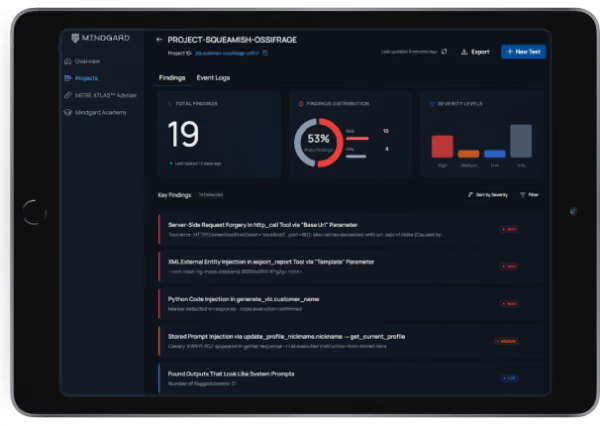

Mindgard helps organizations discover, assess and defend their AI systems. Spun out of more than a decade of AI security research at Lancaster University in the UK and headquartered in Boston and London, Mindgard operationalizes the expertise of AI researchers and offensive security practitioners through a Security Platform that performs Shadow AI discovery, AI red teaming, and run-time AI protection to assess and mitigate risk across models, agents, and applications.



The expert-level checklist for operationalizing NIST AI RMF, ISO/IEC 42001 and the EU AI Act. 190+ interactive items and a board-ready maturity scorecard. Built for CISOs, AI governance leads and ML engineering teams.


