(updated as of March 9, 2026)
THIS END USER LICENSE AGREEMENT (THE “AGREEMENT”) IS ENTERED INTO BY THE MINDGARD ENTITY(IES) IDENTIFIED IN THE ORDER FORM (“MINDGARD”), AND THE “CUSTOMER” IDENTIFIED IN THE ORDER FORM INTO WHICH THIS EULA IS INCORPORATED BY REFERENCE. THIS EULA TOGETHER WITH THE ORDER FORM CONSTITUTE THE “AGREEMENT” BETWEEN MINDGARD AND CUSTOMER, WHICH GOVERNS MINDGARD’S PROVISION AND CUSTOMER’S USE OF THE SOFTWARE AND OTHER MINDGARD MATERIALS AND IS EFFECTIVE AS OF THE DATE SHOWN ON THAT ORDER FORM (THE “EFFECTIVE DATE”).
THE PARTIES AGREE AS FOLLOWS:
1. INTERPRETATION
1.1 The following definitions apply in this EULA, including in the introductory language set out above:
(a) “Authorised User” means (i) employees of Customer; or (ii) other individual end users or categories of end users approved in writing by Mindgard or expressly identified in the Order Form, in each case of (i) or (ii), that are authorised by Customer to access and use the Software.
(b) “Beta Feature” means any feature or functionality of the Software, which is made available by Mindgard on a ‘beta’, pre-release or evaluation basis.
(c) “Claim” means any claim, demand, complaint, proceeding or other action.
(d) “Customer Inputs” means any artificial intelligence models owned or used under licence by Customer, which that are submitted by Customer to the Software for processing and analysis to generate Results; but expressly excludes any Results themselves, and any algorithms, artifacts, models, objects, or software that are part of the Software or used to generate any Results from the Software.
(e) “Customer Environment” means Customer’s computing environment in which the Software will be installed, which may include a ‘Virtual Private Cloud’ environment operated and controlled by Customer.
(f) “Documentation” means any printed and digital instructions, online help files, technical documentation and user manuals made available by Mindgard to Customer describing the intended operation of the Software.
(g) “Initial Term” means the initial term as set out in the Order Form.
(h) “Intellectual Property Rights” means all copyright and related rights, patents, rights to inventions, utility models, trade marks, service marks, trade, business and domain names, rights in trade dress or get-up, rights in goodwill or to sue for passing off, unfair competition rights, rights in designs, rights in computer software, database rights, topography rights, moral rights, rights in confidential information (including know-how and trade secrets) and any other intellectual property rights, in each case whether registered or unregistered and including all applications for and renewals or extensions of such rights, and all similar or equivalent rights or forms of protection in any part of the world.
(i) “Mindgard Materials” means the Software, Documentation, Results and any other materials or information (including Mindgard’s Confidential Information) delivered or made available by Mindgard under the Agreement.
(j) “Order Form” means a mutually executed Order Form, statement of work, subscription agreement, services agreement, purchase order, or any other written agreement, schedule, addendum, or document that incorporates this EULA or otherwise sets out the Software to which the Customer is obtaining access or a licence under and subject to this EULA, together with the Fees to be paid by Customer and any other applicable commercial terms or particulars.
(k) “Renewal Term” means the renewal term set out in the Order Form.
(l) “Results” means any results, scores, findings or other outputs related to any security vulnerabilities and associated mitigations concerning to the Customer Inputs, which are generated as a result of the Customer’s submission of those Customer Inputs to the Software.
(m) “Software” means the Mindgard software identified on the Order Form to be delivered by Mindgard to Customer, including where applicable any fixes, updates, upgrades and any Beta Features made available to Customer by Mindgard.
(n) “Specifications” means the then-current version of the product specifications for the features and functionality of the Software (including as may be set out in the Documentation).
(o) “Term” means the Initial Term and any Renewal Term(s).
(p) “Use Limitations” means any use limitations or restrictions with respect to Customer’s use of the Software set out in the Order Form.
1.2 The following rules of interpretation shall apply in this Agreement: (a) any reference to this Agreement terminating shall, where the context requires, include a reference to this Agreement terminating by expiry of the Term; (b) the words “include” and “including” (or similar) shall be construed as illustrative only and shall not limit the sense of the description, definition, phrase or term(s) that comes before the relevant term; and (c) any reference to the “Parties” means Mindgard and Customer, and “Party” shall mean one of them.
2. LICENCES AND USE
2.1 License to Software. Subject to the terms and conditions of the Agreement, Mindgard hereby grants to Customer, during the Term, a non-exclusive, non-sublicensable, non-transferable license to install, and for its Authorised Users to use, the Software in the Customer Environment for Customer’s internal business purposes in accordance with the Documentation and any Use Limitations.
2.2 License to Results. Subject to the terms and conditions of the Agreement, Mindgard hereby grants to Customer, during the Term, a non-exclusive, non-sublicensable, non-transferable licence to use the Results for Customer’s internal business purposes in connection with its information and software security procedures and programmes.
2.3 License to Documentation. Subject to the terms and conditions of the Agreement, Mindgard hereby grants to Customer a non-exclusive, non-transferable, non-sublicensable license during the Term to reproduce for internal dissemination, without modification, and internally use a reasonable number of copies of the Documentation solely in connection with Customer’s authorised use of the Software (as set out in Section 2.1).
2.4 Updates. During the Term, Customer is entitled to all bug fixes and updates to the Software, when and if available, that Mindgard makes generally available to its customers (in its sole discretion) without any additional charge.
2.5 Restrictions. The rights granted in this Agreement are conditioned upon Customer’s compliance with the following restrictions. Customer shall not and shall not suffer, allow, assist or enable any other person to: (a) use, copy or reproduce any Mindgard Materials: (i) otherwise than to the limited extent necessary to exercise the licensed use of the same hereunder; or (ii) in a way that infringes, misappropriates, or violates any Intellectual Property Rights or other right of Mindgard or any third party; (b) attempt to probe, scan or test the vulnerability of the Software, breach the security or authentication measures of the Software; (c) use the Mindgard Materials to create, market or distribute any product or service that is similar to, competitive with, or otherwise replicates or seeks to replicate any features or functionalities of, the Mindgard Materials; (d) engage in competitive analysis or benchmarking of the Mindgard Materials; (e) transfer, distribute, sell, resell, lease, license, sublicense, operate as a service for or on behalf of others, or otherwise publish or assign the Mindgard Materials or offer access to the Mindgard Materials to a third party other than Authorised Users for Customer’s internal business purposes; (f) use the Software to process any unlawful, infringing or harmful data or code, or any data or code that Customer is not authorised to transmit, either to or from the Software; (g) remove, alter or obscure any trademark notice, copyright notice or any other proprietary notice from any Mindgard Materials; (h) circumvent, disable, or interfere with security-related or rate-limiting features of the Software or features that limit, prevent or restrict use, access to, or copying of the Mindgard Materials, or that enforce limitations on the use of the Mindgard Materials; (i) reverse engineer, decompile, unbundle, disassemble the whole or any part of the Software, or otherwise create, access, inspect or derive any data or datasets in the Mindgard Materials or any source code to any Software or other software composing the Mindgard Materials, unless and to the limited extent that applicable laws of Customer’s jurisdiction require Mindgard to give Customer the right to do so to obtain information necessary to render certain software interoperable with other software – provided that in such case, Customer must first request such information from Mindgard, and Mindgard may (in its sole discretion) either provide such information to Customer or impose reasonable conditions on such use of the source code to ensure that Mindgard and its licensors’ proprietary rights in the source code for any relevant part of the Mindgard Materials are protected; (j) otherwise use the Mindgard Materials except as expressly permitted under this Agreement; or (k) take any action designed or intended to do any of the foregoing. Breach of this Section 2.5 constitutes a material and irremediable breach of this Agreement for the purposes of Section 9.2.
3. OWNERSHIP
3.1 Mindgard Materials. As between the Parties, Mindgard retains sole ownership of all right, title and interest, including all Intellectual Property Rights, in and to the Mindgard Materials. Customer will not acquire any right, title or interest in or to the Mindgard Materials, and Mindgard reserves all rights therein and thereto not expressly granted in Section 2. The Mindgard Materials constitute Mindgard’s Confidential Information.
3.2 Customer Inputs. As between the Parties, Customer retains sole ownership of all right, title and interest, including all Intellectual Property Rights, in and to the Customer Inputs. Mindgard will not acquire any right, title or interest in or to the Customer Inputs and Customer reserves all rights therein and thereto not expressly granted in this Agreement.
4. FEES
4.1 Fees. Customer shall pay the fees set forth in the Order Form (“Fees”) in advance in accordance with this Section 4 and any relevant terms of the Order Form. Mindgard shall issue Customer with invoices in respect of any Fees that come due and payable and Customer shall pay the amounts shown in all such invoices in full into the Mindgard Bank Account (or such other account as directed by Mindgard) within thirty (30) days of the invoice date, unless otherwise agreed in the Order Form. The Parties acknowledge and agree that failure by Customer to pay any Fees when due shall constitute a ‘material breach’ for the purposes of Section 9.2(a). All Fees: (a) shall be payable in the currency shown on the Order Form; (b) are non-cancellable and non-refundable unless and to the extent expressly provided otherwise in this Agreement; and (c) are exclusive of any and all taxes (including value added tax). Mindgard reserves the right to increase the Fees following the Initial Term, and each Renewal Term thereafter, provided that Mindgard will provide notification of any such increase at least sixty (60) days in advance of the end of the Initial Term or then-current Renewal Term (as applicable).
4.2 Late payments. In addition to any other rights or remedies available to Mindgard, if Customer fails to pay any sums by the due date: (a) any portion of any sums that is not paid when due and payable shall accrue interest equal to the higher of: (i) four percent (4%) per annum above the Bank of England’s base lending rate from time to time; or (ii) the default statutory rate applicable from time to time under the Late Payment of Commercial Debts (Interest) Act 1998; or (iii) where neither (i) nor (ii) applies, the higher of: (A) four percent (4%) per annum above the applicable central bank base lending rate for the currency in which payment is denominated, from time to time; or (B) the maximum rate permitted by applicable law; in each case accruing on a daily basis and compounded quarterly from the time the indebtedness arose, with interest on all overdue interest accruing at the same rate and calculated and payable in the same manner until fully paid, whether before or after judgment; and (b) Mindgard may immediately suspend the access to the Software until payment of the sums is made by Customer in full without liability to Customer or prejudice to any other rights or remedies available to Mindgard in the circumstances.
4.3 Excess Usage. In the event that Customer exceeds the prompt quantities stated within the Order Form, including any additional prompts purchased in addition to the original Order Form amount ("Excess Usage"): (a) Customer shall immediately notify Mindgard of such Excess Usage; (b) the prompt quantity shall be automatically amended to reflect the amount of such Excess Usage for the remainder of the term; (c) the fees payable for such additional quantity shall be charged at Mindgard's then-current rates for such usage; and (d) upon invoice, Customer shall pay for the Excess Usage at the amounts so invoiced.
4.4 Audits. Customer shall maintain, and Mindgard is entitled to audit, any records relevant to Customer’s use of the Mindgard Materials hereunder. Mindgard may audit such records on reasonable notice at Mindgard’s cost (or, if, and only if, the audits reveal material non-compliance with the Agreement, at Customer’s cost).
5. WARRANTIES
5.1 Reciprocal Warranties. Each Party warrants and represents on an ongoing basis that it has, and undertakes that it shall continue to have for the duration of this Agreement at all relevant times, the requisite power, capacity and authority to enter into this Agreement, to perform and carry out its the obligations under this Agreement.
5.2 Limited Software Warranty. Mindgard represents and warrants that during the first ninety (90) days following the date on which the Software is first delivered to Customer (the “Warranty Period”), the Software will, in all material respects, conform to the Specifications. Mindgard’s sole and exclusive obligation, and Customer’s sole and exclusive remedy, for a breach of this warranty during the Warranty Period shall be that Mindgard shall be required to use commercially reasonable efforts to correct the Software to conform in all material respects to the Specifications, and, if Mindgard is unable to materially restore such functionality within thirty (30) days from the date of written notice of said breach, as Customer’s sole and exclusive remedy, Customer shall be entitled to terminate the Agreement upon written notice and receive a pro-rata refund of the Fees which have been paid for the Software under the Order Form. The warranty set out in this Section 6.1 shall not apply: (a) in the event that Customer has breached any of the restrictions outlined in Section 2.5; (b) to any defects or issues arising as a result of any use of the Software in combination with other products, hardware, equipment, software, or data not expressly authorised by Mindgard to be used with the Software; (c) to any defects or issues arising as a result of Customer’s use of the Software otherwise than as described in the Documentation; and/or (d) any defects or issues arising as a result of any Customer Inputs.
6. DISCLAIMER AND BETA SERVICES
6.1 Disclaimer. Except as expressly provided in Section 5.2, to the fullest extent permitted by law, Mindgard disclaims all conditions, warranties, representations, undertakings, or other terms which might have effect between the Parties with respect to the Mindgard Materials, or otherwise be implied or incorporated into this Agreement, whether by statute, common law, custom or otherwise, including any implied conditions, warranties, undertakings or other terms relating to satisfactory quality, reasonable skill and care, fitness for any particular purpose, non-infringement, ability to achieve a particular result or arising from course of dealing or usage of trade. Furthermore, Customer acknowledges that Mindgard does not warrant, represent, endorse, support or guarantee the completeness, truthfulness, accuracy, reliability, performance, appropriateness, fitness for purpose or any other attributes of any Results, and that Mindgard shall not be responsible for reviewing or attempting to verify the accuracy or currency of any Results. Customer shall be solely responsible for Customer’s use of the Software and for evaluating the fitness of any Results as appropriate for Customer’s specific use case or any other purpose.
6.2 Beta Testing. From time to time, Customer may have the option to participate in a programme where Customer is permitted at no additional cost to access certain Beta Features. Customer may only use the Beta Features to internally evaluate and test such Beta Features and for no other purpose whatsoever. The Beta Features are not generally available and are provided by Mindgard “as is”, without any conditions, warranties, representations, undertakings, or other terms either express or implied whatsoever (including as to non-infringement, merchantability, satisfactory quality, use of reasonable skill and care or fitness for any particular purpose). Furthermore, Mindgard does not provide any indemnities or warranties whatsoever in relation to the Beta Features (e.g., Sections 5.2 and 7.1 do not apply in respect of Beta Features). As Mindgard sees fit in its sole discretion, it may from time to time impose, and Customer shall comply with, certain additional restrictions or limitations on Customer’s and its Authorised Users’ use of the Beta Features. Mindgard may terminate Customer’s access to any Beta Feature(s) at any time with or without notice, at which point Customer and its Authorised Users must stop using such Beta Feature(s).
7. INDEMNITIES
7.1 Mindgard Indemnities. Subject to Sections 7.2 and 7.3, Mindgard shall indemnify Customer from and against amounts awarded in judgment or settlement of any third party Claim against Customer that Customer’s use of the Software as permitted under this Agreement, infringes, misappropriates or violates the Intellectual Property Rights of that third party. The obligations set forth in this Section 7.1 shall constitute Mindgard’s entire liability and Customer’s sole remedy for any actual or alleged infringement, misappropriation or violation of any Intellectual Property Rights of a third party arising out of or in connection with this Agreement.
7.2 Customer obligations. Customer shall: (a) notify Mindgard in full, accurate and complete detail in writing promptly (and in any event within two (2) days) after it becomes aware of any event or any Claim, which it believes may give rise to a claim for indemnification under Section 7.1 (an “Indemnified Claim”); (b) allow Mindgard sole authority to control the defence and settlement of any Indemnified Claim; (c) provide Mindgard with all reasonable cooperation in the defence of such Indemnified Claim; and (d) not settle or compromise any Indemnified Claim or make any admission of liability without the express prior written consent of Mindgard. In relation to any Indemnified Claim, at its option, Mindgard may elect to: (x) modify or replace all or any relevant part of the Software so that it becomes non-infringing; (y) obtain any required licence(s) to use the applicable third-party Intellectual Property Rights; or (z) if the options set out in (x) or (y) are judged by Mindgard not to be reasonably practicable in the circumstances, terminate this Agreement on written notice to Customer and refund to Customer any pre-paid Fees pro-rated to reflect the remainder of the Initial Term or then-current Renewal Term (as applicable).
7.3 Exclusions. Mindgard shall have no liability whatsoever to Customer under the indemnity set out in Section 7.1 in respect of any Indemnified Claims based on or arising as a result of or in connection with: (a) any breach of this Agreement (including the restrictions outlined in Section 2.5 or any use of the Mindgard Materials by Customer not in accordance with the Agreement); (b) any use of the Software in combination with other products, hardware, equipment, software, data or other content (including any Customer Environments) where the Software would not by itself be infringing; (c) any modification of the Software by any person other than Mindgard or its expressly authorised agents; (d) any Beta Features (including any use of any other elements of the Software in conjunction with any Beta Features); (e) any Customer Inputs; (f) compliance with designs, guidelines, plans or specifications provided by Customer; (g) Customer’s failure to implement and apply any bug fixes or updates to the Software made available to Customer by Mindgard; or (h) any failure by Customer to comply with any applicable law, regulation or applicable code of practice.
8. LIMITATION OF LIABILITY
8.1 Unlimited Liability. Nothing in this Agreement limits or excludes: (a) the liability of either Party for: (i) death or personal injury caused by its negligence; (ii) fraud or fraudulent misrepresentation; or (iii) any other act, omission, or liability which may not be limited or excluded by applicable law; (b) Mindgard’s liability under the indemnity set out in Section 7.1; or (c) Customer’s liability: (i) to pay Mindgard any sums due and payable under this Agreement; or (ii) arising as a result of any breach of Section 2.5.
8.2 Exclusions. Subject only to Section 8.1, Mindgard shall not in any circumstances be liable to Customer whether in contract, tort (including for negligence), breach of statutory duty (howsoever arising), misrepresentation (whether innocent or negligent), restitution or otherwise, for: (a) any (i) loss, damage or liability (in each case whether direct or indirect) of profits, business, business opportunities, revenue, turnover, reputation or goodwill, anticipated savings or wasted expenditure (including management time); or (ii) special, indirect or consequential loss or damage whatsoever, in each case (i) and (ii) however arising and even if Mindgard was aware of the possibility that such loss or damage might be incurred; or (b) any loss, damage or liability (in each case whether direct or indirect) arising as a result of (i) Customer’s or any third party’s reliance upon any Results; (ii) any loss or corruption of data or information; (iii) any breach, non-performance or any other default by Customer under this Agreement; and/or (iv) any failure by Customer to comply with any applicable law, regulation or applicable code of practice.
8.3 Cap. Subject to Section 8.1 and 8.2, Mindgard’s total aggregate liability under this Agreement (whether in contract, tort (including negligence or breach of statutory duty), misrepresentation (whether innocent or negligent), restitution or otherwise) arising in connection with the performance or contemplated performance of this Agreement shall under no circumstances exceed one hundred percent (100%) of the Fees paid by Customer under and in accordance with this Agreement in the twelve (12) months immediately preceding the first event (or first event in any series of connected events) giving rise to a Claim against Mindgard – provided that, the existence of more than one Claim, or event (or series of connected events) from which liability arises shall not enlarge the limit set out in this Section 8.3.
9. TERM AND TERMINATION
9.1 Commencement and duration. Unless terminated earlier pursuant to the terms of Section 9.2, this Agreement shall: (a) commence on the Effective Date and continue for the Initial Term; and (b) automatically renew for further successive Renewal Terms at the end of the Initial Term and at the end of each Renewal Term thereafter unless either Party gives written notice to the other Party not later than thirty (30) days before the end of the Initial Term or then-current Renewal Term to terminate this Agreement upon the expiry of the Initial Term or then-current Renewal Term.
9.2 Termination. Without affecting any other right or remedy available to it, either Party may terminate this Agreement with immediate effect by giving written notice to the other Party if the other Party: (a) commits a material breach of any term of this Agreement which breach is irremediable or (if such breach is remediable) fails to remedy that breach within a period of thirty (30) days after being notified to do so; or (b) becomes insolvent or unable to pay its debts, proposes a voluntary arrangement, has a receiver, administrator or manager appointed over the whole or any part of its business or assets, suffers the presentation of any petition, the making of any order shall or the passing of any resolution for its winding up (except for the purposes of a bona fide solvent amalgamation or reconstruction), bankruptcy or dissolution, otherwise proposes or enters into any composition or arrangement with its creditors or any class of them, ceases to carry on business or claims the benefit of any statutory moratorium, or undergoes any similar or equivalent process in any jurisdiction.
10. CONSEQUENCES OF TERMINATION
10.1 Consequences. On termination of this Agreement: (a) notwithstanding Section 4, Customer shall promptly (and in any event within ten (10) days of the date of termination) pay Mindgard any outstanding balances owing to Mindgard under this Agreement; (b) any and all licences, permissions and authorisations granted to Customer by Mindgard under this Agreement will terminate automatically, and Customer shall immediately cease all use of any and all Mindgard Materials; and (c) each Party shall promptly: (i) return all Confidential Information (including the Mindgard Materials) received from the other Party, together with all copies, or (ii) destroy such Confidential Information and all copies – on request from the other Party in writing, each Party shall certify that it has complied with its obligations under Section 10.1(c).
10.2 Survival and accrued rights. Any provision of this Agreement that either expressly or by implication is intended to come into or continue in force on or after termination of this Agreement shall remain in full force and effect. Termination of this Agreement shall not affect any rights, remedies, obligations or liabilities of the Parties that have accrued up to the date of termination, including the right to claim damages in respect of any breach of this Agreement which existed at or before the date of termination.
11. CONFIDENTIAL INFORMATION
In this agreement, “Confidential Information” means any information that is clearly labelled or identified as confidential, or reasonably ought to be treated as being confidential. Confidential Information excludes any information which: (a) is or becomes publicly known other than through a breach of this Agreement; (b) was in the receiving Party’s lawful possession before the disclosure; (c) is lawfully disclosed to the receiving Party by a third party without restriction on disclosure; (d) is independently developed by the receiving Party and that independent development can be shown by written evidence; or (e) is required to be disclosed by law, by any court of competent jurisdiction or by any regulatory or administrative body. Each Party shall hold the other’s Confidential Information in confidence and, except as otherwise provided in this Agreement, not make the other’s Confidential Information available to any third party unless that third party is subject to an equivalent duty of confidentiality. Neither Party shall use the other’s Confidential Information for any purpose other than the implementation and performance of this Agreement.
12. GENERAL
12.1 Prevail. To the extent of any inconsistency or conflict between any provision(s) of this EULA and any provision(s) of the Order Form, the relevant provision(s) of the Order Form shall govern and prevail.
12.2 Marketing. Customer acknowledges and agrees that Mindgard may, and Customer hereby grants Mindgard a right and licence to, include Customer’s name and a description of the technology and services provided to Customer under this Agreement in case study marketing content, lists of or references to any of Mindgard’s customers on its website and/or in proposals, and in other marketing materials.
12.3 Feedback. If Customer provides feedback, suggestions or recommendations to Mindgard regarding the Mindgard Materials (“Feedback”), Customer hereby grants Mindgard an unrestricted, unconditioned, irrevocable and perpetual right and licence to freely use and exploit such Feedback without any requirement of compensation (including to use, incorporate and otherwise fully exercise and exploit any such Feedback in connection with its products and services). It is further acknowledged that Feedback constitutes Mindgard’s and not Customer’s Confidential Information.
12.4 Force Majeure. No Party will be in breach of this Agreement nor liable for any failure to perform its obligations under this Agreement if that failure results from circumstances beyond its reasonable control (a “Force Majeure Event”). If a Force Majeure Event continues for three (3) months, the unaffected Party may terminate this Agreement by giving thirty (30) days’ written notice to the other Party.
12.5 Subcontracting. Mindgard may engage any third party to perform its obligations under this Agreement, provided that Mindgard shall remain fully liable to Customer for performance of such obligations (subject to the exclusions and limitations outlined in this Agreement).
12.6 Assignment. The Customer shall not assign, transfer, charge, sub-contract or deal in any other manner with all or any of its rights or obligations under this Agreement, without the prior written consent of Mindgard; provided that, Customer may, with not less than five (5) Business Days’ prior notice to Mindgard, assign the benefit of this Agreement (in whole and not in part) in connection with Customer undergoing a change of control (with “control” for these purposes meaning the power of a person to secure that the affairs of Customer are conducted in accordance with the wishes of that person either: (a) by means of the holding of shares, or the possession of voting power, in or in relation to Customer or any other entity; or (b) as a result of any powers conferred by the articles of association or any other document regulating Customer or any other entity). Mindgard may at any time freely assign, transfer, charge, sub-contract or deal in any other manner with all or any of its rights or obligations under this Agreement.
12.7 Notices. Any notice required to be given under this Agreement will be sent by email to the Notice Address set out in the Order Form. Notices will be deemed to have been received at the time of transmission as shown by the sender's records (or if sent outside business hours, at 9am on the first business day following its dispatch, determined by reference to the business hours of the location in which the contracting Mindgard entity has its registered place of business). A Party may change its details given on the Order Form by giving written notice to the other Party.
12.8 Variation. Unless and only to the extent expressly permitted in this Agreement, no variation of this Agreement shall be effective unless it is in writing and signed by the Parties (or their authorised representatives).
12.9 Waiver. A waiver of any right or remedy under this Agreement or by law is only effective if given in writing and shall not be deemed a waiver of any subsequent breach or default. A failure or delay by a Party to exercise any right or remedy provided under this Agreement or by law shall not constitute a waiver of that or any other right or remedy, nor shall it prevent or restrict any further exercise of that or any other right or remedy. No single or partial exercise of any right or remedy provided under this Agreement or by law shall prevent or restrict the further exercise of that or any other right or remedy.
12.10 Entire Agreement. This Agreement constitutes the entire agreement and understanding between the Parties relating to the matters contemplated by this Agreement and supersedes all previous agreements (if any and whether in writing or not) between the Parties in relation to such matters. The Parties acknowledge and agree that, except as otherwise expressly provided for in this Agreement, they are not entering into this Agreement on the basis of, and are not relying on and have not relied on, any statement, representation, warranty or other provision (in any case whether oral, written, expressed or implied) made, given, or agreed to by any person (whether a Party to this Agreement or not) in relation to the subject matter of this Agreement, provided that nothing in this Agreement shall exclude any Party from liability for fraud or fraudulent misrepresentation.
12.11 No Partnership or Agency. Nothing in this Agreement is intended to, or shall be deemed to, establish any partnership or joint venture between any of the Parties, constitute any Party the agent of another Party, or authorise any Party to make or enter into any commitments for or on behalf of any other Party. Each Party confirms it is acting on its own behalf and not for the benefit of any other person.
12.12 Rights of Third Parties. A person who is not a Party to this Agreement shall not be entitled to enforce any of its terms under the Contracts (Rights of Third Parties) Act 1999.
12.13 Fair Usage. Customer shall use the Service in good faith and apply commercially reasonable efforts to achieve its testing objectives without disproportionate per-prompt token consumption. Where Mindgard's monitoring indicates that Customer's average per-prompt token consumption is materially higher than typical comparable usage, Mindgard may investigate, share its findings with Customer, and work with Customer in good faith to reduce consumption. If such consumption is sustained for more than thirty (30) days following such consultation, or materially degrades the service quality of other customers, Mindgard may apply rate limiting or, upon seventy-two (72) hours' written notice, suspend the Service. This clause operates independently of, and in addition to, clause 4.3 (Excess Usage).
12.14 Governing law and jurisdiction. The Agreement and all matters arising from it (including any dispute relating to the existence, validity or termination of this Agreement or any contractual or non-contractual obligation) shall be governed by, and construed in accordance with, the laws of England. In relation to any legal action or proceedings to enforce this Agreement or arising out of or in connection with this Agreement (including any dispute relating to the existence, validity or termination of this Agreement or any contractual or non-contractual obligation) (for the purposes of this Section 12.13, “Proceedings”) each of the Parties irrevocably submits to the exclusive jurisdiction of the courts of England and waives any objection to Proceedings in such courts on the grounds of venue or on the grounds that the Proceedings have been brought in an inappropriate forum provided that a judgment or order of any court may be enforced in any court of competent jurisdiction.
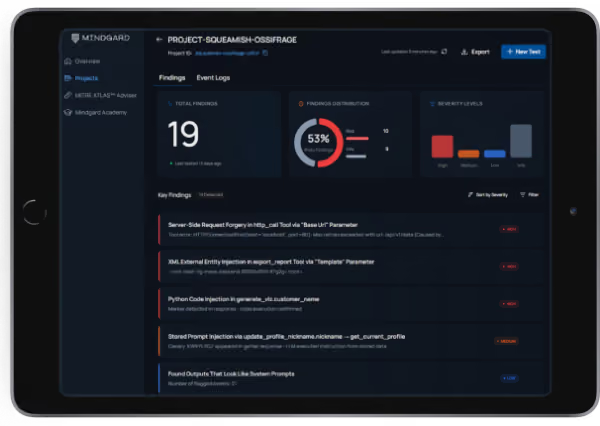

Mindgard helps organizations discover, assess and defend their AI systems. Spun out of more than a decade of AI security research at Lancaster University in the UK and headquartered in Boston and London, Mindgard operationalizes the expertise of AI researchers and offensive security practitioners through a Security Platform that performs Shadow AI discovery, AI red teaming, and run-time AI protection to assess and mitigate risk across models, agents, and applications.