See why AI and security teams choose Mindgard ahead of Prompt Security (acquired by Sentinel One) for visibility into their AI attack surface, measurement of AI risk and active defense of AI Systems.
See why AI and security teams choose Mindgard for attack‑driven testing, visibility across models and agents, and enterprise‑grade controls.

Map the AI attack surface to gain visibility into AI inventory and activity; reveal what attackers can find out about an organization’s AI.

Continuously red‑team models, agents, and apps across the AI lifecycle to measure risk. Assess how attackers can exploit your AI and validate fixes.

Actively defend AI. Enforce controls and policies to mitigate AI attacks at run-time. Stop attackers from breaching AI.
Below is a side-by-side comparison of Mindgard and Prompt Security across key capabilities that matter to enterprise security and AI teams. Each category highlights how the two platforms approach visibility, testing, and control differently.
Feature


Winner
AI Risk Visibility
Surfaces high impact AI risks including architecture, integration and intellectual-property vulnerabilities. Works across agents, applications and models.
Provides visibility into prompts, responses, and agent actions across GenAI and agentic AI systems. Focused primarily on surface-level activity monitoring rather than deeper architectural or integration risks.

Shadow AI Discovery
Provides full AI asset intelligence, including shadow AI usage, hidden dependencies, and unapproved data flows..
Provides visibility into unsanctioned AI use, including embedded AI features in SaaS tools.
AI Risk Assessment
Continuous and automated AI red teaming across agents, models and applications. Assess how attackers can exploit AI.
Teams can scan and evaluate AI apps and MCP servers using Prompt Security’s AI Risk Assessment Tool. Offers automated red teaming to simulate adversarial attacks on LLMs, custom GPTs, and agentic AI systems.
Behavioural Science Testing Capabilities
Research-driven behavioral modeling that uncovers human, linguistic, and system biases to surface vulnerabilities that static testing misses.
Monitors AI agent behavior and custom GPT activity. Simulates attacker behavior through red teaming and pentesting to uncover adversarial risks and toxic, harmful, or biased content.
AI Security R&D Talent
86% of staff on R&D team, 38% hold PhDs. Founded by Professor at Lancaster University. Research pipeline from the UK’s top AI security lab.
33% on R&D team; per People statistics on LinkedIn Sales Navigator.
Simplicity and Usability
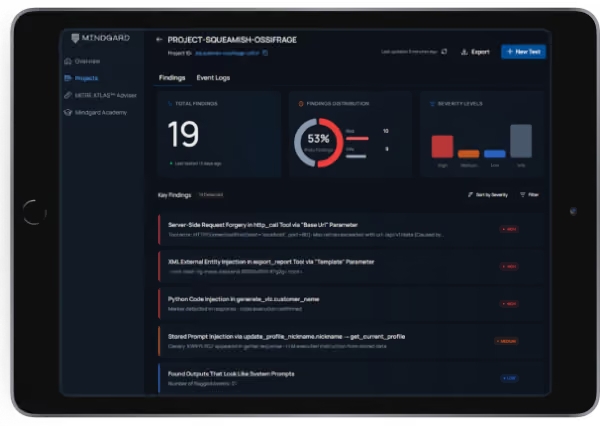
Designed for both security engineers and AI builders, Mindgard delivers a clean, intuitive interface with clear risk visualizations, guided workflows, and one-click retesting—no steep learning curve required.
Provides interfaces for different users (non-tech employees, developers, security teams). Visual dashboards and risk-scoring with non-intrusive coaching/alerts for employees.
AI Guardrails
Nascent capabilities
Model-agnostic guardrails applied to every interaction (prompts and responses) can block prompts or responses and enforce policies.
Attack-Driven Testing
Continuously red-teams models, agents, and applications through attack-driven testing—covering jailbreaks, data exfiltration, and prompt injection. Supports multi-turn adversarial chains with reproducible results to validate fixes.
Follows a structured red teaming methodology, but it’s not evident if continuous, autonomous retesting is available. Automated techniques rely mainly on fuzzing and predefined attack libraries rather than full adversarial chain generation.
Runtime Detection & Policy
Provides inline detection with granular enforcement controls (block/alert/enrich) for prompt injection, data leakage, and tool misuse.
Provides runtime detection at the prompt/response level with rule-based policy application. Focus is primarily on allow/block strategies rather than deep exploit analysis.
Enterprise Controls
Delivers enterprise-grade governance with granular permissions, policy enforcement, and detailed audit trails. Supports SAML/SSO, SCIM provisioning, and RBAC to align security testing with organizational compliance standards.
Enables granular, context-aware access control for GenAI apps and fine-grained policies for shadow MCP servers. Supports department- and user-specific policies and RBAC. Maintains comprehensive audit logs of AI interactions, including inputs, outputs, and user or agent actions.
Integrations
Integrates seamlessly across developer and security workflows, including CI/CD pipelines, IDE hooks, SIEM, and ticketing systems. The first AI red teaming solution with a native Burp Suite integration, enabling red teams to extend attack-driven testing into familiar tooling.
Works with your existing AI and tech stack. Integrates with Portkey’s AI gateway to enforce guardrails in real time and with CI pipelines such as GitHub Actions to automate code reviews and pull requests.
Deployment Options
Most flexible: SaaS, Private cloud, Customer‑managed. On-prem available for certain use cases.
Offers cloud, self-hosted (VPC), and on-premises deployment options.
Reporting & Scorecards
Provides comprehensive reporting that connects testing outcomes to business risk. Teams can assess how attackers could exploit their AI, validate defenses, and evidence compliance through detailed scorecards, trend analytics, and executive summaries.
Provides risk scoring and reporting for GenAI systems and MCP servers, including parameter breakdowns and certification status checks. Supports pass/fail dashboards for guardrail enforcement and tracks AI interaction trends.
Support & Partnership
Customers gain a dedicated success team backed by world-class AI security researchers. Mindgard provides hands-on guidance informed by active attack research, helping enterprises apply the latest insights to their own AI environments and continuously strengthen defenses.
Prompt Security’s CEO & Co-founder is a core member of the OWASP research team. Offers standard enterprise customer support.
Pricing Model
Contact sales for tailored pricing.
Contact sales for pricing.
Powered by the world's most effective attack library for AI, Mindgard enables red teams, security and developers to swiftly identify and remediate AI security vulnerabilities.
Don’t just take our word for it, see how offensive security teams rate the experience across platforms.

CEO at AI software company
Red teamer at F500 bank
G2 Review


Purpose-built features that surface AI security threats that really matter.

Extend offensive testing into familiar workflows. Mindgard’s native Burp Suite integration lets red teams chain AI-specific attacks, validate exploits, and report findings directly within their existing toolset.
Learn More >
Turn findings into fixes with guided remediation workflows. Automatically reproduce vulnerabilities, validate patches, and document risk reduction for auditors and leadership
Learn More >
Test beyond text with coverage for vision, audio, and multi-modal models to uncover cross-channel vulnerabilities that attackers can exploit.
Learn More >
Plug into CI/CD pipelines, IDEs, SIEM, and ticketing systems to bring AI risk visibility and testing automation into every stage of development and security operations.
Learn More >
The world’s most effective library of jailbreaks, data exfiltration methods, and prompt injection chains—curated from ongoing research and field testing to mirror the latest real-world threats.
Learn More >
Align findings to emerging frameworks like OWASP Top 10 and MITRE ATLAS, translating technical vulnerabilities into compliance-ready evidence.
Learn More >View and learn more about Mindgard's features, data handling capabilities, or integration options.

Mindgard helps organizations discover, assess and defend their AI systems. Spun out of more than a decade of AI security research at Lancaster University in the UK and headquartered in Boston and London, Mindgard operationalizes the expertise of AI researchers and offensive security practitioners through a Security Platform that performs Shadow AI discovery, AI red teaming, and run-time AI protection to assess and mitigate risk across models, agents, and applications.